Service Voltage 33 kV and 34,5 kV - Insulation voltage cables to be used

Joao

Member
Location
portugal
Occupation
engineer
For this service voltages I believe that cable 18/30 (36) kV should not be used even designed for Umax=36 kV.

Also in most cases earthing regime is IT.

In this way may be the best technical solution is cable 26/45 kV and not use 18/30 (36) kV cable.
 
I am not entirely clearn on your syntax and ratings. It appears you are from Portugal. Here in the States we commonly have 35 KV cables. An IT grounded system would typically have a 133% insulation level.
 
See ANSI/ICEA S- 97-682-2023 Standard Publication for Utility Shielded Power Cables 5-46 kV
 

Attachments

  • 25-35 kV Cable catalogue.pdf
    373.3 KB · Views: 5
If it is manufactured according to the standard of course. However, it still depends on the application.
It should be better to consult the manufacturer before.
 
I am not entirely clearn on your syntax and ratings. It appears you are from Portugal. Here in the States we commonly have 35 KV cables. An IT grounded system would typically have a 133% insulation level.
yes from Portugal. I agree with you about 133%, so at least a 26/45 kV shall be chosen.
 
Note insulation level is different than the voltage rating. For example you can have a 15kv cable with either a 100% or 133% insulation level
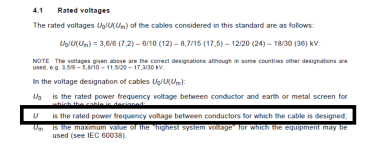
15 kV cable I believe it referes to "U" as IEC 60502-2:

1763045884497.png

In this case that 15 kV shall have a U0 value and Um value.
 
Note insulation level is different than the voltage rating. For example you can have a 15kv cable with either a 100% or 133% insulation level
Insulation level is often determined by the "grounding" of the system, and the maximum voltage which is expected during a fault. For example, during certain conditions it is possible for an ungrounded system to experience close to 200% of the nominal line voltage.

Typical installs i have seen are:
Impedance grounded 100% of L-L voltage
Grounded Wye systems 133% of L-L voltage
Delta systems 175% of L-L voltage.
 
Insulation level is often determined by the "grounding" of the system, and the maximum voltage which is expected during a fault. For example, during certain conditions it is possible for an ungrounded system to experience close to 200% of the nominal line voltage.

Typical installs i have seen are:
Impedance grounded 100% of L-L voltage
Grounded Wye systems 133% of L-L voltage
Delta systems 175% of L-L voltage.
I agree, however just as a matter of curiosity, what is the difference between a 15 kV cable with 175% insulation level, and a 25kv cable with 100% insulation level? 🤔
 
In IEC 60502-2 Standard ch.4 Voltage designations and materials it is a note:
If the system is expected to be operated fairly often with a permanent earth fault, it may be advisable to classify the system in category C.
In the Table 1 – Recommended rated voltages Uo it is not any value for C category voltage for more than 30 kV rated. So you have to follow IEC 60840 Standard. Table 4 – Test voltages
Then it has to be 45/26 kV as you said.
 

Attachments

  • Halley Cables 1.8-3 to 26-45 kV.pdf
    204.3 KB · Views: 3
Bye the way, in my opinion, IT it is an earthing arrangement for Low Voltage installations.
In IEC 60364-1 11 Scope1 11.2 It covers:
circuits supplied at nominal voltages up to and including 1 000 V a.c. or 1 500 V d.c.
Also in British Standard BS 7430:2011 it is noted:
NOTE Requirements for earthing HV installations are given in
BS EN IEC 61936-1:2011 and BS EN 50522:2011.
No such an earthing system as IT for HV installations.
 
Bye the way, in my opinion, IT it is an earthing arrangement for Low Voltage installations.
In IEC 60364-1 11 Scope1 11.2 It covers:
circuits supplied at nominal voltages up to and including 1 000 V a.c. or 1 500 V d.c.
Also in British Standard BS 7430:2011 it is noted:
NOTE Requirements for earthing HV installations are given in
BS EN IEC 61936-1:2011 and BS EN 50522:2011.
No such an earthing system as IT for HV installations.
Yes you are right. We shall used = Isolated or unearthed.
 
Top