Solar Towers producing 50% More Energy

Status
Not open for further replies.
Keep in mind that 'too cheap to meter' didn't ever mean free.

It meant that you'd pay a flat fee for the infrastructure and the reactor(s) and just use however much electricity you wanted.

Of course they got this wrong, both in terms of the cost of the power plants and the cost of the distribution infrastructure.

But this sort of billing isn't crazy for some applications; think of your internet bill for example.

Jonathan
Yeah, but in the 60's it just sounded like a big win
 
3He hasn't taken off as a fusion fuel because we don't yet have an actual working fusion reactor to use it.

Not sure about other uses for the stuff, nor the idea of air transport of liquid helium.
There is also the problem that supplies of helium are limited and 3He is only present in trace quantities in helium sources. There's probably not enough of it around to enable us to do anything with it.
 
There is also the problem that supplies of helium are limited and 3He is only present in trace quantities in helium sources. There's probably not enough of it around to enable us to do anything with it.

That is the reason given for mining it from the moon.

If we actually had a working fusion system, the amount of 3He needed as fuel is plausibly small enough to make it worth bringing back from the moon. The benefit of using 3He for fusion is that the reaction doesn't produce neutrons and thus doesn't 'activate' the walls of your reactor.

With all that said, I'll repeat that we don't have working fusion reactors, and if we did I expect that they would likely use tritium ( 3H) as fuel. We can make 3H from lithium by bombarding the Li with neutrons. So if your fusion reactor has a lithium breeding blanket in the walls you use the fusion neutrons to make more fuel. (No this is not a solved engineering problem, just like the entire reactor is not a solved problem. But we at least understand the reactions so we can make guesses as to what might work.)

Also if you have copious quantities of 3H available, you will solve any shortage of 3He. 3H is unstable and decays to 3He over time.

Separate note: the thing about limited helium supplies is also a funny on. We have more helium available on earth than we could possibly use. The problem is that most of it is simply very expensive to capture. The cheap easy to capture helium is found in natural gas wells, and that cheap helium supply is very limited. But the amount of helium simply floating in the air is staggering. If we were willing to pay 10-100x more for our helium, then we won't run out.

 
I was wondering what they are up to. The live cam of their demo project in Sandpoint, ID is not up anymore. Their website is still up but the last news from them I could find was in 2019. They were living off of government clean energy grants to do design work. No indication anyone actually built an operational solar roadway.
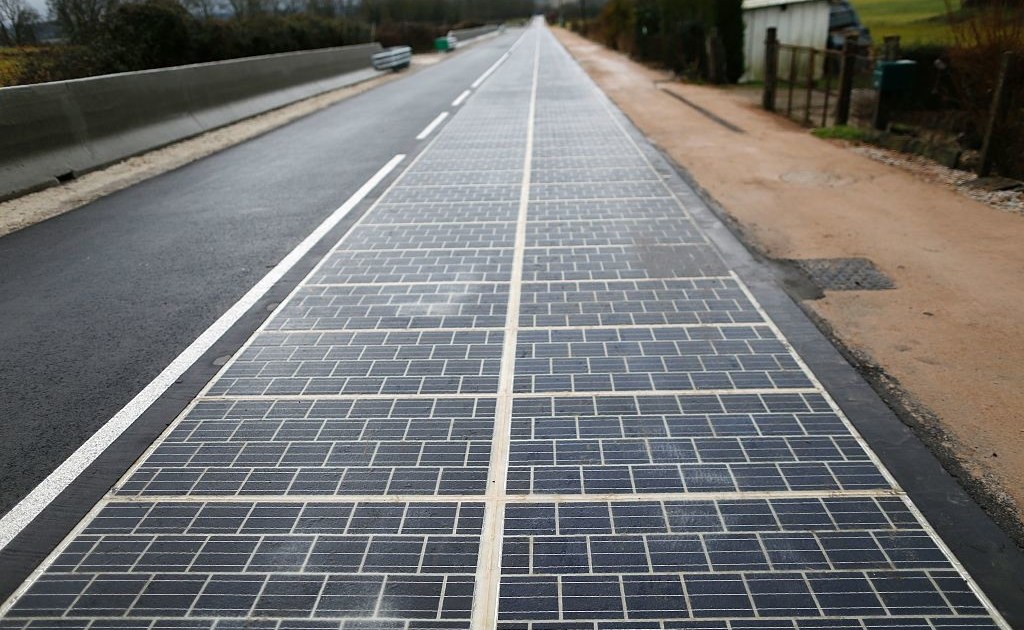
A very short section was built in France. It did not go well.

 
Rubber from tires, oil and scuffing would quickly reduce the output even if they did hold up under the weight. Might be useful for sidewalks in city parks with enough battery storage, to power lights, and maybe snow melt, but probably not.
 
Structurally unsound, and then to make matters worse, abrasive dust and dirt, silt, snow and ice melting chemicals (I don't care if they don't salt them, it's going to end up with it leaking in.

I don't think you could come up with a worse use for solar panels
 
Structurally unsound, and then to make matters worse, abrasive dust and dirt, silt, snow and ice melting chemicals (I don't care if they don't salt them, it's going to end up with it leaking in.

I don't think you could come up with a worse use for solar panels
Not even Solyndra? Too soon? :D
 
A very short section was built in France. It did not go well.
That's why I said operational. They have done a number of grant supported demo installations.
This pretty much sums up the results in France.
In a report from the Global Construction Review, it was found that engineers didn’t take into account the damage that would be caused by thunderstorms, leaf mold, and huge tractors that would be using the road. In the first few months, the highest amount of energy generated from the roadway hit only half their stated goal at around 150,000kWh before falling to 78,000 in 2018 and finally 38,000 in early 2019.
The vice president of the Network for Energy Transition, Marc Jedliczka, stated: “The technical and economic elements of the project were not sufficiently understood. It is a total absurdity to innovate at the expense of solutions that already exist and are much more profitable, such as photovoltaics on roofs.”
 
Last edited:
The solar roadway in France was not using the Solar Roadways modules. It used a module developed by the french company Wattway. I find it mind blowing that two companies would try to make this a marketable product.
Wattway has smartly shifted focus to covering walking areas, parking lots, and bicycle lanes. Although PV modules on the ground are still not a great idea.
www.wattwaybycolas.com
 
Solyndra panels worked fine. They just weren't competitive.
They were also pretty fragile, and when they broke they released a fluid that was slipperier than motor oil, causing a mess on rooftops that was very hard to clean up. Been there, done that.
 
Seeking that sweet, sweet, VC dollar. Reminds me of the V3Solar spinning solar cone. Remember that attempt and being the next big thing?
If those solar cones were developed further, rather than shelved, shrunk-down cones on magnetic bearings could have produced a perfect sine wave at spin frequency, without inverters.

The spinning cone idea may have threatened the inverter, and VSD industry, if designed for backfeed, producing perfect sine waves at adjustable frequencies.
 
If those solar cones were developed further, rather than shelved, shrunk-down cones on magnetic bearings could have produced a perfect sine wave at spin frequency, without inverters.

The spinning cone idea may have threatened the inverter, and VSD industry, if designed for backfeed, producing perfect sine waves at adjustable frequencies.
Color me skeptical. :D
 
These are all just gimmicks, perhaps well intended inventors that are good schmoozers with the right people to fund them.
All well except Fusion.
If we actually had a working fusion system, the amount of 3He needed as fuel is plausibly small enough to make it worth bringing back from the moon. The benefit of using 3He for fusion is that the reaction doesn't produce neutrons and thus doesn't 'activate' the walls of your reactor.

With all that said, I'll repeat that we don't have working fusion reactors, and if we did I expect that they would likely use tritium ( 3H) as fuel.
We had one in the US the now defunded Lawrence Livermore National labs achieved 'ignition'.
Once that happened it moved form a physics theory to a engineering problem.
 
Status
Not open for further replies.
Top