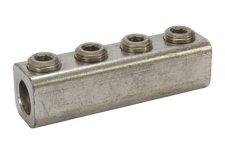
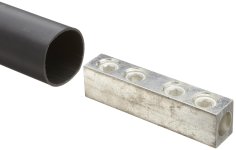
Splice for extending Service Conductors

solarken

NABCEP PVIP
Location
Hudson, OH, USA
Occupation
Solar Design and Installation Professional
I may need to extend some service conductors that enter a residential basement and trying to minimize space, so insulated taps are a little to big. Is there any issue with using the attached polaris crimp splices, and and heat shrink tubing? And maybe electrical tape as well? How many
 

Attachments

  • POL_ASC20T_CMP_ProDraw_DIGITAL.pdf
    314.5 KB · Views: 33
IMO those type of crimp on connectors are the best splicing method there is. For one they take up very little room and two when crimped properly and insulated they're foolproof. We always use cold shrinks instead of heat shrinks. Take a look at 230.46 regarding listing.
 
If this is a one time or rare thing I'd probably use the insulated multi-tap or inline connectors. NSI has been catching up to 230.46 with those. That way you avoid dealing with obtaining the correct crimper and die. Unless you have a buddy who has that stuff.
 
If this is a one time or rare thing I'd probably use the insulated multi-tap or inline connectors. NSI has been catching up to 230.46 with those. That way you avoid dealing with obtaining the correct crimper and die. Unless you have a buddy who has that stuff.
I have a crimper and dies. I have used them only for crinmp lugs to date but I have a die that should work on these crimp splices. Trying to minimize bulk so that was why I was thinking crimp.
 
IMO those type of crimp on connectors are the best splicing method there is. For one they take up very little room and two when crimped properly and insulated they're foolproof. We always use cold shrinks instead of heat shrinks. Take a look at 230.46 regarding listing.
So this installation is a little weird. The utility feed comes in on a pole in the back yard, and into a meter enclosure mounted on the pole, and then into a 200A fused disconnect on the pole. The load side conductors exit the disconnect at the bottom and go underground about 150 feet to the house, penetrating the basement into a junction box. From there, comeone spliced THWN2 on in the jbox and ran it inside PVC conduit over to the Main load center. So the conductors in the jbox, which is after the fused disconnect, do not seem to be service enetrance conductors, but feeder conductors.
 
IMO those type of crimp on connectors are the best splicing method there is. For one they take up very little room and two when crimped properly and insulated they're foolproof. We always use cold shrinks instead of heat shrinks. Take a look at 230.46 regarding listing.
I have never used cold shrink. But have used Heat shrink, and have several sizes and a heat gun. Is there any reason cold shrink is better? Looks like it may be thicker.
 
I have never used cold shrink. But have used Heat shrink, and have several sizes and a heat gun. Is there any reason cold shrink is better? Looks like it may be thicker.
It’s quicker, I’ve used it were the insulation is damaged from a truck relocating a pad mount transformer. It just slides down the wire, pull the cord, and it cinches up nice and tight on the wire. Works great when you don’t have room to heat the tube, especially when you have several wires tightly bunched like going into a conduit.
 
It’s quicker, I’ve used it were the insulation is damaged from a truck relocating a pad mount transformer. It just slides down the wire, pull the cord, and it cinches up nice and tight on the wire. Works great when you don’t have room to heat the tube, especially when you have several wires tightly bunched like going into a conduit.
Cold shrink is great. I would say the only drawback is that it does not have the adhesive lining that some heat shrink does.

Mark
 
Top