230.40 Ex. 3 and grounding and bonding

wdingman

Member
Location
Chicago
Occupation
Electrician
So I have an interesting conundrum. I have a service where the meter is on the detached garage. This is because there is vegetation obstructing installation of the service drop to the house.

The meter supplies two service disconnects. One is in the garage and one is in the house. The location is Chicago. Chicago requires the service disconnect for a house to be located inside the house so I can't put it on the garage and run feeders to the house. 230.40 Ex. 3 lets me have two sets of service entrance conductors.

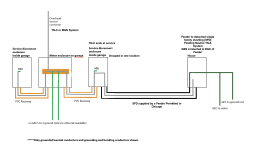
As currently set up, the neutral is bonded in the meter enclosure (the enclosure come that way by default) and in each service disconnect enclosure. The AHJ does not like it because neutral current flows over the service raceway and the neutral conductor between the house and the garage (which is weird, because this happens in all services in Chicago, and probably most other places where metal raceways are used for the service between the meter and the panel(s)).

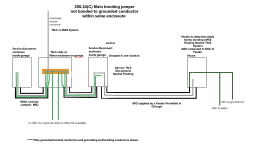
Anyway, I am thinking about asking if I can rework the set up as shown below. Isolating the neutral from the meter enclosure is not a violation of C
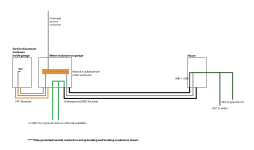
Screenshot 2025-11-24 103735.png
 
Anyway, I am thinking about asking if I can rework the set up as shown below. Isolating the neutral from the meter enclosure is not a violation of C
You cannot keep the meter enclosure unbonded from the neutral because the neutral bond is required to create a fault current path for the metallic meter enclosure. Personally I think that your AHJ needs to brush up on when objectionable current is permitted.
 
The way I read that section of the Chicago code section 560.23 (B) only applies if your supplying a one or two family dwelling with a 'service', in your case if you wanted to use two 200A breakers you'd be supplying the dwelling with a '4 wire feeder' and your service would be to a 'accessory structure'. Your not required to supply a one family dwelling with only a service that would be silly.
 
Well anyway, every single service that has a meter and a service disconnect with a metal raceway between them will have neutral current flowing on that metal raceway.
To be purely contrary, would it be permissible to find/modify a meter base so that the case is not directly bonded to the neutral in the meter base, and then run an SSBJ from the service disconnect back to the meter (or rely on the metal conduit to be the SSBJ)?

If not, then I agree with the above including all the corner cases. : - ) In which case, the NEC and the relevant product standards consider that neutral current on the metal service raceway is less of a problem than the risk of a meter base enclosure being unbonded.

Cheers, Wayne
 
would it be permissible to find/modify a meter base so that the case is not directly bonded to the neutral

Cheers, Wayne
No in a TN-C (MGN) system the neutral is the equipment ground and a current carrying conductor.
The idea is to switch to TN-S as soon as practical for interior wiring.
 
To be purely contrary, would it be permissible to find/modify a meter base so that the case is not directly bonded to the neutral in the meter base, and then run an SSBJ from the service disconnect back to the meter (or rely on the metal conduit to be the SSBJ)?

...

Permitted but not required. In certain circumstances the SSBJ might not be required. No need to find/modify a meter socket, just land the SSBJ on the ground lug instead of the neutral. The SSBJ could also just go to a grounding bushing on the raceway, instead of back to the service disco, assuming the raceway is otherwise made up according to 250.92.
 
No need to find/modify a meter socket, just land the SSBJ on the ground lug instead of the neutral.
This statement would make sense to me if meter sockets have grounded conductor lugs that are insulated from the case, and separate ground lugs bonded to the case. But my understanding is that they don't, they just have one set of lugs bonded to the case.

In case I wasn't sufficiently explicit, my idea was to eliminate the grounded conductor to metal case bond in the meter socket, and instead bond all metallic service equipment enclosures/raceways via the single MBJ in the service disconnect, thereby eliminating parallel paths and any grounded conductor current on those enclosures/raceways.

Cheers, Wayne
 
Wayne, in your scenario one could just pass the grounded conductor through the meter socket uncut, or possibly splice it with a insulated connector. No need to land the neutral anywhere in the socket. (I've done this dozens of times for load side solar meters. 😉)
 
Permitted but not required.
A residential utility meter can to me is a 'service enclosure' and required to be connected to the grounded conductor per 250.80 (2023 NEC)
The NEC has set the service disconnect(s) as the point where the system changes to TN-S.
 
A residential utility meter can to me is a 'service enclosure' and required to be connected to the grounded conductor per 250.80 (2023 NEC)

Yeah but 250.92.gives you the ways to do that. 'Connected to' isn't precise enough to mean 'bonded to the wire within the enclosure'.

The NEC has set the service disconnect(s) as the point where the system changes to TN-S.

Idk man, the NEC doesn't use that terminology or get super precise about the location. An SSBJ is a thing in the NEC.
 
Yeah but 250.92.gives you the ways to do that. 'Connected to' isn't precise enough to mean 'bonded to the wire within the enclosure'.


Idk man, the NEC doesn't use that terminology or get super precise about the location. An SSBJ is a thing in the NEC.
Well if you float the neutral in any enclosure on a TN-C system then run a separate SSBJ (PE) wire for fault clearing/bonding, your line to case fault path has to backtrack over the neutral, seems like a recipie for a common mode choke.
In other words you create a TN-S-C-S system
What the code could allow, for those experiencing objectional current or just preference, but it does not seem to (to me), is for the installer to pick any point between the service point and the service disconnect and convert to a TN-S system (AKA 4-wire). I doubt a utility would want that in a meter but you'd have something like this or perhaps this is what Wayne is suggesting?250_24C.png
 
Last edited:
Well if you float the neutral in any enclosure on a TN-C system then run a separate SSBJ (PE) wire for fault clearing/bonding, your line to case fault path has to backtrack over the neutral, seems like a recipie for a common mode choke.
...

I'm not seeing the common mode current. The fault current path is longer by the length of the SSBJ×2, but I think it's still differential mode the whole way.
 
I'm not seeing the common mode current. The fault current path is longer by the length of the SSBJ×2, but I think it's still differential mode the whole way.
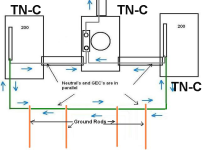
Right thanks for the correction , I often see 320A dual 200A services wired like this illustration (original from this old thread) when if you were able to put a ground bar in the meter or a gutter and transition to 4-wire before the service disconnects this could be avoided;
groundloop.png
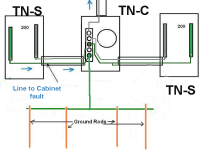
Becomes this; but I don't think current code allows this:

no_groundloop.png
 
...
Becomes this; but I don't think current code allows this:

View attachment 2580786

Current code allows this nominally. (It's 250.64(D)(3).) The problem is it requires the GEC termination to be accessible and I understand many AHJs don't consider the meter socket or trough accessible once the utility seals it. (Also some utilities may prohibit it, while I hear others require a rod to the meter. 🤷🏻‍♂️).

Maybe propose a clarification that a utility seal shall not be considered to make an enclosure inaccessible for the purposes of that requirement.

I definitely agree the 2nd diagram is better, although I'd like to see the options preserved.
 
Top