Surge Protection Devices

Grouch

Senior Member
Location
New York, NY
Section 230.67 requires surge protection for dwelling units.

The exception to 230.67(B) says the following: THE SPD SHALL NOT BE REQUIRED TO BE LOCATED IN THE SERVICE EQUIPMENT AS REQUIRED IN (B) IF LOCATED AT EACH NEXT LEVEL DISTRIBUTION EQUIPMENT DOWNSTREAM TOWARD THE LOAD.

We're renovating an apartment in NYC which will require a new upsized feeder, with a new meter and 125 amp enclosed circuit breaker (serving the apartment) in the electrical service room. The meter will tap from an existing trough that is fed by an existing 600 amp service switch. The trough presently feeds other apartments in the building. The 600 amp service switch, nor do any other disconnect switches coming off the trough, do not have SPD.

Based on the exception I posted above, is my enclosed circuit breaker required to have SPD? NYC is about to update their NEC version from 2008 to 2020 next month. The 2008 did not require SPD. The 2020 version now does.
 
My same question applies to an existing meter center, fed by a service switch. Nowhere is there SPD. So if I pull a new feeder from the meter center up to an apartment, do I need to add in SPD for that one apartment feeder coming off the meter center? If so, where would the SPD go?

It's a similar scenario to my post above. My post above is a service switch feeding a trough where the meters tap off from; my post here is a service switch feeding a meter center.
 
It sounds like SPD is not required in these feeders. The exception says the SPD has to be located at EACH next level distribution. Meaning ALL next level distribution has to have SPD? So if this is an existing installation where none of the feeders off the meter center have SPD… then it’s not needed for a new feeder off the meter center?
 
Section 230.67 requires surge protection for dwelling units.

The exception to 230.67(B) says the following: THE SPD SHALL NOT BE REQUIRED TO BE LOCATED IN THE SERVICE EQUIPMENT AS REQUIRED IN (B) IF LOCATED AT EACH NEXT LEVEL DISTRIBUTION EQUIPMENT DOWNSTREAM TOWARD THE LOAD.

We're renovating an apartment in NYC which will require a new upsized feeder, with a new meter and 125 amp enclosed circuit breaker (serving the apartment) in the electrical service room. The meter will tap from an existing trough that is fed by an existing 600 amp service switch. The trough presently feeds other apartments in the building. The 600 amp service switch, nor do any other disconnect switches coming off the trough, do not have SPD.

Based on the exception I posted above, is my enclosed circuit breaker required to have SPD? NYC is about to update their NEC version from 2008 to 2020 next month. The 2008 did not require SPD. The 2020 version now does.
My opinion is that under the 2020 NEC, only a new "service" needs an SPD. It does not appear in my reading of your description that you are touching a "service", it looks like you are only dealing with feeders and branch circuits.

The scientifically correct approach is to place the SPD in the subpanel that feeds the dwelling unit. You want the SPD as close to the load as possible based on the science of how they work. To oversimplify, the SPD varies it's resistance based on the voltage it encounters so that it has higher resistance to higher voltage and lower resistance to lower voltages, which forces the voltage to smooth out at lot closer to 120v nominal. Because the SPD is connected directly to both phases, it is electrically continuous with all of the hot wires in the circuit, so if the SPD can keep the voltage at 120v even, the rest of the wires continuous with the SPD must be an even 120v too as long as the wires are short enough to keep voltage drop from coming into play.

The 2023 NEC fixed the 2020 NEC in this regard. The 2023 NEC requires an SPD whenever a feeder is replaced, as well as a service, and basically requires you to put the SPD in the furthest downstream panel closest to the load, instead of out at the service where it would be less effective. If all you touch is the service, you can put the SPD at the service if you don't want to touch anything downstream, but if you touch a feeder, you would be putting it at the subpanel.
 
Hmm. I think you're on to something.

Section 230.67(D) says:
REPLACEMENT: Where service equipment is replaced, all of the requirements of this section shall apply.

Since I'm not touching the service equipment, then I wouldn't have to comply with this section requiring SPD.
 
To oversimplify, the SPD varies it's resistance based on the voltage it encounters so that it has higher resistance to higher voltage and lower resistance to lower voltages, which forces the voltage to smooth out at lot closer to 120v nominal. Because the SPD is connected directly to both phases, it is electrically continuous with all of the hot wires in the circuit, so if the SPD can keep the voltage at 120v even...
Well, not exactly. You seem to think that an SPD is a voltage regulator. It is not. An SPD sits there and does nothing until the voltage rises above a certain level, usually something like 400 volts. Then it clamps- basically drops a crowbar quickly across the line hopefully killing the spike before it can do any damage. An SPD is sacrificial and will self destruct if a big enough spike comes along or after a number of clamps. So it is something that must be checked and maintained.

The thought is that the NEC is mandating SPDs not necessarily to protect owners equipment but to protect the electronics in AFCI breakers.

-Hal
 
If this is residential and you are putting in a panel with AFCI's, I would put in a surge surpressor whether the code requires it or not. Once the code cycles catch up, the current 2023 215.18 would probably require a surge suppressor in a feeder to a dwelling unit. You can get little SPDs that plug into a panel just like a circuit breaker. In fact, I think there are now combo surge suppressor branch circuit breakers which plant a SPD in a 30A or 50A double pole breaker used to also supply a water heater, clothes dryer, or range.
 
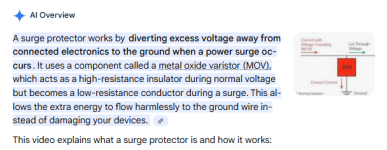
Check out this completely wrong AI generated drivel
Pretty much spot on. The MOVs in the SPD connect between line(s) and ground. When they clamp, they tie everything together- both hots and ground.

In fact, I think there are now combo surge suppressor branch circuit breakers which plant a SPD in a 30A or 50A double pole breaker used to also supply a water heater, clothes dryer, or range.
Why? Just something else for the buyer to pay for (and worry about going bad) when the manufacturers of those appliances should be incorporating surge protection if they are prone to damage. Same with those damn AFCIs!

-Hal
 
Pretty much spot on. The MOVs in the SPD connect between line(s) and ground. When they clamp, they tie everything together- both hots and ground.
When they operate they clamp the entire voltage to ground, they effectivelybcreate a short circuit. This is not the same as clamping excess voltage while allowing the correct amount to go to the load as I read in the post.
 
Last edited:
Pretty much spot on. The MOVs in the SPD connect between line(s) and ground. When they clamp, they tie everything together- both hots and ground.
Ground meaning grounded conductor, grounding conductor, or the "ground" as in "earth" via the GEC? I think I know the answer, and I think this is a good example of why there is much confusion around this topic...
 
Why? Just something else for the buyer to pay for (and worry about going bad) when the manufacturers of those appliances should be incorporating surge protection if they are prone to damage. Same with those damn AFCIs!

-Hal
The idea is to use a combined breaker instead of a separate plug in breaker slot TVSS. I have 3 panels in 2 different houses now with plug on TVSS that waste 2 slots in the panelboard. They cost about $100. If you can buy a combined 30A double pole breaker and TVSS for a bit more money you get your TVSS without wasting 2 slots. I should have done that on the last one as I moved the 30A dryer double pole to the bottom of the panelboard and put a TVSS in the top right slot where the dryer breaker had been. Those combined breaker/TVSS units may still be a bit pricey. Give them time.
 
When they operate they clamp the entire voltage to ground, they effectively create a short circuit. This is not the same as clamping excess voltage while allowing the correct amount to go to the load as I read in the post.
Well, I did say pretty much. No use critiquing the finer points of dumbed down explanations which are good enough for people with no knowledge.

-Hal
 
Well, I did say pretty much. No use critiquing the finer points of dumbed down explanations which are good enough for people with no knowledge.
The AI description makes it sound like the SPD is a voltage regulator that stops all voltages higher than nominal.
It absolutely doesn't do this. It should have been just as simple to say it blocks extremely high voltages.
 
Last edited:
Why? Just something else for the buyer to pay for (and worry about going bad) when the manufacturers of those appliances should be incorporating surge protection if they are prone to damage. Same with those damn AFCIs!
There is no reason to "worry" about it going bad, it "will" go bad. The SPD's have a lifetime, and are a maintenance item.
(In the plumbing world many places prohibit AAV's for this exact reason: while they last a long time, they don't last forever, and that's not acceptable everywhere. )

With the SPD's:

Will anyone ever change one?
Do people press the button to test smoke detectors weekly?
 
Top