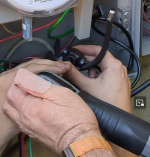
Polaris connector absolutely destroying aluminum wire at required torque

Merry Christmas
I think next week that guys regular $800 paycheck would be 800¢ due to a clerical error, but you'll straighten out the error on the following pay period
He'll just have to eat some Ramen this week

Screenshot 2025-11-29 162005.png
 
Somewhere along the line the apprentice should have taught by an experienced person does this spec make sense... 15 FOOT lbs is something equivalent to a gallon container of milk pulling on lever arm of 2 feet. My mower blades sheaves are something like 90 foot pounds and I'm a weenie as I was honking on it to achieve.
 
How could someone get anywhere near that without holding the Polaris tap in a bench vise and destroying it?
Agree, my first thought was would the device even handle 180 ft-lb without breaking but how do you hold on if tightening to that level
 
Interesting,Besmirching the connector manufacturer and then the inspector and then failing to apologize for it.

Seems like the inspectors request was the correct way to proceed, or better staff supervision.

Maybe Newton-meters would be a more appropriate value for the manufacturer to use for dyslectic folks that have a hard time,
differentiating the difference between inch lbs and foot lbs. Because common sense didn't seem to prevail. I remember days in the lab having to convert values often, sure made you pay better attention.
 
Damn.
I hate making mistakes, and especially public ones.
But turns out I besmirched the apprentice.

The NSI specifications said 180 in*lbs


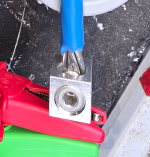
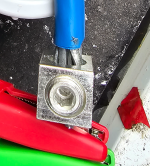
But I ran the inspection video again. They stripped the insulation off
the center of the Al wire, and went for it:

1764573685013.png

1764573487163.png
1764573532105.png


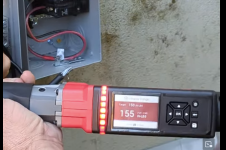
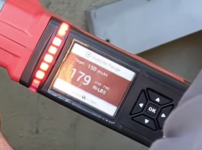
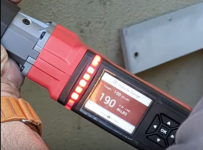
The words said in the video were foot*pounds, but the tool clearly shows inch*pounds.
They struggled, it took two, but they topped out at 190 in*lbs on the video and stopped.

The tool did show "out of range" which is confusing me.
I'll send the video to anyone who wants.

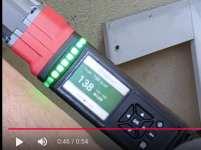
The machine showed green until about 150 in*lbs, then went red. I don't know what that means, but will try to learn:
1764573853692.png

I'm back to worrying about crushing historic stranded Al wire with NSI Polaris connectors.
Sorry for the misinformation.
 

Attachments

  • 1764573584278.png
    1764573584278.png
    386.2 KB · Views: 7
The display shows the target was set for 150in-lbs which is correct for the connector you said you were using. The display turns red when you pass the target setting. Why are they continuing to tighten the corrector. Sounds like the issues is the employees doing the work don't have a clue of what they are doing.
 
The display shows the target was set for 150in-lbs which is correct for the connector you said you were using. The display turns red when you pass the target setting. Why are they continuing to tighten the corrector. Sounds like the issues is the employees doing the work don't have a clue of what they are doing.
I spoke to NSI / Polaris technical support this am, and they said they've never tested on older aluminum wire,
and speculated that the wire is the issue. I will be trying to get a sample of the wire for some bench testing. (The particular
wire from the video unfortunately was not saved).

The video does show the tool set to 150 in*lbs : the verbal conversation on the video says they are headed to 180 ft*lb.
They peak very briefly at 190 in*lb after struggling with two people.

If others are tapping 1950's aluminum subpanel feeders with these connectors, I'll chalk it up to installer error. But this also may be a fairly rare tapping need, and I know that wire is brittle. My concern is that if the wire does not completely shatter and come loose, it could
be very damaged, and fail over time using this technique.
 
The connector and wire wire size you previously stated require 150in-lb. They set the tool at 150 so why are they trying to exceed that? Why even use a torque wrench if they are not going to use it properly. Over-torqued connections can be worse and under-torqued.
 
The set screw possibly has some steel in it but the connector body is mostly an aluminum alloy AFAIK, just can't believe that body can take that kind of pressure. Stripped threads at the very least?
Yeah I agree. What size and thread? If it's an aluminum body it's got to be some kind of coarse thread. My best guess is what they did looked something like this picture, and the fastener never saw that kind of torque, They had to be sideways or something. God only knows , they might have even had a universal somewhere between the torque wrench and the fastener

Screenshot 2025-12-01 113102.png
 
OP here.
It gets deeper.

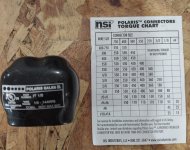
Turns out the first google search result for the proper torque value returns a datasheet showing 150 in*lb,
as did the paper insert available to the electricians. The proper value in this chart for the wire is 150 in*lb:
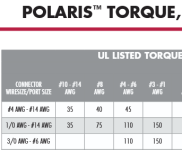
1764610605768.png

I've now spoken to the vendor of the connector body, and it turns out the
vendor changed the value after field experience and re-listed the product some years ago.
The old data sheet read 150 in*lb, correctly at the time.
The old data sheet remains what Google Gemni AI and Google Search return first.
The official vendor website has the updated value which is now 65 in*lb.
to avoid exactly the issues experienced.

-----
In the code history story I just heard the Beverly Hills Supper Club Fire
https://en.wikipedia.org/wiki/Beverly_Hills_Supper_Club_fire
Was the story used to motivate original change away from the 1350 Aluminum alloy used in this era of building.
Thus the older wire is less and less tested with newer designs of connectors.

---
Thus:
Brittle wire, inexperienced work, an old data sheet, and exceeding the target torque all appear to be factors.
Should have been 65 in*lb, but they used an old data sheet that read 150 in*lb, put 150 in*lb into the digital
tool, but the spoke the words 180 ft*lb when doing the work and peaked at 190 in*lbs, all on aged wire. It was all captured on video.

 
In the code history story I just heard the Beverly Hills Supper Club Fire
https://en.wikipedia.org/wiki/Beverly_Hills_Supper_Club_fire
Was the story used to motivate original change away from the 1350 Aluminum alloy used in this era of building.
Thus the older wire is less and less tested with newer designs of connectors.

I remember that one, it was bad. Not to mention the investigation was handled poorly. I think the Govender ordered loaders or dozers in before the investigation was done

 
I remember that one, it was bad. Not to mention the investigation was handled poorly. I think the Govender ordered loaders or dozers in before the investigation was done
And if the wiring and building was done without permits, how did Aluminum conductors take the fall for that?
The more you idiot proof the world, the more idiots can do.
 
The torque to clamp load result seems very error prone from my experience. For a given 1/0 mechanical lug with a typical 3/16 hex, you are going to get drastically different results given the wire type, lug manufacturer, an even the batch.

I tested a number of connections of #2 compact stranded AL in 1/0 mech lugs a year ago. 3/16" hex, 120 in LB.

The lug with no oxidation inhibitor applied to the conductor SHEARED OFF 3 out of 7 of the strands.
The lug with oxide inhibitor brushed in, the conductor crushed uniformly, and lost no strands.

Same torque wrench, same NSI 1/0 lug a minute apart. Both ends of each resulted in the same.
 

Attachments

  • No inhibitor.png
    No inhibitor.png
    957.8 KB · Views: 15
  • Inhibitor applied.png
    Inhibitor applied.png
    1.5 MB · Views: 15
They should probably make them with some kind of head that shears off at a set torque. Keep the Oompa Loompas from torquing it incorrectly, and seeing the sheared off head would be a good visual conformation
 
They should probably make them with some kind of head that shears off at a set torque. Keep the Oompa Loompas from torquing it incorrectly, and seeing the sheared off head would be a good visual conformation
The lay-in clamps my utility uses to connect overhead services at weatherheads do exactly this. The utility engineer gave me a handful and said "Be careful. Don't die!" when giving me installation instructions for tying in a service upgrade live (they couldn't get out the site that day).


SceneryDriver
 
The lay-in clamps my utility uses to connect overhead services at weatherheads do exactly this. The utility engineer gave me a handful and said "Be careful. Don't die!" when giving me installation instructions for tying in a service upgrade live (they couldn't get out the site that day).


SceneryDriver
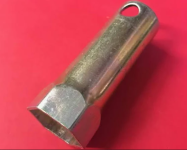
Make the head something like this plug socket where you used a screwdriver for a tommy bar. I'm betting the guy already has a screwdriver in his hand or within an arm's reach. Why have Oompa Loompa's more loaded down with tools than need be. Let alone carrying around overly complicated things with digital displays and damn little buttons designed by some twit that designs buttons to please female office workers.
How many drops do you think that thing is going to survive?

1764730901092.png

You 70's Yamaha, Suzuki, and Kawasaki dirt bike guys should recognize this and have changed a lot of plugs with one. A screwdriver worked fine.

Honda guys,,,, not so much,,,, but what kind of guy wants to ride a 4 stroke dirt bike??????
 
Top