
selective coordination

binwork91

Senior Member
Location
new york
Occupation
electrical engineer
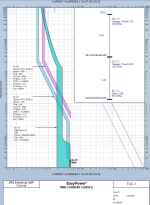
BL-170 feeds panelboard with branch breaker BL-171. BL-171 is in series with downstream breaker BL-172


These are emergency loads.


Question:
Does BL-172 need to coordinate with BL-170?


My opinion is no, because BL-171 will trip before BL-170.


But my coworker has a different opinion. He says yes, because the code states:


700.27 Coordination. Emergency system(s) overcurrent devices shall be selectively coordinated with all supply-side overcurrent protective devices.

His argument is that all supply-side, means BL-170 is a supply-side device relative to BL-172.


What do you think?
 

Attachments

  • TCC.PNG
    TCC.PNG
    71.2 KB · Views: 18
I agree with your co-worker. The mis-coordination between BL-172 and BL-170 would cause the loss of power in the MLO panel and any other branches fed from there. You can't rely on BL-171 to provide the coordination with BL-170 for BL-172.
 
The only exception is if there are 2 breakers in series and either opening will be the same outage, then they do not need to be selective with each other, but they both would need to be selective with the one above them.
 
I agree with your co-worker. The mis-coordination between BL-172 and BL-170 would cause the loss of power in the MLO panel and any other branches fed from there. You can't rely on BL-171 to provide the coordination with BL-170 for BL-172.
The only exception is if there are 2 breakers in series and either opening will be the same outage, then they do not need to be selective with each other, but they both would need to be selective with the one above them.
Hi all, I’m adding my two cents here for discussion.

Are you suggesting that because BL-171 might fail to trip, BL-170 must coordinate with BL-172? But, the code would consider the system acceptable even without BL-170. We need to agree that all protective devices are functioning properly; otherwise, the entire exercise becomes moot.

There is no other branch offs between BL-171 and BL-172. If a fault occurs at MCB, either or both BL-171 and BL-172 will detect it, race to trip, and de-energize MCB. The MLO would remain energized. Are you suggesting that selective coordination is not achieved because the feeder C-95 becomes involved as well? The only advantage I see in having BL-172 trip before BL-171 is reducing the amount of troubleshooting required afterward.

Please correct me if I am wrong in my thinking.
 
So 172 is basically a supplementary OCP. Maybe just there for a local disconnect, or something like that.

I don't think the code ever intended to require that breaker to be coordinated with anything upstream, as long as 171 is coordinated with 172.

So I agree with the above post, but that is just my opinion. I'm not sure the CMP writing that section really thought about that specific situation.
 
Of course they did. That is why the NEC has an exception not requiring OCPDs in series to be coordinated. See post #3.
Yes, but the exception only says coordination is not required between 2 breakers in series.

It doesn't say anything about one in series not having to coordinate with an upstream breaker even if the other series breaker does coordinate with that upstream breaker.
 
The NEC does not define coordination.
That term is used in Article 517 and 517.31 says this:
(G) Coordination.
Overcurrent protective devices serving the essential electrical system shall be coordinated for the period of time that a fault’s duration extends beyond 0.1 second.
That is different from selective coordination used in the rest of the code.
Coordination, Selective. (Selective Coordination)
Localization of an overcurrent condition to restrict outages to the circuit or equipment affected, accomplished by the selection and installation of overcurrent protective devices and their ratings or settings for the full range of available overcurrents, from overload to the available fault current, and for the full range of overcurrent protective device opening times associated with those overcurrents. (CMP-10)

However there is no definition of coordination in the code that fully describes what needs to happen when a system is coordinated. The first part of the selective coordination does give a good start to a definition of coordination.
 
OK, but you guys are using the terms "coordination" and "selective coordination" in this thread, and I don't know what you are talking about.
Coordination means that for any given amount of current the downstream OCPD, the one closest to the load, should open and clear the current before any upstream, towards the source, OCPD operates. The intent is to limit the portion of the electrical system outage. The available fault current is often chosen as the value used for coordination.

Remember there are really 3 types of currents. Overload, short circuit, and ground fault and all must be coordinated.

The rules for coordination in Healthcare are looser than those for other Emergency systems. Some state and local codes have coordination cut off points, for instance .01s

In my experience, most situations of Main GFP tripping are due to a lack coordination with downstream devices that do not have GFP.
 
But, the code would consider the system acceptable even without BL-170.
I noticed I wrote it wrong here. I meant BL-172 the panel main breaker...the panel main breaker is optional, and its main purpose is to protect the panel and act as a local disconnect.

We established that BL-171 and BL-172 are in series and therefore do not need to achieve selective coordination with each other. My concern with posts #2 and #3 is that they suggest BL-171 and BL-172 must each selectively coordinate with BL-170, which is not accurate. For a fault on the MCB branch, the combined BL-171/BL-172 time-current curves will clear the fault before BL-170 responds, meaning selective coordination with the supply-side protective device is already achieved. There is no requirement to evaluate BL-171 and BL-172 individually against BL-170.

In my experience, most situations of Main GFP tripping are due to a lack coordination with downstream devices that do not have GFP.
Haha, that’s exactly why multiple layers of GFP are needed. Unfortunately, many designs stick to the bare minimum required by code and include GFP only at the main, which then has to compromise by setting the GF pickup and delay at maximum just to achieve some semblance of coordination.
 
Haha, that’s exactly why multiple layers of GFP are needed. Unfortunately, many designs stick to the bare minimum required by code and include GFP only at the main, which then has to compromise by setting the GF pickup and delay at maximum just to achieve some semblance of coordination.
Even worse is when they leave the settings at the factory minimum which do not coordinate with any "normal" short circuit on a typical branch circuit.

Max settings still will not coordinate with many circuits over 70A. For coordination with branches up to 30A, I rarely needed to go to max pickup and definitely not max time.
 
You can't tell from the SLD if it's just 3 breakers in series or if there are other branch breakers in the MLO panel. In the first case, selectivity is not required. In the second, it is.
 
Top