Alwayslearningelec
Senior Member
- Location
- NJ
- Occupation
- Estimator
Tapping main service. From my calcs nothing wring with conductor/sizing sets here correct?
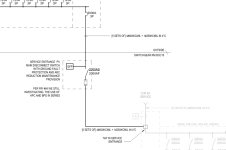



So that is not considered a tap? Why?I'm confused, where is the tap? I'm assuming that the top portion labeled "outside" is PV and is feeding the service? A service tap wouldn't go to the load side of the 2000 amp disconnect.
Maybe PV has other definitions but from 240.2 there is this definition:So that is not considered a tap? Why?
Tap Conductor.
A conductor, other than a service conductor, that has overcurrent protection ahead of its point of supply that exceeds the value permitted for similar conductors that are protected as described elsewhere in 240.4.
If you're using 2000 amps that number is likely much higher than the actually current level.The run from the tap/PV switch to the outdoor switchboard is 220' which according to my VD calcs and having to keep it 3% or below the conductors may be undersized.

The run from the tap/PV switch to the outdoor switchboard is 220' which according to my VD calcs and having to keep it 3% or below the conductors may be undersized.
Since this is PV, amd making some reasonable assumptions, an actual current of 1400 is under 2%If you're using 2000 amps that number is likely much higher than the actually current level.
I know little about PV so what is the reasonable assumption here? Would you estimate that each 125 amp OCPD is only loaded to a certain %? Is that a typical design margin? His other thread shows 21-125 amp OCPD's in this 2000 amp switchboard.Since this is PV, amd making some reasonable assumptions, an actual current of 1400 is under 2%
Just that the conductors andI know little about PV so what is the reasonable assumption here? Would you estimate that each 125 amp OCPD is only loaded to a certain %? Is that a typical design margin? His other thread shows 21-125 amp OCPD's in this 2000 amp switchboard.
So the 2000 amp OCPD would be sized with a 125% factor?Just that the conductors and
OCPD would be sized on 125% of the inverter output currents, and assuming 1600 would be too small.
Yeah. The max inverter output current will be an actual number that could be maintained for hours, particularly with todays high DC:AC ratios, so it is a continuous load (in practice but also 690 specifically require it).So the 2000 amp OCPD would be sized with a 125% factor?
So for the sake of a VD calculation if he used 80% of the 2000 amps that would be the maximum current if the system is designed correctly?Yeah. The max inverter output current will be an actual number that could be maintained for hours, particularly with todays high DC:AC ratios, so it is a continuous load (in practice but also 690 specifically require it).
Not necessarily. The maximum AC design current is the total published Imax for the inverters. That is the number you would use to calculate the maximum AC Vd.So for the sake of a VD calculation if he used 80% of the 2000 amps that would be the maximum current if the system is designed correctly?
Yes, if the 2000A OCPD is not 100% rated.So for the sake of a VD calculation if he used 80% of the 2000 amps that would be the maximum current if the system is designed correctly?
Use the summed maximum inverter output current to calculate Vd.Yes, if the 2000A OCPD is not 100% rated.
In the other thread, the full picture of the 2000A switchboard is shown, and it has 21 125A breakers. So if the 2000A OCPDs are 100% rated, the design current could be as high as 2000A.
Cheers, Wayne
Isn't this something the solar designer has to do, rather than the estimator for the contractor?Use the summed maximum inverter output current to calculate Vd.
Well, yes. A Vd calculation is part of the design process, and I use the inverter Imax to upsize the conductors if necessary so that if there is a maximum Vd the customer is willing to accept, the inverter output current cannot cause Vd to exceed it. If an estimator wants to downsize the conductors to save money, and the customer is willing to accept the Vd the estimator thinks is likely, and the change does not result in conductors that are smaller than the minimum that the design process otherwise determines, and if am not liable if the Vd losses exceed what the customer wants, then OK.Isn't this something the solar designer has to do, rather than the estimator for the contractor?
Yes, that happens, although I would fervently hope that it would not be "buried".I wouldn't be surprised if there is a note buried in the spec that states the contractor is required to ensure that the voltage drop in the final product is within the written requirement.
