NM Cable for Solar Install?

MChav841

Member
Location
Blythewood, SC
Occupation
IS Security Engineer
I hired a solar installation company to install four 440 watt rigid solar panels on my roof. Wire runs from the roof to the attic, and from the attic to conduit that runs down the side of my house to my garage where it terminates in a disconnect box. The wire in the conduit is THHN, so I know that's fine. The wire coming from the roof into the attic is 14-2 NM cable (Romex), and they transition from NM cable to THHN for the conduit run. My panels are wired in series producing about 157 volts total, and 13.25 amps. Is 14-2 NM cable allowed to be used for solar installations? I'm assuming they transitioned to the NM cable once it enters the attic, but I don't know for sure. I'm hoping they didn't use NM cable outdoors on the roof.
 
Do you have microinverters, or a string inverter?

NM cable inside is not allowed for DC PV circuits, but it is allowed for inverter output circuits. So if you have microinverters, NM cable in the attic is allowable.

Cheers, Wayne
 
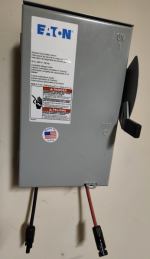
The solar panels will only be used to charge an Anker Solix F3800 Plus Portable Power Station, so it's DC power from the panels to the disconnect box in the garage. The disconnect box terminates with positive and negative MC4 connectors.Disconnect-Box.png
 
The solar panels will only be used to charge an Anker Solix F3800 Plus Portable Power Station, so it's DC power from the panels to the disconnect box in the garage. The disconnect box terminates with positive and negative MC4 connectors.View attachment 2580949
You may have hired the wrong company. I have never seen an installation like the photo shown.
 
I did a quick search on ankersolix.com but did not come up with an install manual.
If the four 440 watt panels are operating at under 30VDC VDC (12v?) that might change the rapid shutdown requirement but I agree the NM would not be allowed.
 
Do you have microinverters, or a string inverter?

NM cable inside is not allowed for DC PV circuits, but it is allowed for inverter output circuits. So if you have microinverters, NM cable in the attic is allowable.
Where is that in the code book? I see no prohibition on NM being used for DC circuits in the NM article. I've not all that detailed in article 690 as it has changed a lot, so maybe there? Is NM a "multiconductor jacketed cable" in the context of 690? Certainly if it is outside it would need to be UF to meet wet and sunlight restrictions, but this seems inside in the attic.
 
My only objection is the 30V rapid shutdown requirement, Article 690 should not impose any dwelling-unit voltage limits more stringent than those already established the rest of the code like 210.6(A).

IMO Emergency responders should be trained, equipped, and prepared to encounter 120-volt line-to-ground conditions in residential occupancies during fire fighting operations, and setting lower voltage thresholds like 30 volts may create a false sense of safety.

Consider all the hypothetical possibilities the code allows on a roof that could remain energized,
For a fictional illustration say there is a off-grid installation (no service) consisting of a remote cabin located next to a flood-prone river. Because periodic flooding is expected, all power-production and storage equipment is installed above grade on the roof. The owner prefers direct-current systems exclusively and has selected a nominal 120 V DC distribution system in the style of an Edison-era DC installation.

Ten 12-volt deep-cycle batteries are series-connected and housed in a rooftop battery enclosure, as the basis for the nominal 120 V DC battery system. A feeder is run from the rooftop battery enclosure to a listed 120 V DC distribution panel inside the structure using wiring methods permitted for the location. All interior lighting outlets and receptacle outlets are supplied from 120 V DC branch circuits, and the installation complies with 210.6(A).
Due to frequent high winds at the site, a wind generator is installed on the roof and connected through a rectifier and charge controller to maintain the 120 V DC battery bank in compliance with Article 694. To supply domestic water pressure, 120 V DC pump is installed in a detached pumphouse and supplied by a OH 120 V DC feeder routed in accordance with Article 225.

A120 V DC standby generator is also installed on the roof to recharge the 120 V DC battery system. When generator noise becomes objectionable, an Article 692 fuel cell system rated at 120 V DC is added.
We could probably think of more stuff to add..
All conductors are properly protected, and the complete installation is permitted, inspected, and approved and firefighters would encounter all of it energized on the roof.

 
I hired a solar installation company to install four 440 watt rigid solar panels on my roof. Wire runs from the roof to the attic, and from the attic to conduit that runs down the side of my house to my garage where it terminates in a disconnect box. The wire in the conduit is THHN, so I know that's fine. The wire coming from the roof into the attic is 14-2 NM cable (Romex), and they transition from NM cable to THHN for the conduit run. My panels are wired in series producing about 157 volts total, and 13.25 amps. Is 14-2 NM cable allowed to be used for solar installations? I'm assuming they transitioned to the NM cable once it enters the attic, but I don't know for sure. I'm hoping they didn't use NM cable outdoors on the roof.
From a code standpoint, your concern is 100% valid. 14-2 NM (Romex) is not allowed in outdoor, wet, or rooftop-exposed locations. It’s only permitted in dry indoor spaces, like inside walls or in a dry attic. So the real issue isn’t that it’s a solar system — it’s where the cable is being used.

On the roof and through the roof penetration: you should see PV wire, USE-2 cable, or THHN/THWN-2 in conduit. Once the wiring has entered a dry attic space, transitioning to NM cable can be acceptable. Also, your array is roughly 157V and 13.25A wired in series.
Even though 14 AWG is typically rated for 15A, solar circuits are treated as continuous loads, so code requires a 125% factor. That puts your effective current around 16.6A, which is really pushing (or exceeding) what 14 AWG should be carrying.

Using NM in a dry attic for a short run can be OK, but using NM on the roof or outdoors is not code-compliant. For an array like yours, 12 AWG THHN/THWN-2 or PV wire would be the safer and more correct choice
 
The Open-Circuit (Voc) volts of the panels is 39.16 volts each. The panels are wired in series, so the total volts is about 157 volts.
Then yeah, you will need to think about rapid shutdown unless you are operating under a very old NEC.
 
We have a somewhat troubling trend occurring in my area, there's one installer who's been stripping the jacket off of NM cable and pulling the conductors through conduit for their PV installations. Seems ridiculous to me, but apparently he's been getting away with it in neighboring jurisdictions. We've been calling it out each time and he still keeps doing it... Sorry, rant over....
 
We have a somewhat troubling trend occurring in my area, there's one installer who's been stripping the jacket off of NM cable and pulling the conductors through conduit for their PV installations. Seems ridiculous to me, but apparently he's been getting away with it in neighboring jurisdictions. We've been calling it out each time and he still keeps doing it... Sorry, rant over....
Getting away with wasting his time?
I mean are we talking just doing this from the LB 2ft below the panel into the crawl space, or for a full run in EMT? How much time is worth saving 5 cents a foot?
 
Getting away with wasting his time?
I mean are we talking just doing this from the LB 2ft below the panel into the crawl space, or for a full run in EMT? How much time is worth saving 5 cents a foot?
I know, that's my thought exactly. Entire installations. Hundred feet or more.
 
The company sent out someone today (neither of the two guys that performed the install), and he was just as perplexed as I was as to why they used NM cable. He stated they should of used 10-gauge MC cable. It's crazy because even with the limited knowledge I have, I told the installers the day they were about to perform the install I didn't think they could use NM cable, and he pointed right at MC cable on the back of his truck and stated he would use it. Well, he didn't, and now they have to come back out to fix it. Since they have to come back out, I'll make sure I mention they need to ensure a rapid shutdown is in place on the roof.

Wouldn't this have failed an inspection? I don't get it.
 
Looking at the manual for the Anker Solix F3800 Plus Portable Power Station
I'd double check that string voltage configuration.
Appears to depend on the firmware version but either way the voltage / current relationship
cant exceed 1200W max on either input 1 or 2 from the manual:
firmware 1.7.8 or earlier; 11-32V = 10A; 32V-60V = 25A (1200W Max)
firmware 2.1.1 or later; 11-15V = 10A; 15V-60V = 27A (1200W Max)

If the unit cost around $3000.00 and is 'plug and play' and 'no complex installation' that means no rapid shutdown included.
Adding rapid shutdown would be pretty complicated and you'd probably expect to spend 1/2 what you paid for the entire unit.
I bet your need a Tigo system, and I would not trust the installers that don't know you cant run NM to a PV system with that.
My guess is this is not intended to have a rapid shutdown, possibly more for the prepper / camper / RV market not the permanent install in your house type.
 
Top