Why do they do this?

Merry Christmas

hbiss

EC, New York NEC: 2017
Location
Little Falls, New York NEC: 2017
Occupation
EC
Actually, I suspect that it's plumbers who do this. I'm talking about the curls in low voltage thermostat wiring on heating equipment that, as far as I know, was done forever. I replaced the control on this boiler about a month ago with one identical. Boiler dates back to the 70's. Is it tradition? What do they wrap it around, a piece of pipe? Why bother, certainly there is no need for that slack.
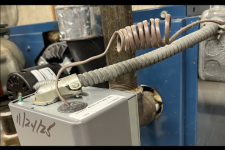
1766791953227.png

-Hal
 
Because it looks cool....
Yeah, the tradition. Then the h.o. really thinks they have edison himself doing the install... meh- harmless trade twick
 
It's to leave slack. No guarantee that was done by a plumber and not an electrician. This is still better than the Mickey Mouse ears in a panel.
 
It's to leave slack.
Ok. But how do you explain the line voltage stuff inside the control? L1 and L2 in that greenfield barely make it to the screws. Same with the draft inducer motor. And I know that motor comes with about an extra 12" of lead out of the end of its greenfield.😖

No guarantee that was done by a plumber and not an electrician.
Measure the inside diameter of the coil. Is it 1/2" copper or 1/2" emt. :ROFLMAO:

-Hal
 
I wonder if the practice stems from installing smaller gauge solid wires on/in vibrating equipment? The loops might have been perceived to help prevent conductor breakage.
 
Telco practice, usually on the customer-side of those old-style carbon block lightning arresters

It adds inductance to 'protect' customer equipment from lightning

No idea how well it worked, but I'd bet there is a 'Bell System Practices' instruction page somewhere that tells in GREAT detail how manty turns and what diameter.
 
Until this thread, IDR ever seeing those loops.
Me neither, at least not in that sort of application.

Seen and even done it with spare conductors/cables before. Never really became any kind of regular habit for me though. Wrapped around a screwdriver handle is usually how I done it.

Possibly have made 2 to 10 wraps a time or two say at a motor contactor or similar application where it was low current draw but wanted a place to take clamp on current readings with a multiplier in the reading.
 
It is very common with the mechanical and controls contractor i work with. I’ve watched a fitter do this with his screw driver for controls on a AHU. Also have seen this around the Washington DC area for years.
 
Telco practice, usually on the customer-side of those old-style carbon block lightning arresters

It adds inductance to 'protect' customer equipment from lightning

No idea how well it worked, but I'd bet there is a 'Bell System Practices' instruction page somewhere that tells in GREAT detail how manty turns and what diameter.
If anybody should know about that it should be me. I go way back with telco but I don't recall seeing this with other than boilers and furnace controls and very old ones at that with the old cloth wrapped wiring. If Bell did have that in their practices, I can't see how it crossed over to this trade.

-Hal
 
If I encountered it, I certainly wouldn’t waste my time straightening it out! 😂
Bill was talking about the curled up neutral that GFCI breakers come with. I certainly do straighten them out and shorten them depending on where the neural bar is. That curled up thermostat wire, if you notice I left it as a tribute to Thomas Edison or whoever thought they did a good job. :rolleyes:

-Hal
 
Bill was talking about the curled up neutral that GFCI breakers come with. I certainly do straighten them out and shorten them depending on where the neural bar is. That curled up thermostat wire, if you notice I left it as a tribute to Thomas Edison or whoever thought they did a good job. :rolleyes:

-Hal
Sorry. I thought you meant the thermostat wire.
 
IIRC it's a telco practice going back into the 40's (30's? before?), I used to see a lot of leads to equipment done up like that.
You beat me to it, also my guess a old telco practice.
Back before 1982 or whenever the break up was they had stack of manuals on how to do exactly everything, called Bell Systems Practices or BSP, it influenced how many hand tools were made.
Makes the NEC look like nothing.
They specify everything including amount of slack, most telco manuals to this day are based on these old manuals, but no longer as detailed.
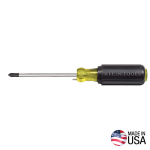
Klein still makes a BSP screwdriver with a extra pin offset in the bottom of handle to support 18- 24 AWG when you curled wires.
1766959284428.png
 
Top