
You are using an out of date browser. It may not display this or other websites correctly.
You should upgrade or use an alternative browser.
You should upgrade or use an alternative browser.
Reversed Transformer
- Thread starter kec
- Start date


- Location
- New Jersey
- Occupation
- Journeyman Electrician (retired)
You mean bonded the enclosure to the incoming EGC?Yes, they should have just bonded the Transformer cabinet.
- Location
- Wisconsin
- Occupation
- PE (Retired) - Power Systems
This is a frequent wiring error. Your failure is more extreme than typical.Does not seem right to me.
We install per the NEC, we are not utilities, we should not be bonding primary side X0 terminals, especially if they are not MV.
Tulsa Electrician
Senior Member
- Location
- Tulsa
- Occupation
- Electrician
From what I can see the install needs evaluated and corrected.
(E) Primary OCPD sizing
(E) Primary conductors for damage and sizing.
(C) Equipment ground bar needs installed at transformer to its enclosure.
(C) A GEC need ran to a qualified electrode.
(C) XO need to float (attached to nothing).
(E) Secondary conductor sizing based on secondary OCPD ( looks like 4/0 in and out).
(C) Corner ground secondary with a SBJ or run as ungrounded delta.
Looks like ser cable ran on secondary with the bare taped green( SSBJ). Should be ok on size if the cable is 4/0 with 2/0 bare.
If so the secondary OCPD can no be larger than the cables ungrounded conductors 4/0 ampacity.
This is an example of the conductors withstand rating in IT² based on the EGC size.
In this case to much ampacity for to long based on the size of the conductors CM. The OCPD only seen this as load and no reason to open. By the time it did the damage to the insulation was done. The root cause is the tie to XO as many have mentioned. A way to look at it too small of wire for the load. An extreme example may be 100 amp load on a #12 with a 100 amp breaker. The #12 being the netural and the 4/0 being the ungrounded. When a phase is dropped on a three phase balanced load the #12 is used to carry the unbalanced load.
This is why we want the OCPD to open very quickly when a fault is detected on the EGC. In this case you used it as a normal current carrying conductor which was sized to small for the load condition by attaching to XO on a reverse feed configuration.
Thanks for sharing the pic.
(E) Primary OCPD sizing
(E) Primary conductors for damage and sizing.
(C) Equipment ground bar needs installed at transformer to its enclosure.
(C) A GEC need ran to a qualified electrode.
(C) XO need to float (attached to nothing).
(E) Secondary conductor sizing based on secondary OCPD ( looks like 4/0 in and out).
(C) Corner ground secondary with a SBJ or run as ungrounded delta.
Looks like ser cable ran on secondary with the bare taped green( SSBJ). Should be ok on size if the cable is 4/0 with 2/0 bare.
If so the secondary OCPD can no be larger than the cables ungrounded conductors 4/0 ampacity.
This is an example of the conductors withstand rating in IT² based on the EGC size.
In this case to much ampacity for to long based on the size of the conductors CM. The OCPD only seen this as load and no reason to open. By the time it did the damage to the insulation was done. The root cause is the tie to XO as many have mentioned. A way to look at it too small of wire for the load. An extreme example may be 100 amp load on a #12 with a 100 amp breaker. The #12 being the netural and the 4/0 being the ungrounded. When a phase is dropped on a three phase balanced load the #12 is used to carry the unbalanced load.
This is why we want the OCPD to open very quickly when a fault is detected on the EGC. In this case you used it as a normal current carrying conductor which was sized to small for the load condition by attaching to XO on a reverse feed configuration.
Thanks for sharing the pic.

herding_cats
Senior Member
- Location
- Kansas
- Occupation
- Mechanical Engineer
You would if a neutral was fed through it?You can't get 277V from a 480V delta.
wwhitney
Senior Member
- Location
- Berkeley, CA
- Occupation
- Retired
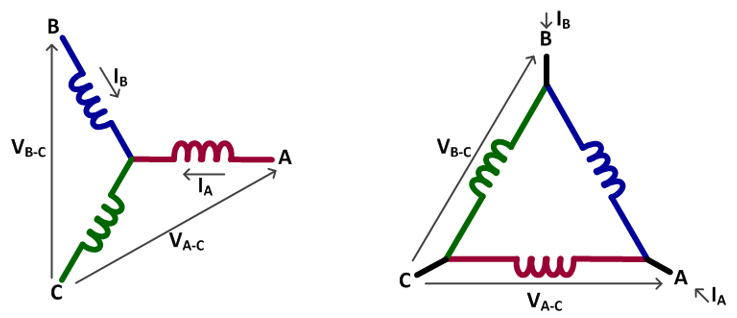
If you have a transformer installed as an SDS, the only voltage relationship between the primary and secondary voltage systems is defined by the grounding choices on each side. If the secondary coils have no neutral (are delta), you can't use a primary side neutral with the secondary side conductors to form a circuit. It would be a fault.You would if a neutral was fed through it?
If the secondary is corner grounded, and the primary wye is grounded as always, you'd have secondary side L-L voltage between the primary neutral and two of 3 secondary conductors, and no voltage between the primary neutral and the third secondary conductors, as they are both grounded.
If the secondary is ungrounded, then the voltage from a secondary side conductor to the primary neutral would be unstable and not sufficient to power a load (absent a fault). If measured with a high impedance meter, it may often measure near what the L-N voltage of the secondary would be if it had a neutral conductor.
Cheers, Wayne

- Occupation
- Licensed Electrician
Not if the transformer is delta. You would need the correct a star configuration on the windings.You would if a neutral was fed through it?

LarryFine
Master Electrician Electric Contractor Richmond VA
- Location
- Henrico County, VA
- Occupation
- Electrical Contractor
Still no. There is no correct way to use a supply neutral as a secondary neutral.You would if a neutral was fed through it?
herding_cats
Senior Member
- Location
- Kansas
- Occupation
- Mechanical Engineer
I’ve never seen 480 delta. Is there a wild leg in this configuration?
herding_cats
Senior Member
- Location
- Kansas
- Occupation
- Mechanical Engineer
Was that wire smoked from an unbalanced phase issue?
LarryFine
Master Electrician Electric Contractor Richmond VA
- Location
- Henrico County, VA
- Occupation
- Electrical Contractor
No. That would require a grounded center tap in one secondary.I’ve never seen 480 delta. Is there a wild leg in this configuration?
Voltages-to-ground are dependent on which conductor is (intentionally) grounded.
- Location
- Wisconsin
- Occupation
- PE (Retired) - Power Systems
Assumed based on the OP which described a utility power loss.Was that wire smoked from an unbalanced phase issue?
ramsy
NoFixNoPay Electric
- Location
- LA basin, CA
- Occupation
- Service Electrician
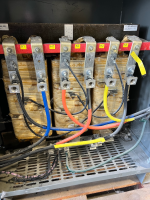
Transformer photo is missing label for H3.
Does H3 belong Left of X1, or Right of X3 ?
Does H3 belong Left of X1, or Right of X3 ?

electrofelon
Senior Member
- Location
- Cherry Valley NY, Seattle, WA
- Occupation
- Electrician
Right, trying to power a load from a ungrounded secondary side conductor and the primary neutral would be like trying to jump start a car from two other cars, A and B, using the negative of car A and the positive from car B. Damn u Kirchoff!If the secondary is ungrounded, then the voltage from a secondary side conductor to the primary neutral would be unstable and not sufficient to power a load (absent a fault). If measured with a high impedance meter, it may often measure near what the L-N voltage of the secondary would be if it had a neutral conductor.
Cheers, Wayne

LarryFine
Master Electrician Electric Contractor Richmond VA
- Location
- Henrico County, VA
- Occupation
- Electrical Contractor
The former. I believe it's cut off on the left.Transformer photo is missing label for H3.
Does H3 belong Left of X1, or Right of X3 ?
MD Automation
Senior Member
- Location
- Maryland
- Occupation
- Engineer
Agree with Jim 100% here. This is a common wiring mistake, and in "normal" conditions, bonding the X0 maybe won't lead to a disaster straight away - but it can cause unbalanced current to flow (in the neutral / EGC) and create unnecessary heat in the transformer.One problem with connecting the X0 of a reverse fed wye is when unbalanced currents flow, such as when the utility has a phase loss. By forcing the wye point to stay as a neutral point, rather than float around, the transformer draws increased current on the X0 to source neutral conductor.
There will always be small imbalances between the neutral to line voltages on the POCO mains. As these 3 slightly different voltages energize the primary side of the transformer (along with tiny differences in the transformer's 3 primary winding impedances) they will create a new transformer X0 that might not be exactly at the same potential as the POCO X0. So you don't want to tie them together. You don't need it - let the X0 float.
I like to think of X0 like the X=0, Y=0 origin on a piece of graph paper when you draw a nice symmetrical 3 phase set of Wye vectors. The POCO X0 and the new primary X0 in the transformer will never line up exactly. They will normally be close, but the "real world" will cause them to be offset and never perfectly aligned.
In "normal" conditions, if they are connected, the POCO source will be the bully, and fight hard (by creating current flow) to draw both X0 points together. And an important thing to remember, regardless if the X0 bond is via a neutral or EGC, there is typically no over-current protection on that conductor.
If the POCO dropped a phase, then those are certainly "abnormal" conditions and odd things can result. What I think would happen here is that the primary Wye windings in the transformer will try to create the dropped phase voltage. The Secondary will still see all its three windings fired up (because it's a closed Delta) and that can magnetize the winding back over in the primary that is NOT being fed by the POCO, energize it, AND reverse feed all the loads back in the mains (and maybe even back into the POCO world?). This would be a very unbalanced situation and the POCO and transformer midpoints (X0) will absolutely get pulled farther apart than normal, with objectionable current flow between these 2 midpoints. This will create abnormal current in a conductor (or the steel in an RGC/EMT if that is the EGC) that has no path thru a circuit breaker to stop it. And often times that conductor is undersized to boot.
I did an experiment a few years back in my shop to supply a Wye - Delta transformer only 2 of 3 phases and a neutral to see if it would generate the 3rd phase on the unconnected Wye winding . It absolutely did. Ran a little 3 phase motor just fine.
That's my 2 cents, feel free to poke holes if you see them.
ramsy
NoFixNoPay Electric
- Location
- LA basin, CA
- Occupation
- Service Electrician
Should H3 and X1 share the same core?The former. I believe it's cut off on the left.
If H3 belongs Right of X3, cores would share same number.
electrofelon
Senior Member
- Location
- Cherry Valley NY, Seattle, WA
- Occupation
- Electrician
about 8 years ago, I had client lose a phase and they had a miswired reverse fed transformer. I guess things got so imbalanced and hot that a primary conductor faulted to the 2"emt and blew a big hole in it.Agree with Jim 100% here. This is a common wiring mistake, and in "normal" conditions, bonding the X0 maybe won't lead to a disaster straight away - but it can cause unbalanced current to flow (in the neutral / EGC) and create unnecessary heat in the transformer.
hillbilly1
Senior Member
- Location
- North Georgia mountains
- Occupation
- Owner/electrical contractor
Mostly industrial. It will be corner grounded, where two of the phases will be 480 volts to ground, while the third will be zero volts to ground, 480 volts to the other phases. There is also a delta ungrounded system, where voltages to ground can fluctuate greatly, if any, to ground, but require a ground detector to indicate a phase has a fault to ground. OCP will not trip until a second phase goes to ground on that system.I’ve never seen 480 delta. Is there a wild leg in this configuration?