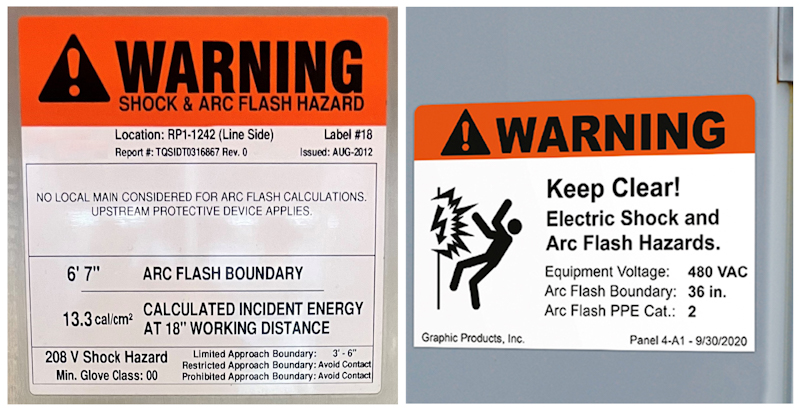
From the 2023 NEC:
110.16 Arc-Flash Hazard Warning.
(A) General.
Electrical equipment, such as switchboards, switchgear, enclosed panelboards, industrial control panels, meter socket enclosures, and motor control centers, that is in other than dwelling units, and is likely to require examination, adjustment, servicing, or maintenance while energized, shall be field or factory marked to warn qualified persons of potential electric arc flash hazards. The marking shall meet the requirements in
110.21(B) and shall be located so as to be clearly visible to qualified persons before examination, adjustment, servicing, or maintenance of the equipment.
(B) Service Equipment and Feeder Supplied Equipment.
In other than dwelling units, in addition to the requirements in
110.16(A), a permanent arc flash label shall be field or factory applied to service equipment and feeder supplied equipment rated 1000 amperes or more. The arc flash label shall be in accordance with applicable industry practice and include the date the label was applied. The label shall meet the requirements of
110.21(B).
Informational Note No. 1:
See ANSI Z535.4-2011 (R2017),
Product Safety Signs and Labels, for guidelines for the design of safety signs and labels for application to products.
Informational Note No. 2:
See NFPA
70E-2021,
Standard for Electrical Safety in the Workplace, for applicable industry practices for equipment labeling. This standard provides specific criteria for developing arc-flash labels for equipment that provides nominal system voltage, incident energy levels, arc-flash boundaries, minimum required levels of personal protective equipment, and so forth.
Enhanced content:
The available short-circuit current must be known at the time of installation to comply with the interrupting requirements of
110.9 and
110.10. This information is necessary to determine the incident energy and working distance for compliance with
NFPA 70E for future work on the service equipment. Section 110.16(B) specifies the information that a label is required to provide. The date that the label was applied is important because, over time, available fault current can change.
Two different arc flash labels meeting the requirements of
130.5(H) of NFPA 70E are shown below. On the left, the label provides the available incident energy and working distance. On the right, the label provides the arc flash PPE category.