winnie
Senior Member
- Location
- Springfield, MA, USA
- Occupation
- Electric motor research
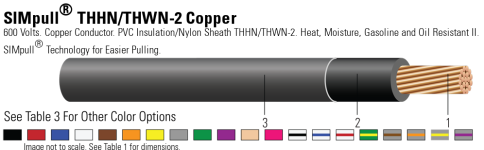
You used to be able to order light gray or 'natural gray', and 'light blue' at least. In some specs telco's used like they called the dark gray 'slate', and the darker pink was 'violet'.I know purple wire exists, and some local rules require it for 277/480V in place of what most of the country marks orange. But do pink and cyan wire exist? Or do pink and cyan tape exist?
The NEC does not forbid the same color being used again for a different phase at a different voltage, its just requires each phase to be unique at its voltage.I know purple wire exists, and some local rules require it for 277/480V in place of what most of the country marks orange. But do pink and cyan wire exist? Or do pink and cyan tape exist?
There doesn't seem to be a good consensus for a solution, when identifying exotic voltage systems (e.g. 347/600V),
That is not how I read 210.5(C)(1). If there is more than one voltage system, the identification must be unique to voltage and phase. I guess you could use the same color for the phases and provide some other method such as tape to identify the voltage.The NEC does not forbid the same color being used again for a different phase at a different voltage,
I had a City of Atlanta inspector force me to use Brown Orange Yellow instead of Yellow Brown Purple because he had never seen Yellow Brown Purple before.Most likely everyone in here has run into discrepancies between the rules and "the inspector doesn't like <insert here>".
Yeah just academically speaking, as a thought experiment (not something I'd do in practice), assume you are on an island with limited supplies and given:That is not how I read 210.5(C)(1). If there is more than one voltage system, the identification must be unique to voltage and phase. I guess you could use the same color for the phases and provide some other method such as tape to identify the voltage.
System: A B C
208Y/120: Black Red Blue
416/240: Red Black Blue
480Y/277: Blue Red Black
600Y/347: Black Blue Red
690/400: Red Blue Black
4160/2400: Blue Black Red

It would get a fail tag from me.Yeah just academically speaking, as a thought experiment (not something I'd do in practice), assume you are on an island with limited supplies and given:
- At every termination, connection, and splice point, all three ungrounded conductors for the circuit/system are present and grouped together.
- Those conductors are separately identifiable by phase/line designation (A, B, C at terminals, lugs, etc.).
- The ordered mapping of conductor colors to (A,B,C) is unique for each nominal voltage system present.
- That ordered mapping is the documented/posting method used for identification at the applicable distribution equipment.
- No two systems use the same ordered A/B/C color assignment.
Under these assumptions, if you had pallets of wire but only three individual conductor colors available, and needed to support six nominal voltage systems, you could create a NEC compliant identification scheme by assigning each system a unique ordered (A,B,C) color mapping. The system could then be inferred from the observed ordered mapping at each termination/connection/splice point.
Example (unique ordered mappings):
System: A B C
208Y/120: Black Red Blue
416/240: Red Black Blue
480Y/277: Blue Red Black
600Y/347: Black Blue Red
690/400: Red Blue Black
4160/2400: Blue Black Red
NEC doesn't even require phase identification to be by colors. You can run all same color conductors (besides grounded and equipment grounding conductors smaller than 4 AWG) and use your imagination to identify phases, still need white/gray green to identify grounded and equipment grounding conductors.The NEC does not forbid the same color being used again for a different phase at a different voltage, its just requires each phase to be unique at its voltage.
There is a mill that had in its spec (from the parent company) Red / Black / Blue, for 600/347V.