
Arc Flash Calculation with only Max Fault Current

So I have a new facility for R&D research that needs an arc flash calculation. The off-site utility provider has only provided the max fault current. From my understanding of IEEE 1584, an arc flash calculation needs to be performed using a max and min fault current. The on-site utility provider I have provides both the max and min fault currents at the 13.kV levels to perform an arc flash calculation. I use the ETAP software to perform the arc flash calculations. So, what do I need to do determine the min fault current? Thanks
 
eaton makes an easy and free fault current calculation app found on cell phone app store. it's worked great for me.
 
If you are taking service at medium voltage from a typical utility distribution feeder, the variation in fault current will be minimal, especially on the secondary side of your step down transformer. But you do have to consider other factors within your system that can change the available fault current. The most common is a local standby or emergency generator which will often produce much lower fault current than the utility source. Also portions of the system that may be normally supplied by a UPS, but can switch to utility power if the UPS fails.
 
You're right that IEEE 1584-2018 requires analyzing both maximum and minimum fault current scenarios for arc flash calculations. D. Castor makes excellent points about system variations, but let me add some specific methods to determine minimum fault current when utilities only provide maximum values.


Practical approaches for minimum fault current:


  1. Request utility impedance data - Instead of just fault current, ask for their system X/R ratio and source impedance at the POC. This lets you model different operating conditions (single vs. multiple sources in parallel, maintenance scenarios).
  2. Understand system operating variations - IEEE 1584-2018 uses an Arcing Current Variation Factor (not the old fixed 85% rule from 2002). But your question is about system operating conditions, which is different. For utility-fed systems at 13.8kV, the variation in available fault current is typically minimal (as D. Castor mentioned) unless there are switching scenarios or parallel source configurations.
  3. Model utility source variations - Use your on-site data: if you have max/min at 13.8kV, work backwards through your step-down transformer to understand the utility variation pattern, then apply proportionally to their reported maximum at the POC.
  4. Generation scenarios - As D. Castor mentioned, this is critical. For standby generators, minimum fault current might actually come from generator-only operation (especially if you have <1MW units).

Software considerations:


ETAP handles this well if you model the utility as a Thevenin equivalent with adjustable source impedance. I've recently been working extensively with IEEE 1584-2018 implementation (validated against 105,000+ test cases to get the equations right), and the minimum fault current scenario often drives the worst-case incident energy at lower voltage levels due to longer clearing times - something that's counterintuitive but mathematically sound per the 2018 revision.


If the utility absolutely won't provide impedance data, document your assumptions clearly in your study report. Consider sensitivity analysis showing results at different minimum values to demonstrate the impact range.


Have you contacted your utility's engineering department specifically? Sometimes fault current data comes from operations, but the engineering group has the detailed models you need.
 
So, what do I need to do determine the min fault current? Thanks
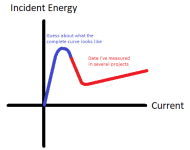
When faced with this scenario, I find the minimum fault current where the system generally becomes dangerous as an alternative to minimum available fault current. I've found the arc flash behavior of a system to have two relatively linear ranges. One above a certain fault current, and one below this fault current, with a "knee" in between. This bifurcation point is a low current range, where your clearing times begin to shoot through the roof, and quickly results in dangerous ratings. I identify this point by adjusting the available fault current in etap and re-running the study, plotting an informal graph to keep track of the behavior. and note the amount of current where this behavior occurs it in the documentation. It is often well out of bounds of reasonable possibility, but not always, so it's worth doing.
 
Incident Energy Behavior.png

This is a simple graph of the behavior I'm referring to at low current levels. At some point, the current gets so low that the fault clearing time dilates faster than the incident energy is reduced by having less fault current, and the resulting incident energy rises rapidly. The blue is what I assume has to happen if you keep lowering the fault current, though I've never tested it.
 
Etap performs the AF study at multiple AF currents already. That's why sometimes the results are presented at a lower current than the max bolted fault current. I've never used a minimum AC fault current with an etap study.
 
I've never used a minimum AC fault current with an etap study.
I did it all of the time.
Arc Flash is likely to occur during periods of maintenance. During maintenance motors may be turned off so they no longer contribute current into the fault. During some maintenance outages the facility may be running on backup generators which have significantly lower fault current than utility systems.
 
Top