300.4. Protection against physical damage.

@wwhitney is looking at the word parallel, If understand him correct the section revolves around the qualifier 'parallel' to the a framing member. Implied is the framing member is the one the romex is traveling along. also "from the nearest edge of the framing member"
Another section (F) covers shallow groves, so if a box or obstruction creates a 'shallow groove', then (F) would also apply to say a cable passing behind a box.
 
@wwhitney is looking at the word parallel, If understand him correct the section revolves around the qualifier 'parallel' to the a framing member. Implied is the framing member is the one the romex is traveling along. also "from the nearest edge of the framing member"
Another section (F) covers shallow groves, so if a box or obstruction creates a 'shallow groove', then (F) would also apply to say a cable passing behind a box.
Yes, it’s specifies parallel. It’s not parallel once it dives out and goes into the box so that rule doesn’t apply like I stated that like post 4
 
I do not see how protection is optional when wiring is so close and does not meet the distance.
Because the requirements within 300.4 depend on both location and direction of travel of the cable.

Now 300.4 could just say "any portion of any cable within 1-1/4" of the edge of a framing member shall be protected." That would be a requirement that is based only on location, and that seems to be how you are reading 300.4. But that's not what 300.4 says.

Instead we have requirements based on both location and direction of travel. For holes in a framing member closer than 1-1/4" from the attachment face of the framing member, we are required to protect the portion of the cable within the framing member; there's no language about extending that protection to 1-1/4" past each edge of the framing member.

Likewise, for conductors installed parallel to a framing member, we are required to protect the cable if it is within 1-1/4" of an edge of the framing member. But that doesn't apply to cables traveling diagonally, they can be closer than 1-1/4" from the edge of a framing member without requiring additional protection.

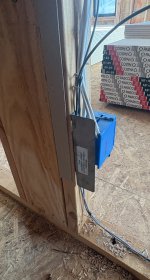
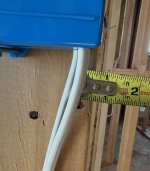
So say you have a 2x4 wall and you have a box that extends 2-3/4" into the wall framing, with a back corner box entry that is say 1/2" from the wide face of the stud (and 3/4" from the wallboard behind the box). So you route your cable down the middle of the wide face of the stud, that complies with the 1-1/4" requirement, until the cable is within say 3" vertically of the box. Now your cable bends to a diagonal route to the box entry, it travels diagonally 3" vertically, plus 1/2" away from the stud, plus about 1" towards the backside of the wallboard. That diagonal section is not subject to the 1-1/4" distance requirement.

Now you could route your cable less carefully and thereby trigger 300.4(D) protection. For example, if the diagonal jog described above doesn't occur in the vertical region 0" to 3" away from the box, but instead occurs between 6" and 9" away from the box, then the first 6" out of the box would be installed parallel to the framing member and would require additional protection. But the simple solution is don't do that.

Cheers, Wayne

 
adjective


  1. (of lines, planes, surfaces, or objects) side by side and having the same distance continuously between them.


    Can’t be that—- it’s making an angle into the box come on move on
I would take the hole thing to the state inspector the idea is just laughable—-
 
OK, so there's a small hazard for maybe 3" vertically. Much less hazard than a cable that does that for the full 8'+ height of a stud. 300.4(D) address the latter hazard, not the smaller hazard in your picture.

Cheers, Wayne
Thank you Wayne...its not a great photo, had to crop out a lot to make this work LOL
 
adjective


  1. (of lines, planes, surfaces, or objects) side by side and having the same distance continuously between them.


    Can’t be that—- it’s making an angle into the box come on move on
I would take the hole thing to the state inspector the idea is just laughable—-
Yep...that's the problem , Inspectors are calling for protection !!!
 
how about no electricity that’s safest—-
just make your county mandate 2x6 interior walls and be done with it- in reality 90% of this book does not save life’s —

Department of transportation in Oregon just cause someone dies from a crash from bad. road design they’re not gonna address it. It has to be in habitual incident not just one or two or three every 10 years yet this stupid code if it has one issue will uproot everything just to appease that one issue it’s just stuipid—
It’s not going to do nothing if you hit it with a screw it’s going to blow the material clean away and it’s just going ti sit there—-
Like many state 120-240 volt can’t sustain an arc— and wowiwow aren’t those stupid arch faults suppose to completely stop any possible issue….

go after the handy man that’s screwing the little old lady by messing her crap up that I now have to fix and it’s makes it a pain and costly vs this crap
 
Last edited:
Top