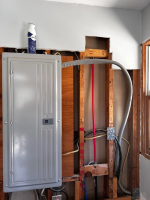
300.4. Protection against physical damage.

boxes that nearly go all the way to other side of wall cavity are nothing new. I questioned this very thing a little nearly 40 years ago when I was fairly new at this. - Why must I keep cables away from edge of stud yet only way to enter this box is near the edge of the stud? I doubt I was the only one that saw that contradiction. I wouldn't be surprised if it hasn't come up with code proposals/PI's and been dismissed by CMP's though.
I agree, dismissed or just never addressed ? Some of the code gets enforced, like bores and vertical wiring away from stud edge, ETC..... then this location just ignored/Missed, because what are you supposed to do ? Building out of 2x6 makes this part of the Code go away, then you have this location, that was looked at by NFPA and that exception that was proposed, by Colorado, was denied...So NFPA and the NEC require protection at this area, although it may be such a small area, no exception. It clearly indicated this topic on deeper boxes and edge of framing members. So , some how they are saying protect it if this condition presents itself, in the field. Areas down here are starting to enforce it, and they are correct to do so. I had one post on here that stated it was only about 3" of violation, at this area. I am getting hammered by some on here, because I am discussing an issue, that is now starting to come up more and more, and had some electrical guys call me, where its being called at, and I try to give them my thought on it, and unfortunately it is a correct call, by those Jurisdictions. If they did not want this "Small" area protected, then give it an exception in the code. Simple remedy. They looked at it and denied it.
 
the NEC require protection at this area
Only if you route your cables through this area parallel to the framing member. Which you don't typically do, you route them diagonally.

I had one post on here that stated it was only about 3" of violation
I stated there was maybe a 3" region of potential hazard, not 3" of violation. Again, it's only a violation if you route the cables through the region parallel to the framing member.

Cheers, Wayne
 
I'll give the OP this, the CMP seems to agree with them, despite the language in 300.6(D) (new numbering) referring to "parallel". Public Input No. 1027-NFPA 70-2023 for the 2026 NEC First Draft proposed adding to 300.6(D):

"Exception No.4 Entrance to a device box installed on wood or metal studs, the cable can be within (1.6mm) 1.25 inch from the framing member and no more than 6 inches above or below the device box."

The committee response was:

"Nails or screws are likely to penetrate cable or raceways within 6 inches either above or below a device box if the 1 ¼” spacing from the nearest edge of the framing member is not maintained. Where this distance cannot be maintained, the cable or raceway shall be protected from penetration by nails or screws by a steel plate, sleeve, or equivalent at least 1.6 mm (1 ⁄16 in.) thick."

So I think I'll submit a PI to change "parallel to" to "running adjacent to". That will align with the committee response above, without extending the 300.6(D) requirements to cables running perpendicular to the framing members.

Cheers, Wayne
 
IDK If I were an inspector I'd be more concerned about and start with residential panel / service changes in older/existing homes with 2X4 wall's, how the service entrance conductors (or feeders) are routed. 14/2 on a AFCI breaker not so much.
An example is a job like this; a unfuesd 4/0 AL SE cable that has large diameter, used to replace service conductors that were originally a raceway wiring method in wall.
When doing a service upgrade the new service conductor size will likely exceed the capacity of any existing raceway so the installer removes the raceway and uses the cable.
Clearly the SE here has more surface area to get hit by a nail,
The larger the cable the more likely it can be subject to physical damage.

For this SE cable issue there are other code sections that apply like 230.50, but when its 'subject to physical damage' can be interpreted in many ways.
I know in some parts of the country SE is routinely run exposed below 8' even on the exterior and not considered subject to physical damage, even routed exposed like this photo, at least you know where the cable is.
but if this wall were rocked and the cable mostly buried in the wall I wonder how much of that SE cable will be within 1-1/4" of the surface or more? And that looks like an ideal place for upper cabinets or shelving:
1770399019840.png
 
Last edited:
I'll give the OP this, the CMP seems to agree with them, despite the language in 300.6(D) (new numbering) referring to "parallel". Public Input No. 1027-NFPA 70-2023 for the 2026 NEC First Draft proposed adding to 300.6(D):

"Exception No.4 Entrance to a device box installed on wood or metal studs, the cable can be within (1.6mm) 1.25 inch from the framing member and no more than 6 inches above or below the device box."

The committee response was:

"Nails or screws are likely to penetrate cable or raceways within 6 inches either above or below a device box if the 1 ¼” spacing from the nearest edge of the framing member is not maintained. Where this distance cannot be maintained, the cable or raceway shall be protected from penetration by nails or screws by a steel plate, sleeve, or equivalent at least 1.6 mm (1 ⁄16 in.) thick."

So I think I'll submit a PI to change "parallel to" to "running adjacent to". That will align with the committee response above, without extending the 300.6(D) requirements to cables running perpendicular to the framing members.

Cheers, Wayne
Thank you Wayne, I do appreciate your time on this issue. It could be worded and made easier to understand and interpret. There is so much confusion and interpretation on this issue. Some enforce, some do not, some think it is stupid, some think it is ridiculous to keep addressing this issue and let it go for God's sake..... I appreciate your time. There are many folks who are viewing this throughout our country, that are silent but reading and trying to understand this, not wanting to comment. I know they have or will run into this and listening to professionals like yourself.
IDK If I were an inspector I'd be more concerned about and start with residential panel / service changes in older/existing homes with 2X4 wall's, how the service entrance conductors (or feeders) are routed. 14/2 on a AFCI breaker not so much.
An example is a job like this a 4/0 AL SE or SER cable that has large diameter, used to replace service conductors that were originally a raceway wiring method in wall. When doing a service upgrade the new service conductor size will likely exceed the capacity of any existing raceway so the installer removes the raceway and uses the cable.
Clearly the SE here has more surface area to get hit by a nail,
The larger the cable the more likely it can be subject to physical damage. For this SE cable issue there are other code sections that apply like 230.50, but when its 'subject to physical damage' can be interpreted in many ways.
I know in some parts of the county SE is routinely run exposed below 8' even on the exterior and not considered subject to physical damage, even routed exposed like this photo, at least you know where the cable is.
but if this wall were rocked and the cable mostly buried in the wall I wonder how much of that SE cable will be within 1-1/4" of the surface or more? And that looks like an ideal place for upper cabinets or shelving:
View attachment 2581848

Wow.....
 
IDK If I were an inspector I'd be more concerned about and start with residential panel / service changes in older/existing homes with 2X4 wall's, how the service entrance conductors (or feeders) are routed. 14/2 on a AFCI breaker not so much.
An example is a job like this; a unfuesd 4/0 AL SE cable that has large diameter, used to replace service conductors that were originally a raceway wiring method in wall.
When doing a service upgrade the new service conductor size will likely exceed the capacity of any existing raceway so the installer removes the raceway and uses the cable.
Clearly the SE here has more surface area to get hit by a nail,
The larger the cable the more likely it can be subject to physical damage.

For this SE cable issue there are other code sections that apply like 230.50, but when its 'subject to physical damage' can be interpreted in many ways.
I know in some parts of the country SE is routinely run exposed below 8' even on the exterior and not considered subject to physical damage, even routed exposed like this photo, at least you know where the cable is.
but if this wall were rocked and the cable mostly buried in the wall I wonder how much of that SE cable will be within 1-1/4" of the surface or more? And that looks like an ideal place for upper cabinets or shelving:
View attachment 2581848
I hope this wasn’t a finished project.
 
Top