VFD on Open delta autotransformer fed from a WYE source

JoeStillman

Senior Member
Location
West Chester, PA
Occupation
Electrical PE
I know that VFD's don't want to be fed from a 4-wire delta transformer. But if I hook up two autotransformers in open delta to buck a few volts off of the wye-fed circuit, the line to ground imbalance isn't as bad as on a 4-wire delta.

Will the VFD work ok? Anybody try this before?
 
Just how far are you planning to buck the voltage, and is there a big reason not to use three autotransformers in a wye or balanced closed delta configuration?
 
The reason VFDs don't "like" delta power sources is because they are built EXPECTING a consistent voltage reference to ground on all 3 phases, as you would have in a Wye (Star) configuration. How you get to the delta is irrelevant in that it's all bad from the standpoint of the risks to the VFD components.

I'm not sure why you are doing this "buck a few volts"... the VFD could not care less so long as the line voltage was in tolerance. So for example of you have a 240V rated VFD and you need to feed a 200V rated motor, it will not know or care. You can still program the output voltage going to the motor to be 200V if that's what it needs, the VFD will do whatever you tell it. The only thing it CAN'T do is create voltage that isn't there; i.e. a 208V supply and having to feed a 230V motor.
 
I know that VFD's don't want to be fed from a 4-wire delta transformer. But if I hook up two autotransformers in open delta to buck a few volts off of the wye-fed circuit, the line to ground imbalance isn't as bad as on a 4-wire delta.

Will the VFD work ok? Anybody try this before?
What does the IOM say? Back when I was working on Baldor and Toshiba drives (almost 25 years ago, mind you), both straight-up required wye sources. There's one site I remember doing a site-walk and feasibility check on installing a very large (500hp maybe?) regenerative drive where the floor ran almost entirely on 480v floating delta. We said "Thanks, no thanks" to that one.

I'm not sure why you are doing this "buck a few volts"... the VFD could not care less so long as the line voltage was in tolerance.
And this... again, what's the IOM say? With the IT gear I deal with today, we have the CBEMA/ITIC curve to guide us, but just about anything industrial should also have this included somewhere in their manuals.
 
I have found a cost efficient way to do a VFD on a open delta is a 1-phase to 3-phase VFD, the vendor oversized the VFD.
Where phases A-B is a 240V stinger transformer,
A-C is 120/240 split phase lighting pot,
and B-C is open,

A 1-phase VFD will work well on the A-B set, even if B is 208 to ground and A is 120 to ground.
And it only loads kVA on that stinger xfromer.
A 1- phase VFD does not like the open B-C set (and it disproportionately loads both stinger and lighting pot)
Only a 3-phase VFD gets weirded out by a 240 delta, 1-phase works fine and you can put its load on either transformer.
 
The reason VFDs don't "like" delta power sources is because they are built EXPECTING a consistent voltage reference to ground on all 3 phases, as you would have in a Wye (Star) configuration.
And this would be even more of an issue with OP configuration.

The open delta would equally affect the (3) L-L voltages but it would totally mess up the L-G voltages one of which would remain at 120V while the other two would be somewhat lower.
 
This discussion has gone slightly awry. The OP has a wye supply, not an open delta. But they want to reduce the voltage for some reason, and want to use an 'open delta autotransformer'. This is quite a bit different than a typical 'open delta high leg supply'. The only similarity is that you use 2 transformers in an open delta configuration, but the grounding is closer (not exactly, just closer) to a typical wye grounded system.
 
To provide a little more detail; installation is a church with 480Y/277V service from the POCO, several RTU's with VFD's. The VFD's have tripped on overvoltage on more than one occasion and blown out more than one VFD. The POCO analyzed their service and pronounced it within tariff (< +10%). Buit this is no help because the specs on the RTU's say max is +5% (504V).

The POCO won't dial down the taps because they say they don't have to. I want to propose bucking transformers and cut down the voltage by 24V or 5%. Maybe the solution is to push harder on the POCO - I don't know.

I didn't know bucking auto transformers come in 277V primary. Isn't that what I would need to make a balanced wye?
 
Oh I see disregard my last post
I am not a VFD expert but I have seen ABB "400V class" drives and also "500V class" so it may be issue with selecting the right drive class;
I think the "400V class" is best suited for the less common range of 416/240 or old 460/266 nominal service voltages, with nominal utilization voltage range of 400/230 - 440/254.
The "500V class" would be best suited for standard US service voltages in the ANSI C84 voltage Range B 480/277 - 508/293 with nominal utilization voltages of 460-266 - 480/277.
 
I don't know how rare 277V primary bucking transformers are. Larson looks like they might have something designed for 277V input, but their website is designed to be confusing:

What you can do with more typical components is use 480:24V transformers to get your 5% voltage reduction. There is no problem using a transformer below its rated voltage. The only 'problem' with using a 504V (480+24 because of the typical buck configuration) transformer at 277V is that you can only use part of the kVA capacity of the transformer.

Say you need to supply 100A of load. This is at nominal 480V, so we are talking a n 83kVA load. To supply this with 'optimal' buck transformers trimming the supply voltage by 5%, you would need 3 transformers rated 1.5 kVA each. But if you use the 480V transformers are reduced voltage you will need to buy 2.5 or 3 kVA units.
 
Last edited:
This is quite a bit different than a typical 'open delta high leg supply'.
Darn industry slang again. Winnie has the correct usage.

Open delta describes how many transformers are being used (2) and how they are connected (L-L). It says absolutely nothing about line to ground voltages.
High leg means you have 1 center tapped transformer. It says nothing about the .ine to line voltages.
Two different descriptions produce two different results. Electricians should get in the habit of using bothe details when describing sources and systems.
 
Last edited:
...I'm not sure why you are doing this "buck a few volts"... the VFD could not care less so long as the line voltage was in tolerance.
Trouble is, voltage is within utility tolerance, but not the drive.

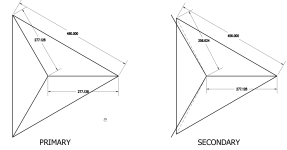
If I'm doing my vector algebra right, I think the open-delta autotransformer will leave one (L-G) phase leg alone while the other two are reduced about 8% and shifted 3°. It's not nearly as "unbalanced" as a 4WD source. My question is, is it too much?
 
Trouble is, voltage is within utility tolerance, but not the drive.

If I'm doing my vector algebra right, I think the open-delta autotransformer will leave one (L-G) phase leg alone while the other two are reduced about 8% and shifted 3°. It's not nearly as "unbalanced" as a 4WD source. My question is, is it too much?
A 4wire center tapped open delta system only has voltage imbalance issues when the neutral carries appreciable current. In a dedicated transformerfeeding a drive the current neutral current would be negligible and not a source of imbalance.
In a 3wire open delta auto transformer fed from a wye source there will be a fairly large L-N/G imbalance because one leg is not transformed at all.
 
Trouble is, voltage is within utility tolerance, but not the drive.

If I'm doing my vector algebra right, I think the open-delta autotransformer will leave one (L-G) phase leg alone while the other two are reduced about 8% and shifted 3°. It's not nearly as "unbalanced" as a 4WD source. My question is, is it too much?

Your vector algebra matches my graphical results.

The 'is it too much' question can probably only be answered by the drive manufacturer. The imbalance will show up in several areas: uneven loading of the input rectifiers, more common mode ripple on the DC bus, and different stresses on the input filtering.

I suspect that in your particular case the main risk is to the L-G connected TVS devices. Will one of these devices get triggered to conduct and try to 'suppress' the 'spike' that is simply the high L-N voltage supplied by the utility. My guess is that other issues (rectifier current balance and DC bus ripple) will not be problems in your 'almost balanced' system.
 
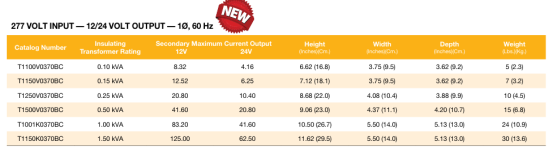
There is an ACME buck boost with a 277V primary, 12/24V secondary, 1.5kVA with part number T1105K0370BC.


That is almost impossible to find.

The selection tables in the buck/boost section of the Acme Electric catalog don't show them....but they are in the catalog as 'new' products in the lighting transformer section, described as Buck/Boost transformers ( page 114 of https://hubbellcdn.com/ohwassets/HCI/Acme_Electric/Acme_Electric_Catalog.pdf )
1771337667470.png
 
If I understand correctly, another option for a balanced ~5% 3 phase buck would be to use (3) 480V : 24/48V single phase transformers in a "zig-zag" autotransformer arrangement. This would be advantageous if the transformers are more available than 277V : 24V transformers, or if the neutral is not available.

Unless I'm overlooking a problem with the above?

Cheers, Wayne
 
Top