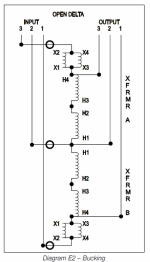
VFD on Open delta autotransformer fed from a WYE source

How did we get from "cut down the voltage by 24V" to "provide 24V"?
Buck/Boost transformers are often specified by their 'isolation transformer' ratings.

To cut a 480V system by 5% you use a 480 to 24V step down transformer connected in an autotransformer configuration. (Note: you can use this to get an exact 5% voltage drop, but typically the connection is done so that you get a 4.76% drop. This makes the transformer slightly more efficient.)
 
Buck/Boost transformers are often specified by their 'isolation transformer' ratings.

To cut a 480V system by 5% you use a 480 to 24V step down transformer connected in an autotransformer configuration. (Note: you can use this to get an exact 5% voltage drop, but typically the connection is done so that you get a 4.76% drop. This makes the transformer slightly more efficient.)
Interesting... this is an area I've never had to deal with (the most I did with VFDs at the shop was repair and sometimes spec line reactor retrofits). Makes for good learning! :)
 
Is it just me, or should a VFD have a voltage tolerance at least as large as the utility tolerance?

I would be looking at replacing the VFD's with something that has more forgiving specs before I started adding transformers.
 
Is it just me, or should a VFD have a voltage tolerance at least as large as the utility tolerance?

I would be looking at replacing the VFD's with something that has more forgiving specs before I started adding transformers.
I posted this earlier in the thread, but honistly my info may be out of date its been a few years since I ordered one;
I am not a VFD expert but I have seen ABB "400V class" drives and also "500V class" so it may be issue with selecting the right drive class;
... /...
The "500V class" would be best suited for standard US service voltages in the ANSI C84 voltage Range B 480/277 - 508/293 with nominal utilization voltages of 460-266 - 480/277.
 
The VFD's have tripped on overvoltage on more than one occasion and blown out more than one VFD. The POCO analyzed their service and pronounced it within tariff (< +10%).
../..
The POCO won't dial down the taps because they say they don't have to.
Actually that +10% is curious ,
is that really in the tariff at the PA public utility commission (PUC)?
My ANSI C84.1 is now 10 years old, I have herd of voltage notching up towards 126-127V. But +10% of 208/120 would be 228/132. I have herd 208/120 is migrating to 220/127 (the range B for 208/120 systems).

508Y/293 is (or was) the Maximum voltage Range B for a 480/277 nominal system according to the 2016 American National Standard ANSI C 84.1, I'd imagine manufacturers targeting the US market at most follow ANSI (in reality prefer 500V max) and you'd think a PUC would follow ANSI also.
The ANSI C 84.1 standard states (on page 3 of my old 2016 version):

"It should be recognized that because of conditions beyond the control of the supplier or user, or both,
there will be infrequent and limited periods when sustained voltages outside Range B limits will occur.
Utilization equipment may not operate satisfactorily under these conditions, and protective devices may
operate to protect the equipment.
When voltages occur outside the limits of Range B, prompt, corrective action shall be taken. The urgency
for such action will depend upon many factors, such as the location and nature of the load or circuits
involved, and the magnitude and duration of the deviation beyond Range B limits."
 
Last edited:
If I understand correctly, another option for a balanced ~5% 3 phase buck would be to use (3) 480V : 24/48V single phase transformers in a "zig-zag" autotransformer arrangement. This would be advantageous if the transformers are more available than 277V : 24V transformers, or if the neutral is not available.

Unless I'm overlooking a problem with the above?

Cheers, Wayne

I think that closed delta configuration of autotransformers would be functional, but the FAQ at ACME does not encourage using it:

 
Now that I think of it, isn't delta bucking as proposed by the OP prohibited by 215.11 / 210.9? You'd have to use a wye-configuration to comply with the requirement that "the system supplied has a grounded conductor that is electrically connected to a grounded conductor of the system supplying the autotransformer."

Cheers, Wayne
 
Actually that +10% is curious ,
is that really in the tariff at the PA public utility commission (PUC)?
Per Google:

52 PA Code § 57.14. Service voltage. . . .
(c) Allowable voltage variation (primarily power). For service rendered primarily for power purposes, the allowable variation in voltage measured at the service terminals of the customer may not exceed, for a longer period than 1 minute in each instance, 10% above or below the standard nominal service voltage during normal system operation.


Cheers, Wayne
 
To provide a little more detail; installation is a church with 480Y/277V service from the POCO, several RTU's with VFD's. The VFD's have tripped on overvoltage on more than one occasion and blown out more than one VFD. The POCO analyzed their service and pronounced it within tariff (< +10%). Buit this is no help because the specs on the RTU's say max is +5% (504V).

t seems reasonable that the VFDs could sense a +10% voltage level and then trip. But I'm somewhat skeptical that 5% could make the difference between having multiple failures and a negligible failure rate. The distribution of the breakdown voltages of production electronic components would be noticeably wider than that.

Have waveforms of the L-L and L-N voltages been measured? Perhaps there are harmonics that are causing a higher peak voltage than a sinusoid would have with the same RMS voltage. Also, there's a possibility that voltage surges or transients from the POCO could be occurring.
 
Now that I think of it, isn't delta bucking as proposed by the OP prohibited by 215.11 / 210.9? You'd have to use a wye-configuration to comply with the requirement that "the system supplied has a grounded conductor that is electrically connected to a grounded conductor of the system supplying the autotransformer."

Cheers, Wayne

I have never seen it mentioned, but I wonder if that prohibition was mostly intended for conversions between nominal system voltages like 120, 208, 240, 277, 480V, even though the wording makes no such limitation. I'm guessing that the exception for the conversion between 208 and 240V could be because of the small change in both L-G and L-L voltages.

I think it would make no sense to prohibit, for example, a 5% change to bring the POCO voltage closer to nominal using a L-L autotransformer, but then allow a 15% change between 208V and 240V in the same manner. But one could argue that the wording does not allow it.
The literature of various manufacturers of autotransformers seems to always show open delta as a recommended configuration.
 
installation is a church with 480Y/277V service
What exactly is the recorded voltage at the church over a months time ?
I'd probably install my own datalogger.
What is the primary voltage stamped on the transformer?


Per Google:

52 PA Code § 57.14. Service voltage. . . .
(c) Allowable voltage variation (primarily power).
Thanks Wayne, great find section (b) is what aligns with ANSI C-84, under § 57.14.(b) lighting service:
(b) Allowable voltage variation (primarily lighting). For service rendered primarily for lighting purposes, the allowable variation in voltage measured at the service terminals of the customer may not exceed, for a longer period than 1 minute in each instance, 5% above or below the standard nominal service voltage and a total variation from minimum to maximum of 8% during normal system operation.

Also 57.14 (a) requires the utility adopt 'standard Service voltage', a recording volt meter you could deduce the mean average voltage.
If say the Church has a older 12.5kv:277 pad-mount, then substation was converted from 12.5kv to 13.5 you'd have a 299/518 nominal system, I might argue thats not 'standard'.

That PA code 57.14 also requires they keep records, so I'd ask the utility what are the recorded voltage records for the utility primary feeder?
I bet if you even start requesting that kinda stuff the voltage might magically get fixed.
 
Last edited:
Now that I think of it, isn't delta bucking as proposed by the OP prohibited by 215.11 / 210.9? You'd have to use a wye-configuration to comply with the requirement that "the system supplied has a grounded conductor that is electrically connected to a grounded conductor of the system supplying the autotransformer."

Cheers, Wayne
Thanks Wayne, sems like I'm proposing a code violation, then, unless the AHU circuit has a neutral wire. But what would I connect it to? Odd that 600:480 connections are allowed in the exception too.

Here's my proposed connection diagram (right out of the Sola catalog)...

1771508295936.png

There is an electrical connection to the grounded circuit conductor. It's just through the main transformer B-phase winding.
 
...Have waveforms of the L-L and L-N voltages been measured? Perhaps there are harmonics that are causing a higher peak voltage than a sinusoid would have with the same RMS voltage. Also, there's a possibility that voltage surges or transients from the POCO could be occurring.
I'm curious about the whole power quality question too. I might hook up an instrument and run it a while.

Fun fact, location is one mile from the substation. I suspect we're on the stiff end of the 34.4 kV primary circuit.
 
Don't forget that B-B transformer secondaries are insulated for primary voltages.
For under 600 or even 1000 volts I could see most having the same insulation for either winding.

Yes and yes.

1) A '480V:24V' step down transformer could be built with different insulation on the 24V coils, such that the transform would not be suitable for connecting as a 'buck/boost' auto-transformer.

2) For for sub 600V class transformers it is pretty typical to just use the same 'magnet wire' insulation for everything.
 
Fun fact, location is one mile from the substation. I suspect we're on the stiff end of the 34.4 kV primary circuit.
This has got to be a POCO issue, +10% of nominal is too high 528/305 volts could be causing other issues you have not even found yet.
Or perhaps this
Perhaps there are harmonics that are causing a higher peak voltage than a sinusoid would have with the same RMS voltage. Also, there's a possibility that voltage surges or transients from the POCO could be occurring.

What does their 208 step down measure ? is that 10% over also 228/132 ?
 
So that PA law I was currious about was HB 944 sponsored in 2010 by Rep. Curt Schroder (House District 155) to possibly address this very problem.
Rep. Schroder wanted to "make utilities financially accountable when voltage variations exceed allowable limits" and the utility did not take "prudent engineering measures" to prevent them.
He described a gap where the PUC had no authority to award actual damages to harmed customers under the then-current regulatory scheme.
That "primarily lighting" term dates back to the 1940's where the customer’s rate class or tariff designates service as lighting-type (general service) vs power-type (large power, industrial, primary customers).
I'd argue the Church is indeed a "primarily lighting" tariff and under 52 PA Code § 57.14.(b) 504/291 V (5% above) is the maximum limit and the utility may be on the hook for the cost of damaged drives if they are supplying 528
 
Thanks Wayne, sems like I'm proposing a code violation, then, unless the AHU circuit has a neutral wire.
Maybe. But you certainly could go back to a panel with a grounded conductor, install a feeder to 3 single phase buck autotransformers L-N to a new "reduced voltage" panel (including running the grounded conductor to the new panel), and then install one or more 3-wire 3 phase branch circuits to the rooftop units. And that balanced arrangement would obviate the concern in the OP.

Cheers, Wayne
 
Top