
Do Optional Installs need to adhere to the NEC

busman

Senior Member
Location
Northern Virginia
Occupation
Master Electrician / Electrical Engineer
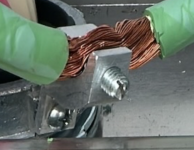
I never thought about this before. If something is OPTIONAL (in this case a Bonding Bushing where one is not required), but is installed anyway, does it need to adhere to the NEC? In this case, the conductor in the bushing is finely stranded and too large for the fitting. In all the years I've been here, I don't remember this being discussed. I apologize if it has and I don't remember it.
1774437665393.png

Thanks,

Mark
 
If something is OPTIONAL (in this case a Bonding Bushing where one is not required), but is installed anyway, does it need to adhere to the NEC?
IMO I would say yes. For example if you install an EGC in a metal raceway it still has to be sized correctly even though it is not required when the metal raceway can serve as the EGC.
 
IMO I would say yes. For example if you install an EGC in a metal raceway it still has to be sized correctly even though it is not required when the metal raceway can serve as the EGC.
That would have been my read. I guess it is all up to the AHJ, but I'm wondering if a red-tag would stand on this. Surprised it hasn't been raised before, or has it?

Thanks for the thought.

Mark
 
Even if the code doesn't require something doesn't mean it can be installed however you want. The installation still has to be code compliant. The NEC doesn't require receptacles for store registers, for example, so that doesn't mean you can cut a the ends off an extension cord and feed a taped up receptacle with no box with it. For your example, the lug has a listing and a max size conductor, and you have to follow the manufacturer's listing and labeling.

Looking at the angle of that lug on that bonding bushing, it looks like someone stripped out the screw hole too. Diecast bonding bushing are all junk these days.
 
That would have been my read. I guess it is all up to the AHJ, but I'm wondering if a red-tag would stand on this.
The NEC is a minimum standard. If an installation exceeds the minimum code requirement it is still required to be code compliant.
 
For example if you install an EGC in a metal raceway it still has to be sized correctly even though it is not required when the metal raceway can serve as the EGC.
What specific section of the NEC would this violate?

As for the picture in the OP, it violates 110.14, 110.14(A) (the conductor appears damaged) and presumably 110.3(B) (using the lug for a wire size for which is it not listed). There's no language in any of those sections that limits applicability to required components.

Cheers, Wayne
 
If something is OPTIONAL (in this case a Bonding Bushing where one is not required), but is installed anyway, does it need to adhere to the NEC?
IMO, if the installation is electrical in nature it needs to conform to electrical standards.
However if the install is not electrical than the NEC would not apply.
 
I should have been a little more specific. In your example where the raceway qualifies as the required EGC, what section would be violated if I install a green wire in the raceway that does not count as an EGC because of 250.122 (it's too small), so I simply don't call it an EGC. It's my optional bonus bonding conductor, just not an EGC.

Cheers, Wayne
 
I should have been a little more specific. In your example where the raceway qualifies as the required EGC, what section would be violated if I install a green wire in the raceway that does not count as an EGC because of 250.122 (it's too small), so I simply don't call it an EGC. It's my optional bonus bonding conductor, just not an EGC.

Cheers, Wayne
I agree that this should be allowed but as it stands there is no wording that would allow you to call the green undersized conductor in the raceway something else when it's actually installed as an EGC.
 
I should have been a little more specific. In your example where the raceway qualifies as the required EGC, what section would be violated if I install a green wire in the raceway that does not count as an EGC because of 250.122 (it's too small), so I simply don't call it an EGC. It's my optional bonus bonding conductor, just not an EGC.

Cheers, Wayne
Would you pull out the egc if it would make the conduit fill legal? Letting the emt be the ground?
 
I said "when it's actually installed as an EGC" are you saying that you can make up your own rules? We all know that EGC's must comply with 250.122.
What does "when it's actually installed as an EGC" mean? Why can't I install an optional conductor that complies with all the EGC rules except 250.122, and simply not call it an EGC?

Cheers, Wayne
 
What does "when it's actually installed as an EGC" mean? Why can't I install an optional conductor that complies with all the EGC rules except 250.122, and simply not call it an EGC?

Cheers, Wayne
For example it's connected to the EGC bus on one end and connected to the equipment on the other end. It is therefore "installed as an EGC" even though there may be a metal raceway that is also a qualifying EGC. If it's installed as an EGC you cannot just call it something else to fit a narrative. I chose those words carefully before someone would argue that you can disconnect it on one end and call it a spare conductor.
 
If it's installed as an EGC you cannot just call it something else to fit a narrative.
I believe I can.

250.122 tells us what size is required to be an EGC, so if it doesn't meet that size, it's not good enough to be an EGC. Just like there are limits on flexible conduit types to be an EGC, if the install doesn't meet those limits then the flexible conduit doesn't qualify as an EGC. That doesn't mean I can't install the flexible conduit, it just means I need to provide something else that qualifies as an EGC.

If you like, here's the (2023 NEC) definition of EGC:

"A conductive path(s) that is part of an effective ground-fault current path and connects normally noncurrent-carrying metal parts of equipment together and to the system grounded conductor or to the grounding electrode conductor, or both."

Note the word effective there. If the wire I install is too small, it's not effective, so it's not an EGC. Just like if the flexible conduit I install is too large of a size, or too long, it's not effective, so it's not an EGC.

Cheers, Wayne
 
Top