Does anyone make a flush mount external cluster meter main any more?

brycenesbitt

Senior Member
Location
United States
Does anyone still make a flush mount meter/main product?

We have a panel that's shot, that's flush mount, and there's really no room for a modern panel.
Working space rules won't permit a surface mount solution, and various constraints hamper moving the service.


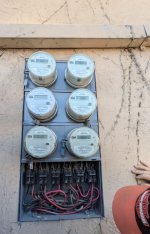
Old panel
200 amps, rule of 6, six 50 amp breakers
38 inches high, 18 inches wide, 3.5 inches deep, flush mount between studs (the meters protrude from the wall)

Standard new panel quote:
VendorPart NumberquantityDescriptionheightwidthdepthOnline Price
SiemensWB1400C1unitPowerMod 400A U/G service entrance 1-phase39.1915.2011.03inches$ 2,506.00
SiemensWMMA311253unitPowerMod 3 Stack, ring 125A/50A sockets43.3148.668.09inches$ 1,267.00
SiemensWMT112251unitEUSERC Test Bypass Facility Single40.5021.509.00inches$ 1,595.00
SiemensWSPD3N20C1unitsLow Voltage Surge Protection Through Bus29.1913.387.75inches$ 6,000.00
43.31168.9011.03
I checked Eaton's B-Line, and did not do much better.

For the old panel:
There's no problem with capacity, but there's evidence of arcing, and one of the meter rings is not original,
having apparently been welded on from another meter main of a similar (but not identical) panel. Low income property, multiple units.
 
Last edited:
Is that flush mount, or flush mounted?
Not sure what you mean.
It's an older style that's mounted between the studs, and has an integral stucco stop.

The main point is that being inset into the wall, the working space clearance is better.

Is there any modern equivalent? Is there a code path to obtaining a used / pulled unit and doing a literal like for like ?
 
The only thing I can think of is to add a panel surface mounted below it and bypass all those breakers. It won't be easy because you would probably have to splice all the line side wires into a larger wire to feed the new panel. You can't just add breakers as that is not compliant anymore.
 
The only thing I can think of is to add a panel surface mounted below it and bypass all those breakers. It won't be easy because you would probably have to splice all the line side wires into a larger wire to feed the new panel. You can't just add breakers as that is not compliant anymore.
New utility regulations make that impossible.
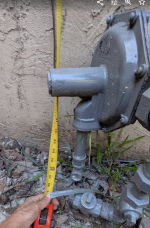
The old panel is above the gas regulator, but there was a little "snorkel" to move the regulator to 3 feet from the panel edge.

1774635400106.png

While there are no reported cases of a problem with this old setup anywhere in the service territory, after an unrelated explosion
where gas saturated the soil then found ignition, the local utility added separation requirements even for above ground gas.
 
I have never seen a multi meter panel that small.

You used to be able to get standard 2-6 meter stacks with flush mount rails. Since none of them meet current NEC requirements they are no longer and option.

As far as I know Siemens is the only manufacture that makes NEC compliant meter stacks now with out adding a service disconnect before the stack. The Siemens units are much larger and defiantly not flush mount.

If the current service in directly over the gas meters I'm surprised that city will allow you to install a new service over the gas meter. Not because of the PG&E gas requirements but it would not meet the NEC working space requirements.

I assume you are joking with the equipment quote you posted. You must have just looked up the over inflated online MSRP pricing. Any supplier quoting those prices really does not like you.
 
If the current service in directly over the gas meters I'm surprised that city will allow you to install a new service over the gas meter. Not because of the PG&E gas requirements but it would not meet the NEC working space requirements.
The current service is just to the left of the gas meters.
If the service can be replaced "in kind" dimensionally everything is fine. If it has to move then
the primary constraint is the utility 10 foot, 3 foot and infinite (straight up) restriction even on unjointed conduit near the gas.

The pricing quoted is not MSRP, but roughly reflects what the local suppliers offer. The TBF units are particularly painful.
 
I can't really help with installation advice especially not seen the job in person.

I can tell you the prices you quoted are ridicules. You must not have a good relationship with the suppliers. With the amount of jobs you talk about on this forum they should have you set up a a SPA program with the vendor. Even a homeowners walking into most supply houses would get better pricing than what they are giving you.

Edited to add: The original service has 6 meters but your new service equipment has 6 standard meters sockets and 2 meter sockets with test by pass. Are you adding 2 meters and feeders to the existing service?
 
Edited to add: The original service has 6 meters but your new service equipment has 6 standard meters sockets and 2 meter sockets with test by pass. Are you adding 2 meters and feeders to the existing service?
The trigger is that the existing common meter, which runs hallway lights, has to be replaced with test bypass due to the 5 unit rule.
The second test bypass socket is for a SOMAH GOM meter (generation only meter), which requires EURSEC test bypass. The cost of
adding meter sockets for future ADU conversion is small, so when I specify I'll add extra sockets to make the layout look neater, and plan for the future. The prices are not final prices from an actual bid.

The challenge in retrofits is fitting even a 1:1 safety replacement into all the new rules that appeared since the original equipment was permitted.
 
Top