314.28 (A) (2)

Rbarkema1

New User
Location
Des Moines Iowa
Occupation
Electrician
One of my coworkers asked me a question about junction box sizing for angle pull he said if I have 2 - 4inch EMT and 2 - 3inch EMT and those contain larger than 4awg conductors so they would certainly count for the box size calculation but if add 2 - 1inch EMT to the box that will not contain 4awg or larger conductors would I need to count them in my calculation. The 2026 code reads this distance shall be increased for additional entries by the amount of the sum of the diameters of all other raceway entries in the same row on the same wall of the box. looks like it says all other to me so I would count them I would like to hear your interpretation of this code article.
 
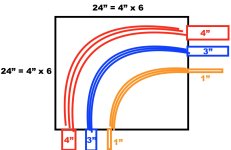
depending upon your directional layout, i believe the code is referring to more conduits that need to meet the 6x pull box size on angled pulls. if there were more 4" pipes on one side, you would need more room on the other, and would be required to go up to a 30" box. the way i read things, your largest requirement is the 4", which would require the minimum 24" (4" x 6) pull size. if you place these correctly, you will have the 24" pull distance and minimum sizing required. next, you can simply fill in the 3" conduit as even if you have a 1" gap on each side of the 4", you're still left with the required 18" (3" x 6) of bending space. lastly, the 1" doesn't even really apply to this section, as it doesn't have 4awg conductors or larger. so fill in where you like. i've thrown together a quick picture showing the way i'm reading things. but i could be wrong. nisser will let you know. pull box.jpeg
 
if add 2 - 1inch EMT to the box that will not contain 4awg or larger conductors would I need to count them in my calculation.
IMO no but this is one of the most poorly written and confusing sections in the NEC, so maybe yes. The 1" raceway would have no bearing on the other two raceways so I'm voting no but I've been wrong before. :rolleyes:
 
My PI to add "with respect to such cables or raceways" to the first sentence of 314.28(A).


Cheers, Wayne
 
depending upon your directional layout, i believe the code is referring to more conduits that need to meet the 6x pull box size on angled pulls. if there were more 4" pipes on one side, you would need more room on the other, and would be required to go up to a 30" box. the way i read things, your largest requirement is the 4", which would require the minimum 24" (4" x 6) pull size. if you place these correctly, you will have the 24" pull distance and minimum sizing required. next, you can simply fill in the 3" conduit as even if you have a 1" gap on each side of the 4", you're still left with the required 18" (3" x 6) of bending space. lastly, the 1" doesn't even really apply to this section, as it doesn't have 4awg conductors or larger. so fill in where you like. i've thrown together a quick picture showing the way i'm reading things. but i could be wrong. nisser will let you know. View attachment 2582560
Doesn't this require 27" of distance since you need to add the 3" conduit and another inch if the 1" conduit had #4 or larger conductors? Don't see anything in 314.28 that says only look at the largest conduits even though the layout above seems perfectly fine.
 
Doesn't this require 27" of distance since you need to add the 3" conduit and another inch if the 1" conduit had #4 or larger conductors? Don't see anything in 314.28 that says only look at the largest conduits even though the layout above seems perfectly fine.
what you say is possible, but i don't read it that way. by the way i'm reading 314.28, i'd say my diagram makes things work. take a look at the code and show me where the diagram that i made up, fails to meet the wire bending space required in 314.28(A)(2). i could be wrong.

the way i see things, the 4" conduit has 24" worth of bending space when placed in the corners, as shown. the 3" has 18" worth of bending space, when placed as shown ... and as mentioned with no more than 1" gap inside and outside of the 4" (roughly calculated, this would be 24 - 4 - 1 - 1 = 18). and the 1" doesn't even apply, because it doesn't have #4awg or larger conductors.

do you read something i do not? i'm always open to learning.
 
what you say is possible, but i don't read it that way. by the way i'm reading 314.28, i'd say my diagram makes things work. take a look at the code and show me where the diagram that i made up, fails to meet the wire bending space required in 314.28(A)(2). i could be wrong.
314.28(A)(2) is giving you the minimum distance between, say, the bottom and the top of your drawing, on a row by row basis for the entries in the bottom. Assuming those 3 entries are in one row, and each contains #4 or larger conductors, then it tells you take the largest entry, 4", multiply that by 6 to get 24", and add the other entries in the row, to get 24 + 3 + 1 = 28".

Of course, the text doesn't define what a row is, so that's ambiguous.

Cheers, Wayne
 
Top