100 plus pound light

Status
Not open for further replies.
Brady Electric said:
I'm sure Larry meant with his tool belt on, I hope. If so that is me also. I'm 6'2" and weigh 267 and my tool belt weight about 60 lbs. Semper Fi.

60 lbs is almost half my body weight, hence my forum name....:grin:
 
stickboy1375 said:
I weigh in at 130lbs with my boots on...:grin:

Eat? Would you please eat?

Now, for the OP's question.

First, as others have pointed out, a 2x6 will carry a lot more than 300# (or 400# or even #1,000 ...) depending on the span. What it won't much tolerate is having that 300# put into it in a stupid manner, or if you've got a forever long span.

Short answer -- get an engineer to tell you how to do it.
 
JohnConnolly said:
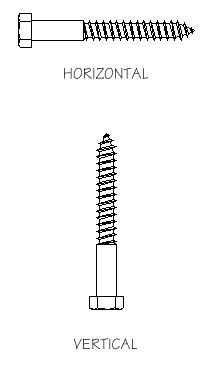
I would avoid VERITCAL lags. A horizontal fastener is stronger.
i agree if you drill a lag or even a through bolt through the joist you just made a weak spot. on a 100# fixture it probably wouldnt make much difference,but on a 400# one it just might. btw ive walked through 2x6s that were knoted up before.
 
Tony Ottenlips said:
What would a horizontal fastener be?
For example...

HVfasteners.gif
 
100 Plus pound light

100 Plus pound light

tallgirl said:
Eat? Would you please eat?

Now, for the OP's question.

First, as others have pointed out, a 2x6 will carry a lot more than 300# (or 400# or even #1,000 ...) depending on the span. What it won't much tolerate is having that 300# put into it in a stupid manner, or if you've got a forever long span.

Short answer -- get an engineer to tell you how to do it.

Julie good to see you are back. I think I can say you were missed, why because you are the only woman or is it because of your whit or cleaver answers? I will probably regret putting my other two cents in but here it goes. I would cut a piece of thick strut and fasten it across two ceiling joist and hang the fixture with two five eights threaded rods holding a ceiling fan metal box with the bolts going all the way through the box and supporting the fixture bar. I have hung only two or three of these kinds of fixtures in my thirty five years of business. One was a chandler over a glass table. Most of these kinds of fixtures come with a guy wire attached to the fixture by the manufacturer which I would attach to the strut for safety. We need to remember that the fixture doesn't move like a fan so its dead weight and will stay hanging safe forever. Calling an engineer could get expensive but I suppose most HO that could afford this type of fixture wouldn't mind paying for some more advice. Hope everyone can understand what I said and not read anything in it that's not there. Good to have you back. Semper Fi. Buddy
 
To each their own and there can always be odd conditions but I would not be calling an engineer for a directions on how to hang a 400 lb item unless the existing structure was weak.

I regularly hang transformers ranging from 100 to 900 lbs., I have hung 1,600 lb transformers as well although those did have details on the plan on how to do it.

I do agree with the others that I would not count on the pull out strength of a threaded fastener in wood. I prefer to use those fasteners in sheer not tensile.
 
as an inspector if a contractor was hanging a 400 pound light I would require a engineer to certify the structure & a mounting detail.
 
mpd said:
as an inspector if a contractor was hanging a 400 pound light I would require a engineer to certify the structure & a mounting detail.

And as an EC I would ask you under what section could you ask me for that?

Pass or fail with a section number....no third option.:cool:
 
iwire

thats easy i only need one option, I can require that info at the owners expense under our administrative code, and I would also pass it on to the building inspector who would also require it if I did not.
 
iwire said:
...but I would not be calling an engineer for a directions on how to hang a 400 lb item unless the existing structure was weak.
I partially agree...

In wood framing construction, ceilings and floors make some design assumptions based on the type of lumber used and the span. In these assumptions are two types of loads considered: live loads and dead loads. There are two other types—snow and wind loads—but they are not considered for interior framing. The dead load is the weight of the building materials alone. The live load is the additional weights due to occupancy, i.e. people, furnishings, and stored materials. Span tables have been developed for this very purpose.

Since we know there is a room above where this fixture will be supported, necessitating that the framing members be rated as floor joists, the information I have at hand says such a floor is typically designed for 40 psf live load and 10 psf dead load. However, if the space above is a sleeping room or attic, the live load rating can be decreased to 30 psf.

At this point, we must discuss what I believe to be a common misconception: interpretation of the load ratings especially that of the live load. Using the example of 40 psf, this does not mean you cannot exceed 40# of "live" weight on any one square foot of floor space. The live and dead load ratings have more to do with weight distribution and the structural members needed to support the floor or what have you. Say you have a 10' x 10' room with load bearing walls under it and around the perimeter. With a total live/dead loading of 50 psf on 100 sq ft of floor space and 40' of load bearing wall, the wall must be capable of supporting it's own weight plus 50 psf x 100 sq ft ? 40 ft... and that is an additional 125# per ft of wall and the floor is capable of supporting 4,000# of fairly distributed live weight. This is the basic concept of load design.

Getting back to floor design, if we have a 15' x 20' room and the joists are spaced 16 oc across the short dimension, each joist is capable of supporting a total weight of 15' x 1⅓' x 50 psf = 1,000#, which would be 800# live weight and 200# dead weight. Adding a 100# fixture to this one joist is not something that can be compensated for by conservative dead weight assumptions. However, if we support the fixture by distributing the weight to two joists (and this means supporting it dead center in the cavity if the supporting member can flex at either end, or structurally tying the two joists together), that would be 50# per joist. I would again say this is not an amount which would be covered by conservative dead weight assumptions. We would therefore have to go to three or four joists, or determine if as-built limits permit heavier loading (which is where a knowledgeable person comes into play)... or we can cheat and lower the live load rating for the joists involved :grin:

 
mpd said:
iwire

thats easy i only need one option, I can require that info at the owners expense under our administrative code, and I would also pass it on to the building inspector who would also require it if I did not.

OK you have a code you can cite.

What State are you in?

What is the weight limit of a fixture before engineering becomes necessary?
 
iwire

I would find it hard to believe any inspection office, would allow a 400 pound fixture to be installed without an engineer to certify the existing structure and a mounting detail,

another example is solar panels installed on a roof, are building inspectors require an engineer certification for the new roof load & a mounting detail,
 
This is great info. for those who know most inspectors don't check everything that can become a liability-insurance issue down the road. While inspectors can object to anything under NEC 80.13 and 90.4, and perhaps get their building dpt. engineer to support a shut down, this can also generate a trail of complaints and lost appeals. Unless the EC is found negligent in other areas, without liability insurance, etc..

I like the galvanized strut idea, since any length can be laid across several joists to distribute the weight. Square strut would be strongest. I believe threading bolts to strut vertically would avoid the weaker sheer strength of horizontal lags, or any lag-threaded penetration into wood structures.
 
Status
Not open for further replies.
Top