250.53(G) Violation?

Status
Not open for further replies.

SiddMartin

Senior Member
Location
PA
If you drive a 10' G-rod to ground the main disconnect outside in macadam, and leave 4" above ground w/ the wire & acorn, does it violate 250.53(G)? The area surrounding the Equip. and g-rod has bollards protecting from vehic. damage, does this protection satisfy 250.10(1)?
 
Code wise that is left up to the inspector to determine if it's protected.

From a personal standpoint I sure would hate to be responsible for someone getting impaled by a ground rod.


They trip, they fall, they land on the rod.
 
See, I thought that code required burying them for that exact reason, but then I see the 250.10 ref, and its about protecting the g-rod and not anything else. I brought this up to a co-worker who did not bury and thats what started this. I agree to bury.
 
FWIW, I do this semi-regularly, but I don't leave that much stick up. Maybe 1". If it's in an area where someone might trip on it, i just gouge out a little bit of blacktop and bang it in flush.
 
You could dig a hole around the ground rod, and install a small sprinkler valve access box. They make nice small round ones, in black or green. (Black is good in an area surrounded by asphalt.) Pound the rod below grade, install box, add some gravel. Ground rod is protected, accessable, and people are safe. Everyone's happy.
 
Usually one of the rods is rights below the main panel in most of my installs - with the rod right up against a wall. Often it is not a concern for physical damage or a tripping hazard in this way because the area is not often exposed to vehicular traffic etc.

The other rod - I usually put somewhere along the path to the water line and it too against a wall or footing. And it all gets one #4 or larger conductor point to point.

For the most part I don't get too much trouble from inspectors unless the conductor is outside - at which point local code would want it in conduit to deter copper theft.
 
LawnGuyLandSparky said:
You could dig a hole around the ground rod, and install a small sprinkler valve access box. They make nice small round ones, in black or green. (Black is good in an area surrounded by asphalt.) Pound the rod below grade, install box, add some gravel. Ground rod is protected, accessable, and people are safe. Everyone's happy.

the connector is rated to be buried. I dont' need it accessible.

i like the 1" idea
 
Our inspectors are mainly concerned about seeing the continuous connection of the #4 bare to the ground rods via the acorns.

One cities inspectors want them even with the ground. Another city wants them above. We usually paint the ends orange or flag the ends to locate them.

Problem is, if they are not driven far enough into the ground, the grading contractor usually tears them out while doing his final grade. Then we are looking at a repair.
 
BackInTheHabit said:
Our inspectors are mainly concerned about seeing the continuous connection of the #4 bare to the ground rods via the acorns.

Then they are concerned with too much.

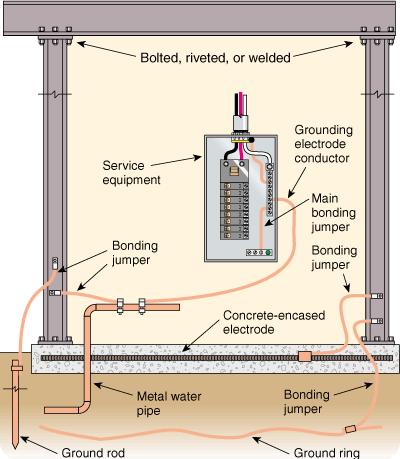
The NEC only requires the GEC to be continuous from the panel to the first grounding electrode, it does not have to be continuous to the next electrode.

Bonding_Jumpers.JPG
 
Last edited:
BackInTheHabit said:
Our inspectors are mainly concerned about seeing the continuous connection of the #4 bare to the ground rods via the acorns.

One cities inspectors want them even with the ground. Another city wants them above. We usually paint the ends orange or flag the ends to locate them.

Problem is, if they are not driven far enough into the ground, the grading contractor usually tears them out while doing his final grade. Then we are looking at a repair.


Since you said "grading contractor" I'm assuming that you mean new buildings. Why are you using ground rods in the first place?
 
infinity said:
Since you said "grading contractor" I'm assuming that you mean new buildings. Why are you using ground rods in the first place?

We are required to use two (2) 8' ground rods 8' apart on a 200 amp service. Whether this is new construction or a service upgrade.

And yes. It is new construction as I was originally referring to.

Grading contractors do work other than new construction.

I'm not the grading contractor but the electrical contractor.
 
iwire said:
Then they are concerned with too much.

The NEC only requires the GEC to be continuous from the panel to the first grounding electrode, it does not have to be continuous to the next electrode.


Your illustration shows a commercial application with metal framing I-beams.

My experience is mainly with residential. The ground rod (GEC) are attached with #4 bare, through 1/2" pvc to the meter base lug screw on the neutral side. The GEC to the water main is taken from the panel. Most, if not all, new homes now use CPVC so we are not required to bond the panel to the plumbing.

See attachment. Any questions feel free.
 
BackInTheHabit said:
Your illustration shows a commercial application with metal framing I-beams.

Residential or commercial the NEC requirements are the same.

The GEC is only the conductor from the panel or meter to the first electrode.

The conductor from that first electrode to the next is a bonding jumper and is not required to be continuous.

Do what you gotta do to pass if you want but your going beyond NEC requirements.
 
chevyx92 said:
Remember the NEC is only a minimum. Anything more is not breaking a standard.

True, but the issue at hand is the inspector making up his own rules or not understanding what is required by the NEC.

Now if "it's a local amendment" comes into the conversation that would be a different story but, this is in the NEC forum.

Roger
 
chevyx92 said:
Remember the NEC is only a minimum. Anything more is not breaking a standard.

Of course, but there is a big difference between going beyond the NEC by choice and going beyond the NEC because an inspector likes it better.
 
GEC not continuous?

GEC not continuous?

So your saying I can run the GEC to the first rod and termintate, and then loop between rods with another piece of 4?
It is a mechanical bond after all, what's the diff. how many acorns ya use.
 
POWER_PIG said:
So your saying I can run the GEC to the first rod and termintate, and then loop between rods with another piece of 4?
It is a mechanical bond after all, what's the diff. how many acorns ya use.

The number of clamps would be whatever is necessary, using only two connectors would be the only reason I would use a continuos conductor, it is not required by code.

BTW, # 6 CU would be code compliant for the rods.

Roger
 
oops

oops

I re-read the previous posts and saw the answer I was searching for was clear.
I wish all inspectors would just enforce the NEC, nuttin' but the NEC. They could actually become mentors instead of babbling intellects.
IMO...just sayin'
 
Status
Not open for further replies.
Top