300.4. Protection against physical damage.

Location
Modesto, Ca
Occupation
Retired Building Inspector
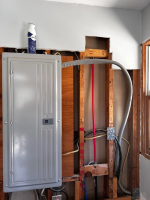
Hi everyone. I was on another thread that was closed for comment. It was a post that a guy said that his inspector wanted the back side of a plastic box protected. I would like to hear from folks regarding this and their opinions on the required protection. CEC 300.4 and NEC 300.4. (NFPA 70). When you look at the code requirements, it is clear as day that protection is required when the conductor is within 1 1/4" from framing member's edge. This is a direct violation of the codes if the wire is closer than the 1 1/4" when it enters the back of the box. The code gives you the requirements that "Shall" be required and the "Exemptions". The plastic box is not an exemption, and does not protect the wiring inside, that is very close. Thus, protection must be provided to a plastic box and wiring inside closer then 1 1/4" to framing member's edge. Call it what is, it just got missed or ignored. There are actually two directions of space that is required at 1 1/4". The plastic box does not meet the required exemptions no matter of all our opinions. It has been missed and never called and should and will be in the future. The verbiage requires it, but you may not find it in any handbook for depictions. I have talked to many code professionals here in California who have stated it is required. What I find on here is that everyone has their own opinions, which is great and needed, but fail too accurately understand this section. My homes I build get this protection now. There is a product made to address this section, and they are from, Metal Products Company in Springfield Oregon, that I use and order this product from. It's called the EBT 1, and it's a patented part just for this location. It works great and is so easy. It's on their website. for some unknown reason people fail to see this requirement or don't want to. Thanks everyone.
 
IMHO the protection is not needed and is ridiculous. What's next armor plate all the walls ceilings and floor? Might as well outlaw cable and run everything in steel pipe. Will protection be required when fishing wires in an already constructed building? Even PVC pipe will not stop a nail or screw. And then we will have to protect all the PEX, ABS and PVC plumbing. The requirements are to protect the wiring where it passes through or run along on the face of a stud. The wiring is hidden and cannot be seen but the box can be seen and needs no additional protection.

Part of this is also due to the box fill requirements in the code (which changed some years ago) which make most metal devise boxes unusable
 
Codes are codes, and if we do not like them then get them removed. But enforcing the codes that are on the books is what is required, not our opinions. The codes are written for a reason. As an inspector, there were many things I thought were ridiculous, but I followed the code that was on the books. I may have not liked them, the contractor may not like them, the super did not like them, but the code is the code. I did not write them, and I am finding that many folks selectively enforce, on opinions. And that is the problem. I appreciate your time and honest opinion. As an electrician do you pick and choose and adhere to codes that you think are good and you agree with ? Or do you do the best to apply all the required codes to your work ? Appreciate your time
 
I also heard and looked up that the next NEC code cycle "may" be requiring and it's for bored wires through studs and they may require protection at the face of stud and out a 1 1/4" from each side of the stud, where the wire is located through the stud. The code verbiage now requires protection in two directions. Why some codes are written are beyond me. Thanks guys !!
 
the requirement to protect from physical damage is understood to be under normal circumstances.

what is the environment that this plastic box is installed in? a mine pit, where dynamite is used on regular basis? if it's used in a home, and the inspector is thinking that drywall is somehow going to protect it, i'd like to hear what damage he thinks he's protecting it from, and also some testing from said "damage" to the drywall vs. the plastic box. a.k.a. - a hammer hitting drywall vs. the plastic box.
 
You’re mixing it up an inch and a quarter is when it’s run parallel to a stud bay as soon as you whip it in and go into a box of snow on parallel, so I would say that small section it’s no longer parallel with the stud base like a 45° whatever it takes to get in the box either way, no state inspector think that’s right well depends on what state at least mine does not

And as far as picking, what codes are I wanna follow , this dumb book so vague at least things open ended I go whatever Favors me as long as I can justify it. It’s no different than two lawyers interpretation just cause it’s on paper doesn’t mean it’s 100% agreeable
 
If you want to clean up some sloppy house ropers act I do have sympathies with that, as there are low bidders underbidding guys that do good work. But I don't think thats the section to look at.
Some years back the inspectors put their heads together (after a IAEI meeting or something) and started enforcing a few never before enforced sections on ropers, like 312.5(C), 314.20, 314.21 and 314.23(A)(1) and there were a one or two others around exposed NM and SER and box fill, I cant recall.
 
Hi everyone. I was on another thread that was closed for comment. It was a post that a guy said that his inspector wanted the back side of a plastic box protected. I would like to hear from folks regarding this and their opinions on the required protection. CEC 300.4 and NEC 300.4. (NFPA 70). When you look at the code requirements, it is clear as day that protection is required when the conductor is within 1 1/4" from framing member's edge. This is a direct violation of the codes if the wire is closer than the 1 1/4" when it enters the back of the box. The code gives you the requirements that "Shall" be required and the "Exemptions". The plastic box is not an exemption, and does not protect the wiring inside, that is very close. Thus, protection must be provided to a plastic box and wiring inside closer then 1 1/4" to framing member's edge. Call it what is, it just got missed or ignored. There are actually two directions of space that is required at 1 1/4". The plastic box does not meet the required exemptions no matter of all our opinions. It has been missed and never called and should and will be in the future. The verbiage requires it, but you may not find it in any handbook for depictions. I have talked to many code professionals here in California who have stated it is required. What I find on here is that everyone has their own opinions, which is great and needed, but fail too accurately understand this section. My homes I build get this protection now. There is a product made to address this section, and they are from, Metal Products Company in Springfield Oregon, that I use and order this product from. It's called the EBT 1, and it's a patented part just for this location. It works great and is so easy. It's on their website. for some unknown reason people fail to see this requirement or don't want to. Thanks everyone.
Would be interesting to see how many of these EBT 1 products are sold.

In almost 30 years I’ve never knowingly had an issue with damaged wiring in the space where it enters a plastic box.

Never knew a product like this existed.

Just curious.
Are you an electrical inspector?
 
The plastic box is not an exemption, and does not protect the wiring inside, that is very close. Thus, protection must be provided to a plastic box and wiring inside closer then 1 1/4" to framing member's edge.
Guess that's why I unwittingly only use metal boxes.
Part of this is also due to the box fill requirements in the code (which changed some years ago) which make most metal devise boxes unusable
Guess that's why I don't use 2x3 device boxes unless I can gang them. 1900 with mud rings. (y)

-Hal
 
Would be interesting to see how many of these EBT 1 products are sold.

In almost 30 years I’ve never knowingly had an issue with damaged wiring in the space where it enters a plastic box.

Never knew a product like this existed.

Just curious.
Are you an electrical inspector?
Retired now thank God....Worked for a city and was a combo. And there were always the code updates, changes and interpretations and opinions. There were many times I made code calls and people did not like it, but I always backed myself up with code. I learned especially with ADA and other codes is never rush into it without be absolutely sure. Many times, I would talk to my contractor and let them know that I would double check on it and get back to them. I did not rush if it was a complex issue until I got into the books. There were times that I would get back to them and let them know they were good, the "exception" allowed them. I worked with my guys to keep their projects going smoothly and helped them to understand codes and changes. That is just how I was and my other guys were also....I enjoyed helping and not thinking I knew everything, like other inspectors I heard of.... 25 years later and retired !!!!
 
Top