A Mathematical Trick:

Merry Christmas
Status
Not open for further replies.

rattus

Senior Member
The fact that the formula for the value of the RMS multiplier, 0.707, requires a knowledge of integral calculus means that most of us must accept that value on faith. There is however, another approach based on trigonometric identities.

The difficult part of the formula is the detrmination of the average value of the cosine squared or sine squared. Now consider this identity,

Cos^2(wt) = [cos(2wt) + 1]/2

By inspection we see that the average value of cos(2wt) over one period is zero. Then the average value of the cosine squared is simply ?, and the square root of that average is 1/sqrt(2) = 0.707
 
Accept that value on faith ...

Accept that value on faith ...

rattus said:
The fact that the formula for the value of the RMS multiplier, 0.707, requires a knowledge of integral calculus means that most of us must accept that value on faith. There is however, another approach based on trigonometric identities.

The difficult part of the formula is the detrmination of the average value of the cosine squared or sine squared. Now consider this identity,

Cos^2(wt) = [cos(2wt) + 1]/2

By inspection we see that the average value of cos(2wt) over one period is zero. Then the average value of the cosine squared is simply ?, and the square root of that average is 1/sqrt(2) = 0.707

Right, what was said:
In order to derive the calculation for RMS to Peak voltages, it is necessary to use a certain amount of mathematics. The essential point is that for sinusoidal power supplies, the RMS voltage is 1/2 of the Peak value. "Kingpin"

*Understanding Alternating Current*
By Kingpin
http://www.alpharubicon.com/altenergy/understandingAC.htm
 
Last edited by a moderator:
I'm still going to have to take your word on it!

I can only count to 9 so hopefuly they never add another Chapter to the NEC...
 
rattus said:
...the value of the RMS multiplier, 0.707...
Is there any significance to the fact that this value falls at 1/8 revolution and every other 1/8 revolution thereafter in the generation cycle?

rms4.gif
 
Smart $ said:
Is there any significance to the fact that this value falls at 1/8 revolution and every other 1/8 revolution thereafter in the generation cycle?
Probably. :cool:
 
Smart $ said:
Is there any significance to the fact that this value falls at 1/8 revolution and every other 1/8 revolution thereafter in the generation cycle?

rms4.gif

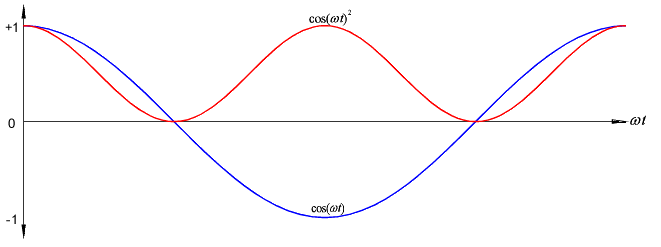
I think it is a coincidence. It would be useful though to see a plot of cos(wt) overlaid with a plot of cos^2(wt).
 
cadpoint said:
Right, what was said:
In order to derive the calculation for RMS to Peak voltages, it is necessary to use a certain amount of mathematics. The essential point is that for sinusoidal power supplies, the RMS voltage is 1/2 of the Peak value. "Kingpin"

*Understanding Alternating Current*
By Kingpin
http://www.alpharubicon.com/altenergy/understandingAC.htm
That is not what I learned. Are you trying to confuse my weak mind?
I always thought that 170V peak / .707 = 120V RMS?
 
Ela

Ela

ELA said:
That is not what I learned. Are you trying to confuse my weak mind?

I always taught that 170V peak / .707 = 120V RMS?
proofing one side of your equation, your math = 240.45

Still seems the same to me, theres no weak mind.. maybe misplaced units

Try

View attachment 644

VRMS = 0.7 ? Vpeak and for Vpeak = 1.4 ? VRMS
"120 VAC" refers to the RMS voltage of the cosine waveform delivered to your doorstep.


http://www.ee.unb.ca/tervo/ee2791/vrms.htm

R.Tervo 1997
University of New Brunswick - Department of Electrical and Computer Engineering​
 
My bad.

I meant to use a "* where I put a / " and so I agree that
170V peak * .707 = 120V RMS.

I did not understand your comment " the RMS voltage is 1/2 of the Peak value. "

Did you mean to say (sqr. root of 2) / 2 ?
 
Ela, Yes

Ela, Yes

Yes a typo

Shot and I took alot of time checking and double check'n ... Doh :rolleyes:
 
rattus said:
rms4.gif


I think it is a coincidence. It would be useful though to see a plot of cos(wt) overlaid with a plot of cos^2(wt).

I've never seen this before. It's intriguing. I'm gonna disagree with you Rattus. There aren't too many mathmatical coincidences and if this image is accurate then the relationship between peak and RMS is RMS is half the angular distance from 0 to peak. Hardly sounds like a coincidence. Seems rather natural actually.
 
Interesting but:

Interesting but:

Physis 3 said:
I've never seen this before. It's intriguing. I'm gonna disagree with you Rattus. There aren't too many mathmatical coincidences and if this image is accurate then the relationship between peak and RMS is RMS is half the angular distance from 0 to peak. Hardly sounds like a coincidence. Seems rather natural actually.

Sam, your assignment is to find some significance here, but that is not the point. The point of this thread is that you can compute the RMS multiplier without the use of calculus. Trig, difficult as it is, is far less difficult than calculus.
 
If that's the question then why not use a waveform other than a sine wave, like a square wave :grin: kidding, I mean a sawtooth with given amplitude and duration?
 
Because, that's why:

Because, that's why:

Physis 3 said:
If that's the question then why not use a waveform other than a sine wave, like a square wave :grin: kidding, I mean a sawtooth with given amplitude and duration?

Because this little trick only works with sinusoids, and that is what the electric power industry is all about.

It is true though that effective values can be computed for any periodic current or voltage waveform, but such values would have limited use.
 
rattus said:
I think it is a coincidence.
I don't think it is "merely" coincidental... but have nothing to offer as irrefutable proof.

But there is no irrefutable proof on using integration to determine the corresponding DC value either. In both cases it simply has proven to work. I'm sure early experimenters tried using the arithmetic mean and found it didn't work and thus reverse engineered it :wink:. Using integration is nothing more than another method of manipulating the numbers so the result works. The premise as to why it works in no more self evident than the premise of comparative rotation angles.

It would be useful though to see a plot of cos(wt) overlaid with a plot of cos^2(wt).

rms5.gif
 
Last edited:
Nice Plot, But:

Nice Plot, But:

Smart $ said:
I don't think it is "merely" coincidental... but have nothing to offer as irrefutable proof.

But there is no irrefutable proof on using integration to determine the corresponding DC value either. In both cases it simply has proven to work I'm sure early experimenters tried using the arithmetic mean and found it didn't work and thus reverse engineered it :wink:. Using integration is nothing more than another method of manipulating the numbers so the result works. The premise as to why it works in no more self evident than the premise of comparative rotation angles.


rms5.gif

Smart, thanks for the plot. It fits perfectly with [cos(2wt) + 1]/2. Until I started this thread, I thought cos^2 was not sinusoidal; well it isn't exactly. Live and learn.

I will counter your argument about the formula by saying that the formula is logically and precisely derived in any decent text on AC circuits. The definite integral is a tool for finding the exact area under a curve. Divide this area by the interval to find the average height of the curve. Nuf sed.
 
rattus said:
Smart, thanks for the plot. It fits perfectly with [cos(2wt) + 1]/2. Until I started this thread, I thought cos^2 was not sinusoidal; well it isn't exactly. Live and learn.
The waveform of cos^2 is perfectly sinusoidal... it just has a DC offset :grin:

I will counter your argument about the formula by saying that the formula is logically and precisely derived in any decent text on AC circuits.
I didn't mean to imply it isn't an accurate method. I'm just saying the premise to use this method is not plainly evident.
 
Smart $ said:
The waveform of cos^2 is perfectly sinusoidal... it just has a DC offset :grin:
and as twice the frequency ...

The 1/8 circle comments ... sin (45) = cos (45) = (sqrt(2))/2 = approx 0.707.

45 degrees is 1/8 of a circle.
 
Calculus Again:

Calculus Again:

Smart $ said:
I didn't mean to imply it isn't an accurate method. I'm just saying the premise to use this method is not plainly evident.

It is not evident unless you know a bit of calculus, and if you don't, that doesn't make you a bad person. It should be evident however that the average value of the cosine squared is of interest to us. It should also be evident that the average value of [cos(2wt) + 1]/2 = 1/2, therefore calculus is not required.
 
Status
Not open for further replies.
Top