

AC Disconnect as a Combiner

hitehm

Senior Member
Location
Las Vegas NV
All - Please see the attached pic of the AC disconnect on this 3-line. This is for a 208/120 3P job we have pending. For reference, this is an Enphase system with two separate rooftop systems, each with it's own load center combiner panel. One has a combined output of approx 90A, the other approx 100A. The circuit designer took the outputs of the two AC combiners and combined them together on the input terminals of the 400A non-fused AC disconnect (circled in red). I personally have never seen this done and also couldn't find an AC disconnect with multi-wire terminals. They suggested we could use 3-port Polaris or similar splices to combine the 2 outputs into a pigtail to attach to the disconnect. This brings up several questions:

1) Are there any code violations or code language that addresses this? Since both the line and load side of the AC disco have OC protection, I don't see an issue there. As for ampacity, all of the wiring meets the ampacity requirements so I don't see any issue there either, including making sure the combined pigtail wire on the Polaris is sized to carry the combined current into the AC disconnect.

2) Has anyone done this before and if so, what listed hardware did you use to make the combined connection into the disconnect?

I know this probably seems simple but normally, if we needed multiple solar systems combined into a single source output, the plans would typically land each system's AC output onto individual breakers in an MLO load center that feeds the AC disco and onto the point of interconnection.
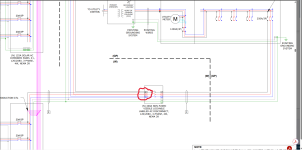

AC combined on disconnect.png
 
for piping, length, and placement requirements, you just need to make sure to abide by feeder tap rules in art 240.21(B).

as for sizing and all of those code references, you'd need to look under 430 (motors) for multiple motor feeders, or 440 (hvac/ref) for multiple loads.

keeping all of the wiring after that disconnect outside would certainly help.
 
...

1) Are there any code violations or code language that addresses this? Since both the line and load side of the AC disco have OC protection, I don't see an issue there. As for ampacity, all of the wiring meets the ampacity requirements so I don't see any issue there either, including making sure the combined pigtail wire on the Polaris is sized to carry the combined current into the AC disconnect.

I think this would be allowed. I agree that the tap rules could apply. There is language in 705.12 which addresses taps and which may require your taps to be larger and calculated around the 250A utility breaker plus the solar sources.

2) Has anyone done this before and if so, what listed hardware did you use to make the combined connection into the disconnect?

Polaris or other listed multi-tap connectors like your designer mentioned would be fine.
 
I have seen a Single Line showing a disconnect being used as a combiner. I didn't win the project so I didn't have to worry about it, but I'm glad this came up and there are answers. I guess a Polaris could combine the two feeds into one feed as long as the combined side feeder excepts the upsized wiring, then use the disconnect as the OCPD. Hmm interesting way to avoid a full scale combiner panel and breakers.
 
All - Please see the attached pic of the AC disconnect on this 3-line. This is for a 208/120 3P job we have pending. For reference, this is an Enphase system with two separate rooftop systems, each with it's own load center combiner panel. One has a combined output of approx 90A, the other approx 100A. The circuit designer took the outputs of the two AC combiners and combined them together on the input terminals of the 400A non-fused AC disconnect (circled in red). I personally have never seen this done and also couldn't find an AC disconnect with multi-wire terminals. They suggested we could use 3-port Polaris or similar splices to combine the 2 outputs into a pigtail to attach to the disconnect. This brings up several questions:

1) Are there any code violations or code language that addresses this? Since both the line and load side of the AC disco have OC protection, I don't see an issue there. As for ampacity, all of the wiring meets the ampacity requirements so I don't see any issue there either, including making sure the combined pigtail wire on the Polaris is sized to carry the combined current into the AC disconnect.

2) Has anyone done this before and if so, what listed hardware did you use to make the combined connection into the disconnect?

I know this probably seems simple but normally, if we needed multiple solar systems combined into a single source output, the plans would typically land each system's AC output onto individual breakers in an MLO load center that feeds the AC disco and onto the point of interconnection.


View attachment 2581862
yeah I’ve seen this come up and it always feels a bit hacky even if it “works” on paper, paralleling feeders with Polaris into a single lug disco is where inspectors start getting picky, main issue isn’t just ampacity, it’s listing and termination rating, most AC discos aren’t listed for multiple conductors per phase unless explicitly marked, so landing a pigtail made from splices can raise eyebrows fast

code wise you’re getting into 110.14 for terminations and 110.3(B) for using equipment per listing, plus 705 for interconnections, nothing clearly says “no” to a splice, but it has to be in a listed enclosure, accessible, and the conductors have to be sized correctly for the combined current, your 190A-ish combined load means that pigtail and lugs better be rated accordingly

in practice, cleaner solution is exactly what you mentioned, land each system on its own breaker in a combiner or MLO panel and feed the disco with a single set of conductors, way easier to pass inspection and service later, if you must splice, use listed multi-tap connectors rated for the conductors and enclosure fill, but expect some AHJs to push back on it 👍
 
Funny you should bring this up. I'm considering doing this after having the idea brought up by one of our designers for a nightmare service case.

I've got a scenario with 2 - 208v Solaredge inverters that keep tripping breakers due to excessive heat localized inside the panelboard we're using to combine Solar inputs into one set of conductors. Solar AC output conductors, as well as the MLO panelboard to AC Disconnect are all appropriately sized, breakers replaced, thermal imaging shows the only place the whole system is hot at all are internal to the breakers. I've gone round and round with this system for literally years now. The system as designed was with 2 150a breakers (fine), and in the panelboard installed that's the largest breaker available... the SquareD Enclosure wont accept any other panelboards, so I can't swap the guts for a 400a ILine or equivalent. I've been pricing out swapping the entire enclosure/panelboard/breakers to an Iline, but it's going to be like 11k+ in just equipment, and our Non profit just cant take that kind of kick to the bottom line if we can avoid it.

So the proposed idea was to use the 2 lug input on the already existing 400a AC Disco (already has 2 discreet lugs for all 3 phases on both line/load sides), and split the OCPD for each inverter into their own single breaker enclosures and eliminate the MLO Load center entirely. Essentially I've got your problem, but working it backwards.

It's going to be ugly as hell... each AC output from the inverters will be piped directly to a single breaker enclosure, then piped into the AC Disco... and there isn't much space available. However the idea is to avoid the load center ($) entirely.

I've been trying to think of reasons I can't do this, and I'm coming up empty. I thought if it was a single lug listed for 2 conductors that it wouldn't be a good idea because variable current outputs on each conductor could end up making them behave differently under the same compression lug, but the AC Disconnect I'm using here has 2 separate terminals, so that's not an issue at all.
 
Top