Another CSST bonding query

OK Sparky 93

Senior Member
Location
Iridea14Strat
Occupation
Electrician
If we bond at the point of entrance, and it is CSST to every appliance, or a section between the POE, is CSST, no matter what, as long as everything has an EGC to it then this gas pipe, is proper? Is this the correct understanding?
 
First it depends on the brand of CSST not all manufacturers require their products to be bonded by an external bonding jumper. Here in NJ it is not even the electricians responsibility to bond CSST when it's required.

When bonding is required a section of black pipe is typically used to create a manifold and the bonding jumper is installed there. When bonding is not required the EGC run with the branch circuit can be used to bond the CSST.
 
No matter who is responsible. If there is no EGC, then would the bond to the POE still be the one and only place, or would there need to be jumper, from the fitting, or any section of black pipe between the appliance and the CSST.
 
Watch out for the appliances with no real EGC, the last building I worked on had 4 units each with a old range that was to be converted to ones with a gas cooktop /electric oven. The existing 3-wire range receptacles were putting neutral current on the CSST, ended up we had to convert the receptacles to 4-wire.
 
No matter who is responsible. If there is no EGC, then would the bond to the POE still be the one and only place, or would there need to be jumper, from the fitting, or any section of black pipe between the appliance and the CSST.
The NEC doesn't care. The requirement is in the fuel gas code. IMO, yes, you can bond to a piece of hard pipe.

Ron
 
If you have arc-resistant CSST (the black stuff), you do not need a separate bond wire, the EGC is fine. This is per both International Fuel Gas Code and NEC.

If it is the yellow stuff from a big box store, it is not arc resistant, and needs a 6AWG ground wire shorter than 75 ft per fuel gas code.

There is also no code requirement to bond at the entrance to the building without a local amendment, it can be at any point in the system. Black pipe can bridge between sections of CSST.

Finally, flexible gas appliance connectors are NOT CSST, even though they are corrugated, stainless steel, and tube shaped. They are a whole separate listing and product standard. They do not require a separate bond wire.

 
If you have arc-resistant CSST (the black stuff), you do not need a separate bond wire, the EGC is fine. This is per both International Fuel Gas Code and NEC.

If it is the yellow stuff from a big box store, it is not arc resistant, and needs a 6AWG ground wire shorter than 75 ft per fuel gas code.

There is also no code requirement to bond at the entrance to the building without a local amendment, it can be at any point in the system. Black pipe can bridge between sections of CSST.

Finally, flexible gas appliance connectors are NOT CSST, even though they are corrugated, stainless steel, and tube shaped. They are a whole separate listing and product standard. They do not require a separate bond wire.
Correct. I have seen CSST used as an appliance connector and vice versa. Not right. I dislike CSST and consider it inferior construction. It is very flimsy. I was a Master gasfitter before I retired and I wouldn't have it in my house.
 
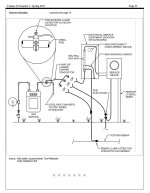
Here in NJ the Division of Consumer Affairs sent out this graphic back in 2011 when the CSST problems started to come to light.CSST Bonding.JPG
 
if the gas guy wants to install that junk, tell him to bond it together according to HIS manufacturer specs, and bring the conductor to your service for you to hook up. otherwise, rip it all out and you're compliant. :)
 
If you think about why gas piping is bonded, it's easier to figure out how to do it effectively. You can bond to the point of the rigid piping that is nearest the GEC connection.

Gas pipe is bonded to make sure that the supply end (i.e., the incoming supply from outside) is at the same potential as the appliance end, to avoid current on the CSST.

If lightning strikes near a house, voltage can be impressed on the gas piping coming into the house. The bonding acts as an equipotential bond around the CSST sections.
 
Top