Another CSST bonding query

OK Sparky 93

Senior Member
Location
Iridea14Strat
Occupation
Electrician
If we bond at the point of entrance, and it is CSST to every appliance, or a section between the POE, is CSST, no matter what, as long as everything has an EGC to it then this gas pipe, is proper? Is this the correct understanding?
 
If we bond at the point of entrance, and it is CSST to every appliance, or a section between the POE, is CSST, no matter what, as long as everything has an EGC to it then this gas pipe, is proper? Is this the correct understanding?
Yes
 
First it depends on the brand of CSST not all manufacturers require their products to be bonded by an external bonding jumper. Here in NJ it is not even the electricians responsibility to bond CSST when it's required.

When bonding is required a section of black pipe is typically used to create a manifold and the bonding jumper is installed there. When bonding is not required the EGC run with the branch circuit can be used to bond the CSST.
 
No matter who is responsible. If there is no EGC, then would the bond to the POE still be the one and only place, or would there need to be jumper, from the fitting, or any section of black pipe between the appliance and the CSST.
 
Watch out for the appliances with no real EGC, the last building I worked on had 4 units each with a old range that was to be converted to ones with a gas cooktop /electric oven. The existing 3-wire range receptacles were putting neutral current on the CSST, ended up we had to convert the receptacles to 4-wire.
 
No matter who is responsible. If there is no EGC, then would the bond to the POE still be the one and only place, or would there need to be jumper, from the fitting, or any section of black pipe between the appliance and the CSST.
The NEC doesn't care. The requirement is in the fuel gas code. IMO, yes, you can bond to a piece of hard pipe.

Ron
 
If you have arc-resistant CSST (the black stuff), you do not need a separate bond wire, the EGC is fine. This is per both International Fuel Gas Code and NEC.

If it is the yellow stuff from a big box store, it is not arc resistant, and needs a 6AWG ground wire shorter than 75 ft per fuel gas code.

There is also no code requirement to bond at the entrance to the building without a local amendment, it can be at any point in the system. Black pipe can bridge between sections of CSST.

Finally, flexible gas appliance connectors are NOT CSST, even though they are corrugated, stainless steel, and tube shaped. They are a whole separate listing and product standard. They do not require a separate bond wire.

 
If you have arc-resistant CSST (the black stuff), you do not need a separate bond wire, the EGC is fine. This is per both International Fuel Gas Code and NEC.

If it is the yellow stuff from a big box store, it is not arc resistant, and needs a 6AWG ground wire shorter than 75 ft per fuel gas code.

There is also no code requirement to bond at the entrance to the building without a local amendment, it can be at any point in the system. Black pipe can bridge between sections of CSST.

Finally, flexible gas appliance connectors are NOT CSST, even though they are corrugated, stainless steel, and tube shaped. They are a whole separate listing and product standard. They do not require a separate bond wire.
Correct. I have seen CSST used as an appliance connector and vice versa. Not right. I dislike CSST and consider it inferior construction. It is very flimsy. I was a Master gasfitter before I retired and I wouldn't have it in my house.
 
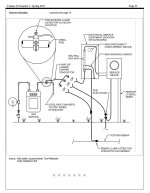
Here in NJ the Division of Consumer Affairs sent out this graphic back in 2011 when the CSST problems started to come to light.CSST Bonding.JPG
 
I'm not a big fan of CSST either, but in areas prone to earthquakes it makes total sense.
 
if the gas guy wants to install that junk, tell him to bond it together according to HIS manufacturer specs, and bring the conductor to your service for you to hook up. otherwise, rip it all out and you're compliant. :)
 
If you think about why gas piping is bonded, it's easier to figure out how to do it effectively. You can bond to the point of the rigid piping that is nearest the GEC connection.

Gas pipe is bonded to make sure that the supply end (i.e., the incoming supply from outside) is at the same potential as the appliance end, to avoid current on the CSST.

If lightning strikes near a house, voltage can be impressed on the gas piping coming into the house. The bonding acts as an equipotential bond around the CSST sections.
 
if the gas guy wants to install that junk, tell him to bond it together according to HIS manufacturer specs, and bring the conductor to your service for you to hook up. otherwise, rip it all out and you're compliant. :)
Here in MA I think were required to to the electrical part, I don't think gas fitters are allowed to run any wire at all, including running ground wires, thats what I am told anyways.
I have also been told that neither CSST nor a flexible appliance connector should be used to bond black gas pipe to the EGC (not evaluated by UL for the purpose) and the black pipe should have its own ground clamp near the gas & water meters.
I sure hope CSST does not rely on that yellow film plastic for anything, anywhere near the salty air off the Atlantic that stuff just cracks falls off in crawlspaces exposed to outside air.
 
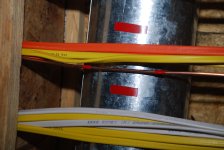
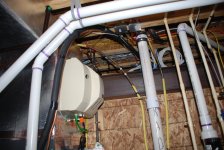
The CSST bonding required by NFPA 54 is a joke IMHO. The NEC grounding system is not lightning protection and should not be used as such. I have investigated dozens of CSST yellow jacket fires. The bonding does not prevent lightning from causing the CSST yellow jacket to arc and cause a fire. There have been cases where the bonding required by NFPA 54 has actually conducted lightning into the structure and caused the CSST yellow jacket to arc and cause a fire. CSST yellow jacket is a actually great product except if you are in an area subject to lightning. The photos below show the where the CSST "bonding" conductor arced to the metal air duct. It did this every where the conductor crossed a metal duct and up to the manifold itself. The other photo shows where the CSST arced to the bonding conductor (red tape) and the steel I-beam (white tape). You can see where the yellow jacket burned away.
 

Attachments

  • DSC_0033.JPG
    DSC_0033.JPG
    1.4 MB · Views: 8
  • DSC_0068.JPG
    DSC_0068.JPG
    1.3 MB · Views: 8
If we bond at the point of entrance, and it is CSST to every appliance, or a section between the POE, is CSST, no matter what, as long as everything has an EGC to it then this gas pipe, is proper? Is this the correct understanding?
Csst bonding where required has nothing to do with the equipment grounding conductor. The electrical code requires that gas pipe, not csst, must be bonded but the equipment grounding conductor to the appliance with the gas piping is accepted as the bond.
Csst has it's own requirements but certain styles do not require any special bonding but , I believe , it would still need some bonding as the equipment grounding conductor would provide.
I can't believe they still allow the standard csst. They make a must thicker and better product lime the counterstrike that omega flex makes. That does not require special bonding.
I also would not have it in my home
 
The origin of CSST is in Japan. They wanted something that would not break during an earthquake. Black steel pipe is too rigid for dealing with earthquakes. I do see the benefits there. Now, it is faster to install, but it also leads to some sloppiness, IMO.
 
Here in NJ it is not even the electricians responsibility to bond CSST when it's required.
Are you sure about that? I tried to look that up after chatting with friend in NJ, I think that would be odd if NJ would have plumbers doing 'electrical work' running electrical ground wires?
I tried to look that up and found this:

It seems CSST Bonding (IFGC Section 310 and IRC Section G2411) to the Electrical Subcode Official for both plan review and inspection.
If the Electrical Subcode Official is the only one authorized to inspect the bonding, it appears the work must be filed under an Electrical Subcode Technical Section (Form F120). Per N.J.A.C. 5:23-2.15(b)2ii,
then that form must be signed and sealed by a Licensed Electrical Contractor.
But its not as clear as MA so thats really interesting if so.
I would not want to be required to do plumbing that incidental to electrical I would guess pipe fitters dont want to be running #6 ground wires into panels.
 
Top