Autotransformer wiring question

11Haze29

Member
Location
Rhode Island
Occupation
Electrical Engineer
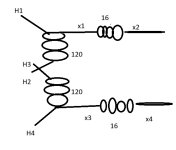
I got a 700ft run for a 100A 240 load to a marine dock. At full load of 80% (or 80 amps) voltage drop is 22 volts. I want to use an autotransformer to boost the voltage. I would use a 240/120 - 32/16V autotransformer. Primary windings would be in series wired at 240V, the secondary side would have the 16V winding in each of the two phase conductors. The neutral conductor would just carry through on both sides of the transformer. I know how to size the transformer kva, but my question is on the secondary. The secondary coils have polarity to the primary, usually shown as dots on a diagram. But the transformers I'm seeing don't show this polarity. So, how can I know in advance how to wire the secondary conductors so they both boost. I know I could just turn it on and measure the voltage and reverse the leads if necessary, but how do I know in advance. What is the correct orientation of the X terminals to have both legs boost voltage.

1768683575471.png
 
1768686142132.png

Read:
 
Don't forget two things:

1. The voltage at the load end of the 700' run will rise as the load current drops.

2. Your supply will need to carry the boost current as well as the load current.
 
I got a 700ft run for a 100A 240 load to a marine dock. At full load of 80% (or 80 amps) voltage drop is 22 volts.
Yeah, but how much are you really drawing out at the dock? If this is just shore power for a boat/boats I'd be willing to bet that you won't have any serious voltage drop problems. Are there HVAC loads?
 
... I want to use an autotransformer to boost the voltage. I would use a 240/120 - 32/16V autotransformer. Primary windings would be in series wired at 240V, the secondary side would have the 16V winding in each of the two phase conductors. The neutral conductor would just carry through on both sides of the transformer.
View attachment 2581496

There are a couple of issues to consider. One is that according to 210.9, an autotransformer will need to be connected to a neutral unless you are converting between a nominal 208V and 240V.
What you are trying to do is similar but not quite
the same.

Secondly, I suspect that the two 16V windings may be wound right over each other, and with only their enamel insulation isolating them electrically. If this is the case, then separating them on opposite legs of the 240V could possibly overstress the insulation. I suggest asking the manufacturer whether your proposed configuration so is OK before proceeding with it.

I think a safer thing to do would be to use two buck-boost transformers with a neutral at their common connection. Each could have 1/2 the kVA rating of having one autotransformer.

From 210.9:
"Branch circuits shall not be derived from autotransformers unless the circuit supplied has a grounded conductor that is electrically connected to a grounded conductor of the system supplying the autotransformer.
Exception No. 1: An autotransformer shall be permitted without the connection to a grounded conductor where transforming from a nominal 208 volts to a nominal 240-volt supply or similarly from 240 volts to 208 volts."
 
IMHO boost/buck transformers are seldom the right answer to a large voltage drop like that. Is this existing wire being reused? If not, just run properly-sized wire and get on with the day.

Another thought- with BB transformers to "compensate" for the loss, is the overall impedance low enough that a short at the far end will trip the breaker at the feed end? If not, then it's really not a good solution.
 
The relevant rule for feeders is 215.11.

I haven't seen a concise explanation for the NEC requirement of having a grounded conductor connection with an autotransformer. But I think
 
The dock is already existing. It currently has three conductors of #3 AWG Cu Thhn plus #8 AWG Cu Thhn ground wire. Overload is breaker at 100 amps. Originally, the voltage drop wasn't an issue as it only powered some lights and receptacle. New boat is going to be an 85 ft yatch with full air conditioning, battery chargers, full kitchen, etc. The 700ft run is underground in pvc conduit, and runs through a garden, pool patio, etc and owner wants to try to see if the existing wire can work but is concerned about voltage drop. He anticipated average load to be 50 to 80 amps. We'll wait to see what the actual load and voltage drop is. If load exceeds 80 amps we have the option of bumping up to 150 amps by pullt 1/0 Cu Thhn, which would be 30% fill capacity. Run is long, but only two long radius sweeps and rest was just straight conduit with slow bends to fit the path.

Understood about the no load voltage going up but usually the equipment can handle higher voltage, and at zero load it would be 240+16V=256. Bit high, but probably not enough to damage anything. Load voltage tends to be a much larger problem with boats.

Good point about the ground conductor. I didn't catch that in the NEC. Also, the fact that the two 16V winding are probably laced on top of each other. So use to looking at diagrams showing them side by side you forget to think of the actual construction.

The idea of using two autotransformer is a good one and solved most of the issues. I'll look to go down that path.

Any idea on how to calculate the added current to excite the primary. Since autotransformer is in series the 100 amp breaker still protects the circuit, but the excitation current would have to be substracted from the load current to maintain the breaker at no more than 80% load.
 
Secondly, I suspect that the two 16V windings may be wound right over each other, and with only their enamel insulation isolating them electrically. If this is the case, then separating them on opposite legs of the 240V could possibly overstress the insulation. I suggest asking the manufacturer whether your proposed configuration so is OK before proceeding with it.
B/B transformer secondaries are specifically insulated for primary voltages, but I see what you're saying, and I agree with your suggestion.

I think a safer thing to do would be to use two buck-boost transformers with a neutral at their common connection. Each could have 1/2 the kVA rating of having one autotransformer.

From 210.9:
"Branch circuits shall not be derived from autotransformers unless the circuit supplied has a grounded conductor that is electrically connected to a grounded conductor of the system supplying the autotransformer.
The circuit supplied does have a neutral. It doesn't say that the auto-transformer itself must have a connection to the neutral.
Exception No. 1: An autotransformer shall be permitted without the connection to a grounded conductor where transforming from a nominal 208 volts to a nominal 240-volt supply or similarly from 240 volts to 208 volts."
I think the neutral should not connect to the center tap of the series'ed primaries.
 
Install transformers and make the feeder operate at 480. Save you from having to tear all that up. It'd give you the most stable voltage while salvaging the conductors and all the labor to replace them. 700 is a lot of feet to dig up through someone's fancy garden.

I think I'd megger them before I got too deep in plans and bought anything
 
I think the neutral should not connect to the center tap of the series'ed primaries.

Because those series primaries are not wound on the same transformer core, the voltages across them are not constrained to be the same. If the L-N loads are unbalanced, I believe those voltages could change substantially, and possibly cause one of the transformer cores to saturate and produce harmonic distortion. If a neutral connection is not used, then I think a parallel arrangement of the two buck-boost primaries across 240V would be better than series.

The circuit supplied does have a neutral. It doesn't say that the auto-transformer itself must have a connection to the neutral.

I agree that in the OPs case the circuit supplied has a neutral. But I think there must be a reason why the circuit supplied by an autotransformer must have a neutral, but not with an isolation transformer. I suspect it could be due to overvoltages on the circuit supplied that could occur if a conductor that drives just the primary winding is disconnected. In this case a L-G fault flowing though a buck-boost low voltage secondary winding could create an overvoltage on the primary winding and any load that's connected to it. Perhaps the rational is that a neutral conductor is less likely to be open circuited than an ungrounded conductor having breakers, switches, etc. in series with it. And so that's why the neutral (grounded conductor) is required with autotransformers. At least that's my possible explanation.

This is from Maddox transformers:

"For applications deriving branch circuits from autotransformers, a connection to a grounded conductor from the system supplying power to the autotransformer must be made at the load side terminal of the transformer. This means there will be four wires connected at the primary and secondary of the autotransformer–three hot wires (ungrounded conductors) and a neutral (grounded conductor). The electrical code allows for two exceptions to this rule as follows:

“Exception No. 1: An autotransformer shall be permitted without the connection to a grounded conductor where transforming from a nominal 208 volts to a nominal 240-volt supply or similarly from 240 volts to 208 volts.” "

 
Last edited:
Because those series primaries are not wound on the same transformer core, the voltages across them are not constrained to be the same.
Ah, you're referring to the diagram in post #3, rather than the 240/120 - 32/16 transformer refered to in the OP. In the latter case, there's just one core.

In which case, if you did connect the neutral (to what would typically called H2/H3, I believe), and L1-N and L2-N were unbalanced, wouldn't it be an issue if the volts/turn on the two halves of the primary were different?

Cheers, Wayne
 
Last edited:
This is from Maddox transformers:
If I understand correctly, that article is just addressing 3 phase transformers.

But I think there must be a reason why the circuit supplied by an autotransformer must have a neutral, but not with an isolation transformer. I suspect it could be due to overvoltages on the circuit supplied that could occur if a conductor that drives just the primary winding is disconnected.
Sounds like just an issue for 3 phase transformers, not an issue for autotransformers with only 2 wires connected to the primary?

Cheers, Wayne
 
Top