AV services on same phase without motors being allowed on that phase

Merry Christmas

mwagner

Member
Location
Buffalo, NY
Occupation
Electrical Engineer
I did a little research and saw the post "TV equipment: AV circuits on same phase" but I think this takes it a bit further. The note we have on our AV construction drawings say:

Power for all AV services in each designated space shall be on the same electrical phase, and this phase shall not include motors, appliances, or any other source that can cause signal interference.

This is a large building (4000A service) with many panels with different percentages dedicated to AV. I don't think the electrical drawing actually put all the AV circuits on a single phase, but even further, there are very large 3-phase motors. How can those be reconciled with this note? Has anyone had any similar experiences since that 2011 post?
 
Obviously if there are any 3Ø motors in the building the note is useless. We have used a transformer and a dedicated panel for only AV power without any other loads. That's about as close as you're going to get.
 
Obviously if there are any 3Ø motors in the building the note is useless. We have used a transformer and a dedicated panel for only AV power without any other loads. That's about as close as you're going to get.
Thanks for your reply! That makes sense to me and would allow those AV power panels to use more than a single phase. Wouldn't conduits carrying (3) phase A circuits cause more noise than a conduit carrying a circuit for each phase with relatively balanced loads?

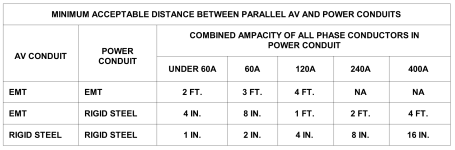
On the same notes page they have this table. Is there any justification behind treating EMT and Rigid differently? I think TIA only distinguishes between metallic and non metallic.

Screenshot 2025-12-17 072918.png
 
On the same notes page they have this table. Is there any justification behind treating EMT and Rigid differently? I think TIA only distinguishes between metallic and non metallic.
Well RMC is much thicker than EMT so you do have more metal for "shielding". I'm no engineer but to me this table sounds like nonsense. I'm curious to hear some other opinions.
 
Well RMC is much thicker than EMT so you do have more metal for "shielding". I'm no engineer but to me this table sounds like nonsense. I'm curious to hear some other opinions.
Like most AV stuff, there is a lot more voodoo than actual science. This is particularly true when saying voltage issues on the input to a power supply impact the output of that supply.

If this is critical AV why isn't it on dedicated power, maybe even a 60/120V system, with dedicated grounding and bonding. Look at what security radios can do to electronic breakers.
 
Modern AV is almost all digital anyway. No one is running a 24ch analog snake 200ft+ for mic level audio any more. It's all Dante over Ethernet, and often over fiber to boot. This note is not only useless, it's unenforceable in a building of any real size. I used to do Audio, and I don't anymore - so many of those folks are insufferable.


SceneryDriver
 
Modern AV is almost all digital anyway. No one is running a 24ch analog snake 200ft+ for mic level audio any more. It's all Dante over Ethernet, and often over fiber to boot. This note is not only useless, it's unenforceable in a building of any real size. I used to do Audio, and I don't anymore - so many of those folks are insufferable.

SceneryDriver

I agree 100%, and I was going to mention the same issues because AV is much more immune to interference now using digitally encoded audio and video, fiber optics, etc..

That being said, to answer the question below, rigid conduit does provide some additional attenuation than EMT does to low frequency magnetic fields induced by currents at 60 Hz and its harmonics. This is simply due to the additional thickness of rigid conduit in providing a boundary for diverting external magnetic fields. Non metallic conduit provides essentially no attenuation to magnetic fields. Steel provides a strong attenuation because of its high "permeabiility", which can be thought of as a conductivity but for magnetic fields instead of for electric currents. Aluminum has a very low permeability, and essentially the same as free space. It only provides about a 10% attenuation, which is hardly noticeable.

.. On the same notes page they have this table. Is there any justification behind treating EMT and Rigid differently? I think TIA only distinguishes between metallic and non metallic.

View attachment 2581131

The paper at the link below shows the results of testing different conduits for their attenuation of magnetic fields at 60 Hz and associated harmonics, in case someone might be interested:

https://steeltubeinstitute.org/wp-content/uploads/2020/05/GEMIVOL1.pdf
 
Top