B/W Controls for a submersible pump

Status
Not open for further replies.

sw_ross

Senior Member
Location
NoDak
I am troubleshooting a submersible pump that uses an old motor starter that I've never seen before and wanted some advice as to what options I have to upgrade the setup,
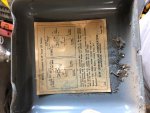
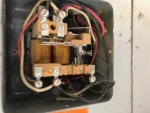
DeMores pump1.jpg

DeMores pump2.jpg

The coil isn't pulling in and apparently the contacts have been chattering a bit before I showed up.
If I "manually" shut the contacts they'll hold for a while but eventually the OL trips. It is pulling rated current during the time when the OL trips (6.3amps).

This is a typical submersible pump motor, 240v, 6 amps, 1/2 hp. It is used to pump water up hill to fill a cistern which is used as gravity feed for some house type structures.

Basically I need to replace this relay with a newer one. It appears that there are 2 heavier gauge wires that feed 240 to the pump motor (spliced onto the "submersible pump wire" in the well head), and then there's 2 smaller gauge wires (individual conductors) that head down in the well head. I'm assuming the smaller individual conductors are control wires? Not sure what the control device is though... And how to use that control device into a modern setup, unless I can use it to open up the contactor coil?


The old contactor coil appears to be 120v.


What's the most economical way to set this system up? a 2-pole contactor with a 120v coil? What about the OL device?


Thanks for any input!
 
They didn't seem to know anything about a control device.

The cistern is about 800 ft uphill. I haven't seen it but supposedly it's about 20,000 gallons!
The way they use it is turn the disconnect switch on, let it run a long time, then go see if the cistern is full...
I'm pretty sure there's not a float switch at the cistern, but haven't seen it for myself.

I looked up B/W Controls online and found some information about them using "electrical conductivity of liquids to design a floatless level sensor".

I guess I'm just trying to figure the best way to get them up and running again.

Wondering if I experiment with a 2-pole contactor and put the control wires in series with the contactor coil? I need to ohm out the control device wires to see what I got...
 
You have just what you described. A floatless control.

They turn the pump on. The pump runs until the water level in the well drops. Water level rises in the well, the pump starts again. Repeating the cycle until someone turns the pump off.

If that's true, then I should be able to put a contactor coil in series with the "floatless control" device and let it turn the pump on and off?

Also, do you think I need to put an OL in the equation? And what/how would be an economical way to accomplish it?

Thanks!
 
If that's true, then I should be able to put a contactor coil in series with the "floatless control" device and let it turn the pump on and off?

Also, do you think I need to put an OL in the equation? And what/how would be an economical way to accomplish it?

Thanks!
No, the "floatless control" drives the relay that is part of that assembly. All those two smaller wires are is probe wires for sensing conductivity between the two "probes". If conductivity is sensed the relay output changes. Some are reverse action and lack of conductivity would change the relay output, some are designed for upper and lower probes plus a common reference and function as "pump up" or "pump down" relays. I used to be around a lot of those for controlling level in tanks in a dairy processing plant. We used to sense both product levels as well as clean fresh water levels, and to turn pumps, valves, etc. on/off depending on the application needs. Probes operate at a low voltage, there is no switch or contact, just senses conductivity between the two terminals (via whatever conductors/probes) are attached to them.

Can't read the details on the diagram in your picture, but seems to be an antique version compared to ones I have been around from B/W - which that company is mostly all about liquid level controls AFAIK.

Don't know what is causing your motor overload to trip, but is possible you need to clean probes (or in your case possibly just the ends of the wires in the well casing as that may be all the probes amount to) if it isn't operating when it should. Probes we used sometimes needed cleaned when things weren't working quite right, hard water deposits insulated them enough they didn't sense properly anymore
 
I've installed quite a few B&W systems. They use a relay controlled by probes, when water contacts the probes it turns on or off the relay, often there are two probes, hi, low and a common ground, usually a water pipe with the probes inside
The B&W relay has a resistor whos value depends on the conductivity of the water.
If the overloads are sized correctly and tripping its almost always a motor problem.
check the open circuit voltage, then the running voltage, should only be about 5% difference
Next, meg the motor

Then dig into how the controls work. B&W is a good system, easy to troubleshoot. I don't think the B&W is causing your motor issues
 
I've installed quite a few B&W systems. They use a relay controlled by probes, when water contacts the probes it turns on or off the relay, often there are two probes, hi, low and a common ground, usually a water pipe with the probes inside
The B&W relay has a resistor whos value depends on the conductivity of the water.
If the overloads are sized correctly and tripping its almost always a motor problem.
check the open circuit voltage, then the running voltage, should only be about 5% difference
Next, meg the motor

Then dig into how the controls work. B&W is a good system, easy to troubleshoot. I don't think the B&W is causing your motor issues
If it is a high or low limit only may only be two wires for probes, pump up or pump down applications use upper and lower probe plus a common - which if sensing level in a metal tank you often just bond the common to the tank, but can have a third probe as well connected to the common.
 
We have two B&W systems on an 11 million gallon reservoir with a floating cover that is one acre is size. Think giant water bed. We pump the rainwater off otherwise it will displace the clean water below. Since its rain water it has a low ph and had to find the right size resistor for the B&W.
The cover is interesting to walk on.
 
1 probe (low limit probe) only?

1 probe (low limit probe) only?

This setup has only 2 wires that head down the casing for probes (besides the 2 power wires for the motor).

The well casing is PVC (not sure of the age of well) so it couldn't be used as a common bond for the probe.

Is it possible that there is only one probe (a low limit probe)? That would shut off the motor to keep the pump motor from running as the well water gets low?

In this application there is no need for a high limit probe. It's not a tank that needs to be shut off.
 
I’m not comfortable with your description. Can you draw it?

you may have two problems. The pump itself and the control. One may have caused the other to fail. What went first is a coin toss.

Motor Circuit.jpg

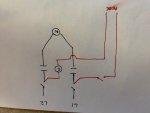
In it's most simplistic form this is basically what I'm thinking of putting together as a replacement.
The switch drawn on the red control circuit would be an on/off switch for the pump rather than using the pld fused disconnect as an on/off switch.


Sorry the pic is upside down, not sure why that happens? It's right side up on my computer...


Input and suggestions are appreciated!
 
This setup has only 2 wires that head down the casing for probes (besides the 2 power wires for the motor).

The well casing is PVC (not sure of the age of well) so it couldn't be used as a common bond for the probe.

Is it possible that there is only one probe (a low limit probe)? That would shut off the motor to keep the pump motor from running as the well water gets low?

In this application there is no need for a high limit probe. It's not a tank that needs to be shut off.

Age of the system and or cycling due to well recharge would be a reason for the pitted contacts. How old is this install?

You say 800 feet uphill. What is the actual rise to the tank high water level?
 
View attachment 20981

In it's most simplistic form this is basically what I'm thinking of putting together as a replacement.
The switch drawn on the red control circuit would be an on/off switch for the pump rather than using the pld fused disconnect as an on/off switch.


Sorry the pic is upside down, not sure why that happens? It's right side up on my computer...


Input and suggestions are appreciated!
The "probe" is just two exposed conductor ends of some sort that get immersed in the media they are to be sensing. The original control is looking for continuity between them, possibly needs to be able to sense around 10kohms to trigger the existing control.

If you wire it like your drawing, you are depending on water between the probes to carry enough current to pull in the contactor coil - too high of resistance in the water to do that.
 
Age of the system and or cycling due to well recharge would be a reason for the pitted contacts. How old is this install?

You say 800 feet uphill. What is the actual rise to the tank high water level?

The B/W Control box I think is from the 50's but not positive...
The well casing and wires/conduit heading out to the well head are definitely newer. PVC conduit and THHN wire.

Visually looking at the rise up to the cistern I'm going to guess its about 400-500 vertical feet?
 
The "probe" is just two exposed conductor ends of some sort that get immersed in the media they are to be sensing. The original control is looking for continuity between them, possibly needs to be able to sense around 10kohms to trigger the existing control.

If you wire it like your drawing, you are depending on water between the probes to carry enough current to pull in the contactor coil - too high of resistance in the water to do that.

Ok. If I ohm out the 2 wire that head to the probe I need lower resistance for my diagram to work.

I'm not sure off the top of my head how I would make this work if it's set up like you describe regarding 10 kohm's on the probe wires...
 
Ok. If I ohm out the 2 wire that head to the probe I need lower resistance for my diagram to work.

I'm not sure off the top of my head how I would make this work if it's set up like you describe regarding 10 kohm's on the probe wires...
There is other controls associated with the "probe wires" on your original controller that may not be shown on their wiring diagram. You still need similar controller to use the "probe" as a control device.

if your system turns on and off as the water in the well rises and falls chances are nothing is wrong with that part of the controls.

You do have a piece of equipment that is apparently very old, output contacts are possibly severely pitted and causing the troubles you are having.

Most such level controllers I have ever used were pilot duty and not able to directly run a motor, so they are used for sensing and turning on an additional motor control.

You sort of need to confirm that the two smaller leads are indeed probe wires, but from what we have seen and read that seems to be the case.

Better picture of the label you posted earlier may help us know better just what it is you have there. I tried searching for that model but no luck. I bet was discontinued long ago. B/W is still very active in liquid level controls though.
 
You need the entire control that BW has. You can’t just connect 120 volt to one probe wire and expect it to pass enough current through the water then back up via second probe wire to the coil of your new contactor. Not that simple or there would be no need for BWs controls.

500 foot of rise is a lot. I suspect somewhat less.
 
Edit pic for wiring diagram

Edit pic for wiring diagram

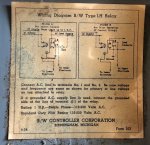
Here's an edited version of the pic of the wiring diagram, trying to make it clearer.

editpic.jpg

I need to look at the setup more to understand which one is used...

Also, not sure if the "4-54" is a date or what...

I'll stop by there this morning to look at the setup closer.
Thanks for the help! I've never encountered this type of setup before and just wondering how to bring it up to date.
 
Status
Not open for further replies.
Top