
Battle of the Phases

Status
Not open for further replies.
coulter said:
Well, not yet. I've attached two pdfs.

The first is as I understand your model. I don't think it extends well -it just doesn't look right.

The second (This works.pdf) is the model I currently prefer (hey, tomorrow is a new day - quien sabe?) I think this one extends with little confusion.

carl
Why do you think you have had such a difficult time drawing these phasor diagrams? It is because Rattus has convinced you to redefine a power source based on where your point of reference is located. A phasor diagram does not change when a point of reference changes.

New Edit (I think) Rattus said earlier that many engineers have abandoned phasor diagrams (or something like that...I don't want to put words in his mouth). I haven't. Phasor diagrams are something that I wholeheartedly embraced when they were taught to me. I paid more attention during the discussion on phasor diagrams than any other part of circuit analysis, because it made the mathematics so much easier to solve.
 
Last edited:
Rick Christopherson said:
No Carl, this isn't a peeing contest. I left that yesterday. This is about proper core circuit analysis, and what Rattus has done in this case is not proper.

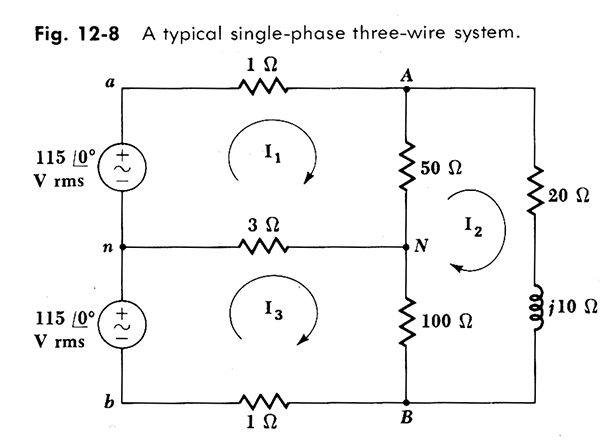
I have scanned a page from "Engineering Circuit Analysis" that specifically discusses this very same situation. I am not arguing about "Single-Phase" "Two-Phase", and as a matter of fact Hayt and Kemmerly even acknowledge that this system can be called both. I do not have a dog in that hunt (to use Rattus' expressions).

What I am arguing about is the improper use of phasors to make this point. Note the polarity of the power sources. It does not matter if you change your point of reference. This polarity remains the same, and you use a minus sign in your equation. You do not redefine the power source.

3-wire-scan.jpg


NEW EDIT I apologize for editing this in the middle of a discussion, but it is better to note this here than to put it in a new posting.

From the diagram above, it is clear that the voltage from "n" to "b" is negative. However, if you had redefined that voltage source to be 115 @180 deg., then the voltage from "n" to "b" would suddenly become positive. If you were to do this and try to apply Kirchoff's law to this circuit, it would fail.

If the reference is "n', then,


Van = 115 @ 0
Vbn = 115 @ 180

That is Van = -Vbn

Vab = Van -Vbn = 230V @ 0.

The currents will come out in the wash.
 
Rick Christopherson said:
then the voltage from "n" to "b" would suddenly become positive. If you were to do this and try to apply Kirchoff's law to this circuit, it would fail.

Why would it fail?

From pg 30 of "Fundamentals of Circuits, Electronics, and Signal Analysis" 1978 by Kendall L. Su, Ga. Inst. of Tech.:

"KCL The algebraic sum of all currents entering an ambit must be equal to the algebraic sum of all currents leaving the ambit. (Each current entering or leaving may be either positive or negative.)"

KVL The algebraic sum of all voltage rises from one node to another is independent of the path traced. (Each voltage rise may be either positive or negative.)"
 
rattus said:
If the reference is "n', then,


Van = 115 @ 0
Vbn = 115 @ 180

That is Van = -Vbn

Vab = Van -Vbn = 230V @ 0.

The currents will come out in the wash.
I am not disputing your math. It is correct. I am however disputing your use of phasors to "prove" your point. Contrary to what you already stated earlier in this thread, you have given your phasor Vbn a negative amplitude.

Vab = Van + (-Vbn) is the proper phasor equation as you have defined it.

The direction of a phasor is not arbitrary. For you to change the phase angle of the power source, you need to negate the magnitude. You redefined the power source to include your negative reference point, and as a result, Kirchoff's law cannot be satisfied. Your math is correct, but you have misplaced your minus sign as it pertains to phasors. If you had simply left phasors out of this discussion, we would not be having this argument.
 
mivey said:
Why is one person's frame of reference any more the most correct in the universe as compared to someone else's? In 100 years, the scientists of the day may be laughing at all of us.

Rattus is trying to analyze his circuit using a set of rules modified to work on a 120/240V circuit using neutral as a reference point.

I have said before "just because you can doesn't mean you should".

I have also offered this example before.
See what adjustments need to be made when using Rattus' method for analyzing voltages (as V1n and V2n) in a 120/240 circuit where there is a 24 ohm resistor wired from L1 to N, a 12 ohm resistor from N to L2, and a 48 ohm resistor wired from L1 to L2. The results should include the currents entering and leaving each node. Pay attention to if the transformer coil currents remain "in phase" with their respective voltages.
 
Vectors

Vectors

While I had the book out I thought you might enjoy this:

From pg 144 of "Fundamentals of Circuits, Electronics, and Signal Analysis" 1978 by Kendall L. Su, Ga. Inst. of Tech. (substituting for symbols):

"The complex amplitude of a sinusoid

e(t) = Em*cos(wt+phi)

is Em@phi. this quantity is also known as a phasor or sometimes, erroneously, as a vector. It is convenient to think of complex amplitudes as vectors because the rules for addition and subtraction of complex numbers are the same as those for vectors. For example, we can add

Em1@phi1 + Em2@phi2 = Emt@phit

by using the parallelogram method, as illustrated in Figure 5.12. But that is where the similarity between vectors and complex amplitudes ends. We can multiply complex vectors as in (5.4) [mivey: the formula was (a+jb)(c+jd)=(ac-bd)+j(ad+bc)] and (5.9) [mivey: the formula was |C1|e^jphi1 x |C2|e^jphi2 = |C1||C2|e^j(phi1+phi2)], but the multiplication of vectors is usually defined very differently. For this reason, engineers have coined the term "phasor" as an alternative to "complex amplitude"
 
center tapped transformer

center tapped transformer

And I just know you are going to love this:

From pg 90 of "Techniques of Circuit Analysis" 1972 Carter/Richardson where they were talking about forming polyphase sources by using voltage sources separated by phase differences:

"...two voltage phasors in opposition-that is, with a phase difference of 180 degrees; a single-phase transformer with a center-tapped secondary winding would be such a source."
 
Negative Magnitude?

Negative Magnitude?

Rick Christopherson said:
I am not disputing your math. It is correct. I am however disputing your use of phasors to "prove" your point. Contrary to what you already stated earlier in this thread, you have given your phasor Vbn a negative amplitude.

Vab = Van + (-Vbn) is the proper phasor equation as you have defined it.

The direction of a phasor is not arbitrary. For you to change the phase angle of the power source, you need to negate the magnitude. You redefined the power source to include your negative reference point, and as a result, Kirchoff's law cannot be satisfied. Your math is correct, but you have misplaced your minus sign as it pertains to phasors. If you had simply left phasors out of this discussion, we would not be having this argument.

Rick, the negative sign applies to the entire phasor. The magnitude remains positive. The polairty marks do not change. Only the phase angle changes because we have changed the reference--swapped the leads, that is.

These voltages can be defined either way, and the solution will be the same in any case.
 
Rick Christopherson said:
Why do you think you have had such a difficult time drawing these phasor diagrams? It is because Rattus has convinced you to redefine a power source based on where your point of reference is located. ....
Why do I think I'm having a difficult time? Rattus has convinced me? Interesting and revealing.

I'm not, he hasn't. But you would have had to read my posts and followed the logic to know that. Foolish of me to have thought I could present a reasoned argument for using a differing model from rattus.

Yes you (plural) are having a peeing contest. From here it sounds like, "AM TOO. AM NOT over and over".

Just in case you (plural) don't know this: Continuing to say the same thing over and over, louder and louder, does not make it more true.

I spent some time working on this - Too bad it didn't help.

carl
 
jim dungar said:
See what adjustments need to be made when using Rattus' method for analyzing voltages (as V1n and V2n) in a 120/240 circuit where there is a 24 ohm resistor wired from L1 to N, a 12 ohm resistor from N to L2, and a 48 ohm resistor wired from L1 to L2. The results should include the currents entering and leaving each node. Pay attention to if the transformer coil currents remain "in phase" with their respective voltages.
I don't know about you Mivey or Rattus, you might be tempted to continue arguing with me, but I know better than to argue with a P.E.

As Rattus has so much enjoyed saying, "that dog don't hunt". Oh, and the all more infamous, "Case Closed"!
 
To each his own:

To each his own:

coulter said:
Well, not yet. I've attached two pdfs.

The first is as I understand your model. I don't think it extends well -it just doesn't look right.

The second (This works.pdf) is the model I currently prefer (hey, tomorrow is a new day - quien sabe?) I think this one extends with little confusion.

carl

Carl, tried to pull up your diagrams, but each time my puter froze. Try again later.

You should of course use the method with which you are comfortable. However, properly done, either method will provide the same result.
 
rattus said:
Rick, the negative sign applies to the entire phasor. The magnitude remains positive.
If the magnitude remains positive with a downward facing phasor, then you are violating Kirchoff's law. Kirchoff's law is additive, and you have just made it subtractive.
rattus said:
The polairty marks do not change. Only the phase angle changes because we have changed the reference--swapped the leads, that is.
In your previous posting, you said we couldn't swap the leads, now it is OK?
rattus said:
These voltages can be defined either way, and the solution will be the same in any case.
No. Kirchoff's law is additive, and you have made it subtractive because you have misplaced your minus sign.

Your math is correct, but you have violated Kirchoff's law in the process. 120 @0 deg is not equal to 120 @180 deg, it is the negative. You have made your phasor magnitude negative, and by your own admission, you cannot do that.
 
coulter said:
Yes you (plural) are having a peeing contest. From here it sounds like, "AM TOO. AM NOT over and over".
Well if that is true, then you are smack square in the middle of it too. I have always hated this expression, but nevertheless, if you are pointing a finger at someone, there are three more fingers pointed back at yourself.:mad:
 
Rick Christopherson said:
but I know better than to argue with a P.E.

But will you side against internationally known circuit theorists, doctorates, phd's, world-renowned author's?
 
Don't say I didn't warn you. I told you my stack of paper could beat up your stack. And I pretty sure my dad can beat up your dad:roll: (Chris - I'm laughing here - at us all)

This isn't about that. It's about responders getting stuck in the fight for "I'm right - I'm the best"

Luckily I never get caught up in that:roll:

carl
 
Status
Not open for further replies.
Top