
Bonding Gas Line

jeramiepluemer

Senior Member
Location
Wisconsin
Occupation
Electrician
I am trying to understand why this is done this way. Generac has never instructed us to do this. 250.104 in the NEC explains this, but I have problems understanding. The guy did it like this because of this reference. It has been an ongoing debate, and I am searching for the right understanding. The inspectors always require us to ground the natural gas piping to the main ground with an irreversible crimp if it hasn't already been done. Propane, they really never say anything because the propane company signs off on that. Any help is welcome.
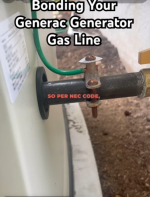
 

Attachments

  • Screenshot 2026-01-01 072512.png
    Screenshot 2026-01-01 072512.png
    291.7 KB · Views: 20
Gas pipe bonding is to make sure that the supply end (i.e., the incoming supply from outside) is always at the same potential as the appliance end, to avoid current across any CSST.

If lightning strikes near a house, voltage can be impressed on the gas piping coming into the house. The outside pipe bonding acts as an equipotential bond around sections of CSST.
 
There is no NEC requirement to have a separate bond to metal gas pipes as long at there is at least one gas appliance that also uses electricity. The EGC for the power supply to the gas appliance is all of the bonding that the NEC requires.
 
I am trying to understand why this is done this way. Generac has never instructed us to do this. 250.104 in the NEC explains this, but I have problems understanding. The guy did it like this because of this reference. It has been an ongoing debate, and I am searching for the right understanding. The inspectors always require us to ground the natural gas piping to the main ground with an irreversible crimp if it hasn't already been done. Propane, they really never say anything because the propane company signs off on that. Any help is welcome.

I do generators and I have never seen it done that way or even heard of this before.

Our county just requires that we run a bond wire from the main service over to the water and gas somewhere, at the time of service installation. Nothing to do with generators really.

That pipe as shown is already bonded inside the generator, because it continues as hard pipe to the gas regulator, which is metal and bolted solidly to the generator floor, which is grounded via big straps to the engine, battery, incoming ground wire from the conduit run, and everything else.
 
Top