

Breaking Resistor on VFD

Saturn_Europa

Senior Member
Location
Fishing Industry
Occupation
Electrician Limited License NC, QMED Electrician
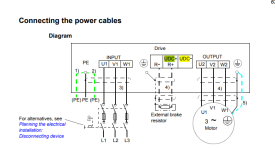
The factory I work at has a large decanter. The bowl motor is 100 hp. The drive is currently an old ABB ACS800. The manual shows that the break should be installed between R- and R+ UDC+.
1769189802865.png


Our set up is completely different. UDC + and UDC - are connected to a 648v DC to 24 V DC power converter that supplies power to a redundancy module. UDC + and UDC - are also connected to a Power Ohm breaking module. The Power Ohm Modul is connected to a large resistor that is mounted on top of the panel.

Everything is working fine for the last 10 years. Its just not what I would expect to see and I am curious about it.

Is this a normal set up?
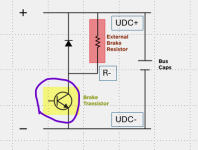
 
What your manual shows is the connection to a braking resistor which is controlled by an internal brake "chopper" (typically an IGBT). Inside the drive there is connection made between R- and UDC- when the drive detects rising DC bus voltages which exceeds some limit. So the braking resistor is effectively connected across UDC+ and UDC- whenever the drive thinks that's needed.

The PowerOhm Module does the same thing, it's just done externally. Never used one, but just looked them up and they indicate they are used for high inertia applications with frequent, fast, or sustained braking. I assume they can do "better" than the drive's internal control, for heavier duty systems.

Both approaches still connect the resistor across the DC bus (UDC+ and UDC-) when they are calling for braking. It's just a matter of who is doing it, the drive itself - or the external PowerOhm module.

Here is a quick diagram I found on the web of a brake chopper - I've labeled your drives connections and circled the switching transistor in blue which connects R- to UDC-...
1769194317188.png
 
Last edited:
What your manual shows is the connection to a braking resistor which is controlled by an internal brake "chopper" (typically an IGBT). Inside the drive there is connection made between R- and UDC- when the drive detects rising DC bus voltages which exceeds some limit. So the braking resistor is effectively connected across UDC+ and UDC- whenever the drive thinks that's needed.

The PowerOhm Module does the same thing, it's just done externally. Never used one, but just looked them up and they indicate they are used for high inertia applications with frequent, fast, or sustained braking. I assume they can do "better" than the drive's internal control, for heavier duty systems.

Both approaches still connect the resistor across the DC bus (UDC+ and UDC-) when they are calling for braking. It's just a matter of who is doing it, the drive itself - or the external PowerOhm module.

Here is a quick diagram I found on the web of a brake chopper - I've labeled your drives connections and circled the switching transistor in blue which connects R- to UDC-...
View attachment 2581563
Thank you!
 
Top