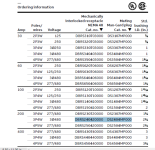
- the SHORE TIE receptacle is as follows:
- 3P4W 3Ø480 DBRS240420000 DS2404MP000 (NOT 277/480)-- This is 3 Pole (L1, L2, L3 + N as opposed to a L1, L2, L3, + G) and currently no neutral is connected to this receptacle but they werent having any issues before.
Given the above information, since the shore tie receptacle is rated to handle 480V, in theory there should be no problem connecting that receptacle to a 3Phase 120/240 system right ?
Per the catalog page, that receptacle is 3P4W straight 480V, implying L1, L2, L3 + G, no neutral.

(
https://pim.galco.com/Manufacturer/...ment/Catalog Page/dbrs240420000_901233_cp.pdf )
There are two separate pieces of receptacle 'voltage', the actual voltage rating of the components and the configuration. (As an analogy think about THHN wire insulation. The wire has an insulation voltage rating of 600V. The wire comes in lots of different colors, and the colors are the configuration.)
It is perfectly fine to use a receptacle with a voltage rating of 480V to supply 240V.
It
may be a code issue and it is always a design issue to use a 480V configuration to supply equipment designed for 240V. The NEC requirement is 406.4(F), and it just limits you to 1 voltage per receptacle configuration in an given facility. If you want to use 480V plugs for your 240V devices in your factory, you can, as long as you don't also use those 480V plugs for 480V devices.
But if you put a 480V plug on a device that moves around (eg a ship), then there is always a risk that someone will plug it into a 480V receptacle (say at a different port). I don't know if there are marine codes that require the plug configuration to match the voltage, but this is certainly a design issue.
UTILITY - 3PHASE 120/240 HIGH LEG (208) CLOSED DELTA (3 Bank Transformer) Verified the Fused Disco Voltage Readings myself ALL Line to Line Voltages Read 240V between each-other, A/B phase 120V to N, and B phase 208V to N.
LOAD (From Disco Next To Meter -> 80 Feet To Shore Tie Receptacle Rated At 200A, 400V 3P ) - The load is a shore tie receptacle that ONLY takes L1, L2, L3 (no Neutral, not even pulled from disco to receptacle).
Good on you for going out there to see what is actually going on. You say there is not neutral pulled from disconnect to receptacle. Was there a wire EGC pulled, or is the conduit used for the EGC?
- BACKGROUND - this shore tie receptacle feeds a small docked ship (NOT A Building, i am sorry gents). The ship has offices, a galley, lounge and sleeping quarters and outlets. It also has pumps, fridges, heaters other 3 phase equipment. Now the ship has had some issues while being docked (issues started happening 6 months ago, from the onboard personnel i talked to, they stated that they have been onboard for 4 years and nothing has changed on their end, no new construction, no upgraded wiring, any reconfiguration of sorts except one thing. While underway one of their batteries exploded and they had to emergency dock. That's all the intel i have)
Ok, so you are trying to understand how the existing electrical system could have 'worked fine', but now does not. As best you can tell, only 240V L-L circuit conductors were provided, but the ship has 120V loads that worked fine.
- SHIP ELECTRICAL SPECS - The ship operates on 240 VAC phase-to-phase and 120 VAC phase-to-ground electrical service. The existing city power configuration consists of a 120/120/208 VAC Wye/Delta transformer configuration.
You cannot have 240V L-L 120V L-N _symmetric 3 phase_ power. You can have:
240V L-L, 120V L-N
single phase power
240V L-L,
139V L-N three phase power (balanced wye 240V 3 phase)
208V L-L, 120V L-N three phase power (balanced wye 208/120V 3 phase)
240V L-L, 120V L-N, 120V L-N,
208V L-N three phase power (high leg delta, exactly what you've measured from the utility)
- the SHORE TIE receptacle is as follows:
- 3P4W 3Ø480 DBRS240420000 DS2404MP000 -- This is 3 Pole (L1, L2, L3 + N as opposed to a L1, L2, L3, + G) and currently no neutral is connected to this receptacle but they werent having any issues before.
**** Right now im still waiting for an email or phone call from the PM to clarify the smorgasbord of false information, in the meantime, i owe you guys an apology. My apologies for wasting your time and mental effort with the wrong premise. If i was in your state Id be more than happy to buy you a beer or lunch to offset any negative energy yall throw out my way ***
My guess, based on what you've described:
The utility service is 240V high leg delta with a neutral center tap. The ship expects 240V high leg delta with two 120V L-N legs. If you get to the ship you can confirm this if all of the 120V circuits are very specifically on 2 of the 3 phases. The ship was
improperly using the EGC as the neutral, and over time the EGC has decayed. And now they are experiencing problems with the high impedance neutral.
My (lower likelihood) second guess is that the ship expects 120/240V _single phase_ power, and that one of the poles on that 3 pole receptacle was used as the neutral. But someone did some work on the service and noticed that one of the 'phase' conductors was landed on a neutral terminal, and switched it to the unused high leg.
Another possibility is that the ship owners have decided that they want to derive the 120V supplies using a transformer so that they can plug the ship into a straight 240V supply of any grounding (high leg, corner grounded or ungrounded) and not have to worry about the specific dock supply configuration. They may even want some sort of fancy transformer that can take 240V or 380V or 480V or whatever and provide as stable 240/120V 3 phase high leg on the ship.