Buck-boost XFMR: Whaaaa?

Status
Not open for further replies.
If you wire the transformer for a 240V primary input and only feed it with 120V you WILL have problems.

A transformer is basically a motor that does not turn. Would you ever feed a motor with only 50% voltage?
 
jim dungar said:
If you wire the transformer for a 240V primary input and only feed it with 120V you WILL have problems.

A transformer is basically a motor that does not turn. Would you ever feed a motor with only 50% voltage?
Not necessarily. Depending on your load, wiring a transformer for half voltage won't damage it at all. We did exactly that on a project several years ago where we needed a 12 Volt power source, and no transformers were readily available. Using a 240-24 transformer, we connected it to a 120 source, and it provided ample 12 Volt output for our needs.

7 years later, it is still working just fine, thank-you-very-much.
 
jim dungar said:
If you wire the transformer for a 240V primary input and only feed it with 120V you WILL have problems.

A transformer is basically a motor that does not turn. Would you ever feed a motor with only 50% voltage?

Yes, I would.

But only if the mechanical load is about 25% of the rated load of the motor at full voltage.

A good VSD will adjust the output voltage at any given frequency in order to maintain the motor at maximum efficiency for that particular mechanical output state.

A transformer at half its rated primary voltage will work just fine, but only at less than half rated KVA. If you actually want to use the transformer at rated KVA, then you bet run it at proper voltage.

-Jon
 
Jon and kbsparky

You both proved my point. You have carefully considered the ramifications of only supplying 50% voltage.

I didn't say it should never ever be done. I just wanted you to make sure the potential problems were addressed.
 
georgestolz said:
We are starting in on the lights for the building I'm working on, and the lighting guy (in his infinite wisdom) sent out a buck-boost transformer for some 12VAC track lights.

I looked at the instructions after everybody else did and couldn't make heads or tails of it. :D

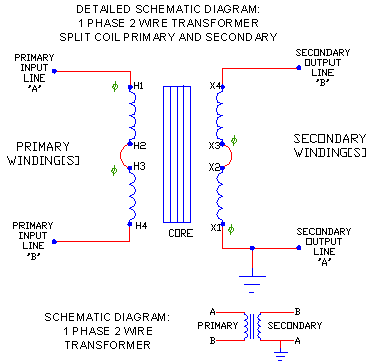
Here is what I imagine you have.

1phd1.gif


With a diagram like this and a 120/240 - 12/24 rating you should be able to connect it correctly.
icon7.gif
 
I got home late last night, didn't get to this thread before the wife got home.

Bob, you were right, the connections were on the nameplate. Pays to read the fine print. :D

They were according to Jim's method, (H1/H3 120V Hot), (H2/H4 120V Neu).

Looking at the diagram, I still don't quite understand why Marc's method provides half the watts. It's not clicking.

I tried looking yesterday, and ran short on time; where is the code reference for OCPD on the secondary? Article 725 is one of the hardest to read, IMO.

I'm not sure of the control method on the panels, but I'm interested to find out.

iwire said:
You probably know this but LV lighting is low volt but it is high current, you can have up to 25 amps of load on one circuit and if you do your going to need to run mighty big conductors to overcome voltage drop.
The transformers are mounted right next to the lights, so that shouldn't be too hard to cope with. :)

Thanks for all replies!
 
iwire said:
By the way, while these transformers can supply the voltage you need I believe they must be listed for the purpose of supplying LV lighting. You might want to take a look at 411.
Well, this morning I pored over the information that came with the lighting components, and found one paragraph on the back page of one booklet that said, "Oh, and by the way, if you don't use our 150W or 300W transformers to supply these products, kiss the listing goodbye and imperil your insurance."

(It might sound comical when I put it in my own terms, but that's pretty much the gist of it.)

So, the right transformers are on the way. :D

Many thanks for all the pushes in the right direction.
icon14.gif
 
georgestolz said:
Looking at the diagram, I still don't quite understand why Marc's method provides half the watts.
Simply speaking, you're exciting a winding designed for 120v at 60v, which means that only half the current can be induced to flow. Connected properly, the transformer exhibits a much lower source impedance.
 
Status
Not open for further replies.
Top