Can I legally use a two wire 120 V circuit without a Ground Conductor by doing this

Status
Not open for further replies.

Installer

Senior Member
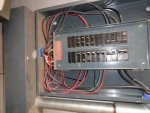
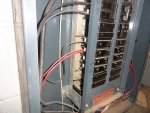
I have a two wire 120 VAC circuit without a Ground Conductor coming from a real old panel.(Red wires) It runs 363' under a road and some concrete to my Load.
Because it doesn't have a Ground Conductor, it won't trip the breaker at the old panel.
I've been told that If I used a 120 to 440 step up transformer right after the panel (and bond the neutral to a ground outside the panel ) and placed a 440 to 120 step down transformer at the Load(and bond the neutral to ground counterpoise at the source), the circuit becomes legal. Something doesn't sound right. Can someone please explain ? Thank you in advance
DSC06742.jpg
 
Is it required to be GFCI protected?
The transformers at each end will be configured to make their secondaries "separately derived systems" (SDS). The neutral bonding you describe is legal at the load end provided the neutral is also connected to any exposed metal raceways, enclosures, and equipment that would normally be connected to an EGC. However if the load area can be considered to be a separate building, you may still be required to run an EGC to it. I would consider this a gray area for AHJ interpretation.

Sent from my XT1585 using Tapatalk
 
If I understand your suggestion, you would be attempting to use planet Earth as the fault clearing path. That is not allowed, and it would not work anyway.
 
Why are there two red wires on the one breaker? Panel say it's a GE. I don't think GE breakers are designed for two wires. Are the wires being paralleled? If so they are too small per code.
 
If I understand your suggestion, you would be attempting to use planet Earth as the fault clearing path. That is not allowed, and it would not work anyway.
Charlie, at the load end, it would be an SDS, with the fault clearing path being to the grounded conductor of the secondary. So no problems there.
The 440 circuit between the two transformers would potentially be without a fault clearing path if the center tap or one end of the 440 winding is grounded at the source. But IMO that circuit could also be operated ungrounded, requiring only the addition of a ground detector to make it code compliant.
 
To clarify I am trying to legally reuse a Two Wire circuit without a grounding conductor--no grounding bus in panel(--yes there are two wires there --one for an Ob Light at 5 A and one for an Electronics enclosure at 4 A-) to supply a remote site without redigging or trenching--at probably $30K---
Any ideas?
DSC06739.jpg
 
Is there room in the existing conduit for a #12 bare copper wire? Can you attach two new circuit wires and one ground wire to the wires at the load, and use the wires at the source to pull the new wires in as the old wires are pulled out? I know it is a long run, but do you know if the run is straight enough to "pull" this off (sorry about the pun). I doubt that the cost of the new wires would be anywhere near $30K.
 
Charlie, at the load end, it would be an SDS, with the fault clearing path being to the grounded conductor of the secondary. So no problems there.
The 440 circuit between the two transformers would potentially be without a fault clearing path if the center tap or one end of the 440 winding is grounded at the source. But IMO that circuit could also be operated ungrounded, requiring only the addition of a ground detector to make it code compliant.


Is this true? Because we are low on money, its public, not commercial funding..if this we had the money, we would dig up the road
Also could you quote a ground detector? Thanks in advance
 
So you have 4A on one red and 5A on the other. What size wire? If you combine and put 9A on one, at 363' what would the voltage drop be? Figure too, one red with the two whites in parallel.

The panel is grounded and you could install a ground bus. I know it's not allowed but you could reidentify one conductor with green tape as a ground.

If the VD is excessive consider a buck-boost autoformer at the panel end. How about putting 240 on the reds with a small step down at the load?

-Hal
 
Last edited:
So you have 4A on one red and 5A on the other.
No, it's just a single 2-wire 120v circuit with one 4a and one 5a load. He's asking what to do about there being no EGC.

That's why I asked about a conduit; if there is one, he could re-pull; if there is one, and it's metal, he doesn't need to.
 
No, it's just a single 2-wire 120v circuit with one 4a and one 5a load. He's asking what to do about there being no EGC.

That's why I asked about a conduit; if there is one, he could re-pull; if there is one, and it's metal, he doesn't need to.

back in those days,in the Pacific Northwest,they always did Direct Burial in these type of installations
 
No, it's just a single 2-wire 120v circuit with one 4a and one 5a load. He's asking what to do about there being no EGC.

Unless I'm seeing double, aren't there two reds on that breaker?


--yes there are two wires there --one for an Ob Light at 5 A and one for an Electronics enclosure at 4 A-) to supply a remote site...

Sounds to me like there are two reds so there has to be two whites.:?

-Hal
 
Unless I'm seeing double, aren't there two reds on that breaker?


Sounds to me like there are two reds so there has to be two whites.:?

-Hal

The OP lied to us?! :eek:


OP, how many conductors are there?? Then, what colors?
Unless he is intentionally leading us astray, probably has two wires, both happen to be red, one is grounded one is ungrounded. Code issues? yes, but the electrons don't care what color insulation is

Kind of doesn't change anything much, but he could make this a feeder, drive ground rod(s) and bond the grounded conductor at the subpanel and it would be allowed if there is no other metallic paths between two the two structures. If this is a branch circuit it always needed an EGC, well at least for 50 -60 years it did.
 
. . . but he could make this a feeder, drive ground rod(s) and bond the grounded conductor at the subpanel and it would be allowed if there is no other metallic paths between two the two structures.
Even if it is changed to become a feeder, with a subpanel at the load end, he would still need an EGC to be run with the feeder conductors. As to the "no metallic paths between the structures," I think they removed that option from the code several cycles ago. Washington State is on the 2017 NEC, and this project, being an alteration of an existing installation, would have to follow the current code.

 
Look at the picture. Both reds are on the breaker. Where is (are) the neutral(s)?
Installer, I will echo Hal's question. Your original statement said both wires going to the load are red. The photo shows two red wires connected to breaker #7. But they can't be the two red wires going to the load, as there is no voltage between them. Is there a different red wire that is connected to the neutral bar in the upstream panel, and that travels the long distance next to the red ungrounded wire?

One more question: Why are you looking at this situation in the first place? Are you adding load, and need to know if the existing circuit will handle it? Or are you just trying to make an existing installation compliant with current code? Or are you trying to make the existing installation safe (or at least safer than it is), even if you can't also achieve compliance with current code?

 
Status
Not open for further replies.
Top