Canless LED and section 230.18(B)

Status
Not open for further replies.

Fred B

Senior Member
Location
Upstate, NY
Occupation
Electrician
2017 NEC
220.18 Maximum Loads.
(B) Inductive and LED Lighting Loads. For circuits supplying lighting units that have ballasts, transformers, autotransformers, or LED drivers, the calculated load shall be based on the total ampere ratings of such units and not on the total watts of the lamps.

Trying to determine the rating for the canless led that have integral driver. Listing on sales pages only show wattage of lamp. Seen listing of lighting with separate drivers that show lamp wattage and driver amperage separately.
Looking for how to determine compliance with above code.
 
The issue is the driver. It is the same for fluorescents too because the ballast uses energy. What is the brand and model?
 
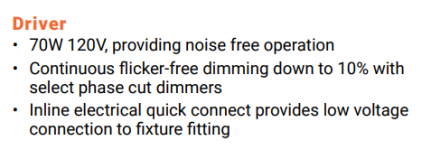
This is from a Halo canless fixture-- Looks like 70 watts. Interesting how when you think you are using 10 watts you get this.... It doesn't seem right

1665835906600.png
 
I would read that to mean the driver is capable of 70W max. I don’t know if that would be LED rating or input?
I can’t believe it would consume 70W driving say, a 10W LED.

It’s certainly not clear, to me at least.
 
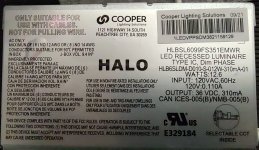
I just looked at some 6" Halo canless fixtures and the input current is 12.6 watts or .11 amps.

Canless Light.jpg
 
The discrepancy seems to come about as a result of the conversion from AC to the low voltage DC of the bulb. Mfg seem to focus on the DC wattage of the bulb ignoring the AC wattage of the driver in the advertising. If the wattage of bulb is listed as 10W DC and driver is putting out 24V the actual amperage is slightly less than the driver Amperage. Perhaps part of the reasoning of the section?

So from @infinity's post looks like they put the info on the device but not in the advertising specifications.
 
So from @infinity's post looks like they put the info on the device but not in the advertising specifications.
In that case you would need to use the nameplate rating on the fixture or the driver. As you can see from the photo the input current is about 1/3 of the output current. The output current is meaningless in calculating 220.18.
 
It would appear that math wise and not counting voltage drop or other factors that might alter the calculations, potentially you could install about 130 of those LED compared to 30-60W incandescent on a 15A circuit.
 
Input and output current aren't the same thing.
1 amp in @ 120 volts would be 2 (ish) amps out at 60 volts.

If it's an integrated fixture, the input current includes what the driver uses.

If it's something like LED strip lighting, I always figure the driver uses 10%
 
I think it is worth noting that the code rules says amps and not watts. This rule long predates LED lighting because many ballasted fixtures had PF of .8 or less. And many of those old CFL lamps had really low PF. This is the code's way of making sure there are enough amps, not just watts.
I think the listing requirements require the manufacturer to mark the input amps on all fixtures of these types so they account for PF and any losses in the driver or ballast.
 
Status
Not open for further replies.
Top