code section help

Merry Christmas
Status
Not open for further replies.
2 things...
1st - Typing in all caps makes it hard your post and is considered shouting.

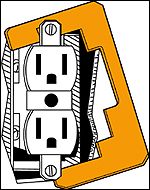
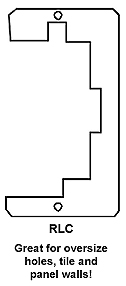
2nd - try these gizmo's from Caddy:
1409.jpg


1408.jpg


http://www.erico.com/products/CADDYcfcDvcLvlrRetnr.asp

If you can't get these things (Caddy RLC) to work, you may need to speak to the drywall/taper crew chief/s.
 
stickboy1375 said:
Just what I want to do is count washers...

I have small fingers I guess? I just hold the nut and turn the screw.. it's all i've ever used...

Well I am not counting much with 1/4-20 nuts. :)

Need one, maybe two on each end more than that and the box needs more attention than some spacers.
 
iwire said:
Well I am not counting much with 1/4-20 nuts. :)

Need one, maybe two on each end more than that and the box needs more attention than some spacers.

But if your 1/4-20 nuts are still a little shy, your plate will still break after someone plugs something into the receptacle... no?
 
JOHNEO99 said:
2005 406.4 d exp. 2 gives the correct verbage and allows my installation and this inspector knows it.

it is incorrect in 2002 in my opinion

The 2 exceptons are new for '05.
If the installation is under the 02', what grounds do you have to cite the '05 as an argument for your situation?
 
celtic said:
The 2 exceptons are new for '05.
If the installation is under the 02', what grounds do you have to cite the '05 as an argument for your situation?


because it says flush or projects the plate. it doesnt say project the front surface of the plate or the back which is probably why they made it more clear in 2005.

if the receptacle projects past the back of the plate it is projecting ..generally speaking. and, if it projects the back of the plate there is no gap

j
 
JOHNEO99 said:
because it says flush or projects the plate. it doesnt say project the front surface of the plate or the back which is probably why they made it more clear in 2005.
hmmm...

406.4(D) Position of Receptacle Faces.
After installation, receptacle faces shall be flush with or project from faceplates of insulating material and shall project a minimum of 0.4 mm (0.015 in.) from metal faceplates.
('02)

Not sure what you mean "it doesnt say project the front surface of the plate or the back"....the NEC does say "project from faceplates".

I'm still not seeing how you are attempting to use the '05 for an '02 situation.

The '05 NECH has the following commentary after the new exceptions (BTW, commentary is NOT enforceable):

Two exceptions have been added to 406.4(D) in the 2005 Code. The first allows the use of listed kits that include the receptacle and a nonmetallic faceplate and that have been evaluated by a recognized testing laboratory to ensure that sufficient blade contact is achieved by the attachment plug when inserted in the receptacle. In addition, the faceplate would not fit the standard style receptacle. The second new exception permits the use of a faceplate with an integral receptacle to cover the face of the box-mounted receptacle. These listed faceplates can be installed with any properly installed, flush-mounted device.

While commentary is just that - I don't see how it helps you...even IF this install was under the '05.

Both the '02 and '05 NECH have the following commentary after 406.4(D):
The reason for requiring receptacles to project from metal faceplates is to prevent faults between the blades of attachment plugs and metal faceplates. The proper mounting of faceplates ensures that attachment plugs can be fully inserted, thus providing a better contact. The NEC does not specify the position (blades up or blades down) of a common vertically mounted 15- or 20-ampere duplex receptacle. Although many drawings within this handbook show the slots for blades up such as Exhibit 406.1, the receptacle may be installed with the slots for blades down. Receptacles can also be installed horizontally as well as vertically. Refer to 406.8(B) for information on receptacles installed in wet locations.

Now that makes sense doesn't it?
At some point in time, the plates could be switched to metallic plates and the end user could be at risk.
 
I've had this issue before (many times) and when all else fails I've used steel cover plates; they are available in all the colors and are thin as well as strong enough to stablize the device.
 
stickboy1375 said:
Do those satisfy the requirement of 312.4?
Being as how the OP is under the '02, I see no problem with them - 312.4 is new for '05.

Imagining that this is under the '05, what problem do you see and WHY?

EDIT TO ADD:
check 314.21 ~ '02 & '05 ('05 has a change)
 
Last edited:
celtic said:
Being as how the OP is under the '02, I see no problem with them - 312.4 is new for '05.

Imagining that this is under the '05, what problem do you see and WHY?


I didn't see a problem, other than I never saw that product before, was basically just asking if you've used them....
 
406.4(D) ex. 2 "listed nonmetalic faceplates that cover the receptacle

face to a maximum thickness of .04 in. shall be permitted.

Do you have .04 in.?

Now we need a feeler gauge to check faceplates. 2005 NEC
 
Last edited:
stickboy1375 said:
I didn't see a problem, other than I never saw that product before, was basically just asking if you've used them....
Far more than I care to tell....the sheetrockers on this job have:
A) Never done sheetrocking before
B) Left their tape measures home
C) Have a severe case of "Jimmy Crack Corn..."
D) All of the above

While I think these things are cheesey, they do allow me to get the job done inspite of the rockers best efforts to prolong the agony of this job. The EI has no problem with thier use.

.....from the link provided:
  • Prevents broken cover plates
  • Stops device from being pushed back in wall
  • Makes floating device rigid
  • UL & cUL Listed
    No Load Rating - Positioning Only
 
celtic said:
hmmm...

('02)

Not sure what you mean "it doesnt say project the front surface of the plate or the back"....the NEC does say "project from faceplates".

I'm still not seeing how you are attempting to use the '05 for an '02 situation.

The '05 NECH has the following commentary after the new exceptions (BTW, commentary is NOT enforceable):


While commentary is just that - I don't see how it helps you...even IF this install was under the '05.

Both the '02 and '05 NECH have the following commentary after 406.4(D):


Now that makes sense doesn't it?
At some point in time, the plates could be switched to metallic plates and the end user could be at risk.

I disagree

the tolerence for plastic plates is different because arcing between the blades and and plastic cant happen so in 406.4 D 2005 the plastic plates can be flush or project no specific amount while the metal ones must project .4mm. Exp. 2 says with plastic plates the FACE of the receptacle be covered by 0.040 thickness which can happen without coming completely thru the plastic plate which is my situation. as long as i have .040 insulated material past the face of the receptacle i should be complying.

If someone took these plates of and put on steel the face of the receptacle would completely project the front of the plate due to their slim design and thickness.


These receptacles are barely touching the ears to drywall which is against code...not "rigid" and they still wont completely project past the front surface even though they are UL listed.

I have literally trimmed thousands of receptacles and know how to do the simple install. Never had this problem before.
 
JOHNEO99 said:
These receptacles are barely touching the ears to drywall which is against code...not "rigid" and they still wont completely project past the front surface even though they are UL listed.

Even if you used a Caddy RLC or the nuts/washers/garden hoses ideas...the problem would still persist?


Not that it *should* make a difference, but are the devices and plates from the same manufac.?
 
Status
Not open for further replies.
Top