Compliant 600A Service

psimmond

Member
Location
Georgia
Occupation
Building Inspector
This home has 4 grouped service disconnects/emergency disconnects: 200A, 200A, 200A, 100A. Feeders are run to four corresponding MLO panels.

It seems this is not compliant but could be made compliant by backfeeding one of the 200A panels via a 100A breaker. Is this right?
 
Wouldn't is be feasible to have overload conditions since the load can exceed the service size?
If I understand your question you're asking about the fact that the 600 amps is less than the sum of the 4 service disconnects? (200+200+200+100=700)
 
If I understand your question you're asking about the fact that the 600 amps is less than the sum of the 4 service disconnects? (200+200+200+100=700)
Yes, less than the sum of the disconnects and potential load demand from the combined panels.
 
That's true of most of the multi-main services.
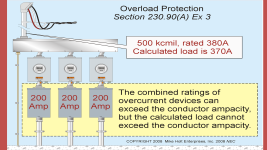
On those (multi-main) the NEC only requires the service conductors to be sized for the calculated load

Here's a pictorial Mike has on the subject.
1763605263893.png
 
Yes, less than the sum of the disconnects and potential load demand from the combined panels.
Yes in this case the combined rating of the service disconnects irrelevant. As depicted in the graphic that Augie posted only a load calculation will be able to determine if the 600 amps is code compliant.
 
That's true of most of the multi-main services.
On those (multi-main) the NEC only requires the service conductors to be sized for the calculated load

Here's a pictorial Mike has on the subject.
View attachment 2580671
Thanks! So if a homeowner wants to upgrade to a 600A service, for example, they just need to show the AHJ that their calculated load exceeds 400A. In a scenario like this, they could use a 1500 kcmil copper SE cable, but I suppose it would be more common for the electrician to size the SE cable based on the actual calculated load, for example, 1250 Aluminum for a 485A calculated load. Is this right?
 
Thanks! So if a homeowner wants to upgrade to a 600A service, for example, they just need to show the AHJ that their calculated load exceeds 400A. In a scenario like this, they could use a 1500 kcmil copper SE cable, but I suppose it would be more common for the electrician to size the SE cable based on the actual calculated load, for example, 1250 Aluminum for a 485A calculated load. Is this right?
A few additional questions:
1. When it comes to se cables, do they come cabled under a sheathe or as individual conductors? Or does it depend on the size?
2. If your calculated demand was 600A for a residence, would you be more likely to use 1500 kcmil copper, or run two smaller parallel conductors?

BTW, I really appreciate you guys putting up with my elementary questions.
 
1) I general they come as a multi conductor cables although the NEC definition allows single conductor SE cables. For practical purposes 750 kcmil is about the largest size you'll see.
2) Anything larger than thst would usptulize parall
 
No, this is America, you can put in whatever size service you want. You dont have to prove anything to the AHJ.
Around here the POCO has some say in what size service you can install and they typically will require a load calculation if you want something larger than 200 amps.
 
Top