Conduit Run S.O.S.

Status
Not open for further replies.
JohnME said:
I just went through something like this- only with 300 mcm cu. I used LB's, and LL's. Just remember, if your going to use these fittings, UP your pipe size. I had a 3" EMT run and went to 4" to accommodate the above fittings. Put the fittings in the best place for pulling/feeding.

JohnME, I'm using 300 mcm aluminum. I was planning to use 3" PVC sched 80 conduit. I'd like to use 4" but than it would require a deeper enclosure to accomodate the connectors. The previously run conduit was only two and a half inch so the 3 inch should provide me a little extra room without going too big. What type insulation did you go with THXW or XHHW ?
 
Krim said:
I would like some suggestions please on the best fittings to use in order to make this run and pull as easy as possible. The scenario is as follows :

From an existing 18" X 18" junction/splice box , I need to transition over 3 feet and 90 up about 30" into the bottom of a 225 Amp Service Panel(Nema 3R) of which will have feed through lugs. Back out the bottom, 90 straight back to another 90 and run the distance of about 48 feet horizontally along the edge of a concrete slab(8" thick) 90 back up again for an 8 foot vertical , 90 yet again to another horizontal run of about 18 feet, down 90 about 2 feet and yes transition yet again to another horizontal run in air (supported with either 6" x 6" treated posts or galvanized pipe secured at the base onto a concrete pad with cradle supports beneath the conduit) for a 12 foot span through the building wall into an existing 200 Amp subpanel. The area where the conduit will be in the air between buildings is not accessible by equipment so there is no worry as to the height, just stability of the supports.
The wiring will be 4 -#300 Aluminum conductors pulled through 3 inch diameter schedule 80 PVC . The area will be wet at least 95% of the time and I was intending to use type "XXHW" for the moisture resistance characteristics due to condensation buildup within the conduit. It will be susceptible to both cold and hot water overspray conditions on a regular basis.
Any and all advise or recommendations would be greatly appreciated due to the fact that I need to turn in an estimate for materials by this weeks ending .
Thanking you all in advance ,
Carl
If I counted correctly you have 5 90's and it is less than 100 feet. With that being said what about a type "C" conduit body, so you could pull straight threw.
 
peter, in response to your question "Why do you have to drop down 2' for the open air part." I have to get below the soffit area of 2 seperate buildings that are at different heights and make an offset to transition from one building to an existing opening directly through and into the existing 200 Amp panelboard the boss wants to reuse.
 
XHHW is what I used. The problem is, 3" LB's and fittings like that are not going to be rated for 300 AL wire. Regardless, you will obviously need a couple pull points.
 
Krim said:
Sorry guys I'm not much of an artist nor do I have any CAD experience. What is an isometric drawing anyway, a rough sketch ?

An isometric drawing is kinn'a like a crooked electrical drawing, much like you see on the M sheets for their piping.

Best Wishes Everyone in 2008
 
mdshunk said:
Probably none, unless that 5,000 gallon tank was about 4" wide and sitting right over the conduit.

It sounds like from one of your last responses that your customer has pretty much dictated what the path will be. Bid it and go with the flow...

He has pretty much laid out the route he would like me to run it, I'm just not quite sure of the best "how to's" just yet. I will talk with him further about your idea though of cutting a trench across the slab to eliminate so many bends ... the most that can happen is he'll say no and give me his reasons for not wanting to do it that way. It would sure save me from some hassles.
 
Krim said:
What is an isometric drawing anyway, a rough sketch ?
I believe it's a drawing with an aspect that provides all three dimensions, rather than an overhead or front view, so all turns can be represented. It can be the easiest way to make a complete parts list. Something like this:

plumbing-diagram.jpg
 
JohnME said:
Just remember, if your going to use these fittings, UP your pipe size.

I'd recommend you keep your pipe size and upsize the LL,LR,LB and install reducing adapters.

You must install the expanion couplings mentioned by Marc. You will probably need them between each LL,LR,LB,90ell,panel,box,etc.
 
peter said:
I get about 93' of run and SIX 90? bends.
Since this is PVC, I would caution against using the factory bell ends. Cut them off, cut off the bell part and use the rest as a coupling. But that's beside the point.
You could possibly get by with one 90? bend: From the top side of the 225 Amp panel, run your tube straight to the wall, place your 90? IN the wall and it hopefully will end right at the side of your last panel.
But wait! there's more. If you replace the 90? with a pair of say 15? bends you can create an offset again into the back of your panel.
Placing two 90?s immediately adjacent to one another [one connected directly to the other] in different planes will make it impossible for a standard flat fish tape to go through since its plane of bending is set by the first bend. But that's the least of your worries.
Why do you have to drop down 2' for the open air part. Can't you use some sort of supports or stantions to support it in the air 2' higher? Or at least replace the two 90?s with a 22 1/2? offset. If any of this is underground or could be, then a couple of sweeps and a straight run should suffice.
But note: I have no idea of your actual situation, obstacles and whatnot so I don't know why you have all those ups and downs.
~Peter


Somebody's thinking, you should thank him for that! I had to see that on paper:confused:
 
Krim said:
I would like some suggestions please on the best fittings to use in order to make this run and pull as easy as possible. The scenario is as follows :

From an existing 18" X 18" junction/splice box , I need to transition over 3 feet and 90 up about 30" into the bottom of a 225 Amp Service Panel(Nema 3R) of which will have feed through lugs. Back out the bottom, 90 straight back to another 90 and run the distance of about 48 feet horizontally along the edge of a concrete slab(8" thick) 90 back up again for an 8 foot vertical , 90 yet again to another horizontal run of about 18 feet, down 90 about 2 feet and yes transition yet again to another horizontal run in air (supported with either 6" x 6" treated posts or galvanized pipe secured at the base onto a concrete pad with cradle supports beneath the conduit) for a 12 foot span through the building wall into an existing 200 Amp subpanel. The area where the conduit will be in the air between buildings is not accessible by equipment so there is no worry as to the height, just stability of the supports.
The wiring will be 4 -#300 Aluminum conductors pulled through 3 inch diameter schedule 80 PVC . The area will be wet at least 95% of the time and I was intending to use type "XXHW" for the moisture resistance characteristics due to condensation buildup within the conduit. It will be susceptible to both cold and hot water overspray conditions on a regular basis.
Any and all advise or recommendations would be greatly appreciated due to the fact that I need to turn in an estimate for materials by this weeks ending .
Thanking you all in advance ,
Carl

Have you consdiered CLX?
 
LarryFine said:
Krim said:
What is an isometric drawing anyway, a rough sketch ?
I believe it's a drawing with an aspect that provides all three dimensions, rather than an overhead or front view, so all turns can be represented. It can be the easiest way to make a complete parts list.
Your example is a plumbing or process piping isometric. Can't say I've ever seen one for conduit and electrical equipment.

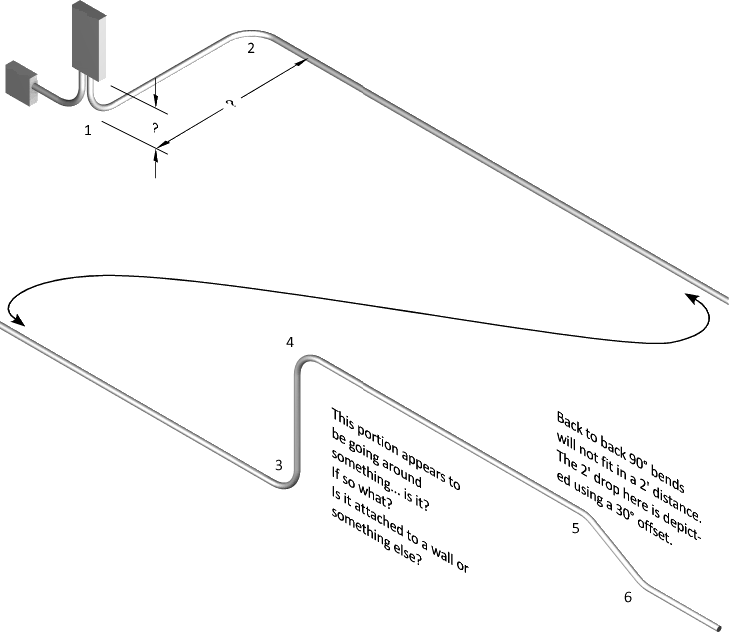
Nevertheless, the following image is a 3D isometric view of how I interpreted Krim's description...

conduitrun.gif


Krim didn't provide distances for the first two legs of the long run—which could make a major difference as to what parts go where—nor did he provide a heading for subsequent turns. Structures in the immediate area can also be of importance. A simple [plan view] layout diagram/sketch would be nice.

BTW, I like Laszlo's suggestion on using CLX instead. Perhaps a messenger cable for last leg will suffice.
 
Last edited:
Smart $ said:
Your example is a plumbing or process piping isometric. Can't say I've ever seen one for conduit and electrical equipment.

Nevertheless, the following image is a 3D isometric view of how I interpreted Krim's description...

conduitrun.gif


Krim didn't provide distances for the first two legs of the long run?which could make a major difference as to what parts go where?nor did he provide a heading for subsequent turns. Structures in the immediate area can also be of importance. A simple [plan view] layout diagram/sketch would be nice.

BTW, I like Laszlo's suggestion on using CLX instead. Perhaps a messenger cable for last leg will suffice.


WOW Smart $ , What program did you use to draw that up ?
I could definitely use something like that for laying out things for a better perspective. Other than a couple of the actual runs needing to be flipped over and some other minor details that is darn close ! I was trying to come up with some ideas to keep from having more 90's at points 5&6 and the 30 deg. offset looks like a good possibility. By the way the missing distances are aprx. between points 1&2 ~3-4 ft, pts 2&3 ~48 ft, pts 3&4 ~8 ft, pts 4&5 ~18 ft, and pts 6 to end wall face ~12 ft. If point 2 were flipped and connected at point 3 and Point 4-5 would pivot towards lower left . This will be exactly what I have .
I don't expect you to make any changes I was just clarifying how it actually is .
Thanks again for all of your help Smart $ and the rest of you guys .
I am serious about wanting to know what program you used though Smart $ , I like this drawing .
Carl :)
 
Krim said:
WOW Smart $ , What program did you use to draw that up ?
I could definitely use something like that for laying out things for a better perspective...
I used TurboCAD 14 Pro. Judging from your earlier comment...
"Sorry guys I'm not much of an artist nor do I have any CAD experience. What is an isometric drawing anyway, a rough sketch ?"​
...learning to use it to the degree of generating such a drawing will probably take more time and patience than you would be willing to depart with. I have ten years of "practice" through ten program versions under my belt.
 
Status
Not open for further replies.
Top