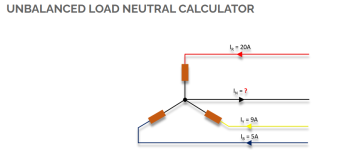
Running a 3 phase, 4 wire riser that is serving five panelboards that are 120/208V single phase panels. I have a calculated load of 43,295 VA demand. On the riser, my calc is showing 120 amps when dividing by 360 but this is incorrect since it is an unbalanced load (would need 6 panelboards to balance). How can I determine what max current is on unbalanced phase?

You are using an out of date browser. It may not display this or other websites correctly.
You should upgrade or use an alternative browser.
You should upgrade or use an alternative browser.
Converting 3 phase load into single phase
- Thread starter cppoly
- Start date
wwhitney
Senior Member
- Location
- Berkeley, CA
- Occupation
- Retired
If all 5 panels have identical loads, then adding a sixth one across the two less loaded ungrounded conductors will give you a balanced arrangement without changing the load on the most loaded ungrounded conductor. In which case the answer is 6/5 * 43,295 VA / 3 / 120A = 144A.
If the loading on the panels varies, then it would be more accurate to assign VA values to each of the 3 conductors A, B, and C from each of the 5 panels, and then add the VA values up per conductor to find the largest, and divide that conductor's VA by 120V to get the current. This will be exact (assuming all loads are unit power factor) if the total 208V 2-wire loading on the 208Y/120V ends up balanced. If it's not balanced, it will be slightly nonconservative (an underestimate), but the effect will be small if the 208V 2-wire loading is close to balanced.
If you're concerned about that potential nonconservativeness, then for each of the 3 panels you can treat the 2-wire 208V loads separately from the 120V loads. [Of course if you have 120/208V 3-wire loads, you have to estimate how the load is divided between those two sources.] So now you end up with 3 total VAs for 120V loads for conductors A, B, and C, and 3 total VAs for 208V loads AB, BC, and CA. That's enough information to exactly calculate the current on each conductor (again assuming all loads are unit power factor), but the procedure is complicated enough that I'll skip explaining unless you provide those 6 numbers.
Cheers, Wayne
If the loading on the panels varies, then it would be more accurate to assign VA values to each of the 3 conductors A, B, and C from each of the 5 panels, and then add the VA values up per conductor to find the largest, and divide that conductor's VA by 120V to get the current. This will be exact (assuming all loads are unit power factor) if the total 208V 2-wire loading on the 208Y/120V ends up balanced. If it's not balanced, it will be slightly nonconservative (an underestimate), but the effect will be small if the 208V 2-wire loading is close to balanced.
If you're concerned about that potential nonconservativeness, then for each of the 3 panels you can treat the 2-wire 208V loads separately from the 120V loads. [Of course if you have 120/208V 3-wire loads, you have to estimate how the load is divided between those two sources.] So now you end up with 3 total VAs for 120V loads for conductors A, B, and C, and 3 total VAs for 208V loads AB, BC, and CA. That's enough information to exactly calculate the current on each conductor (again assuming all loads are unit power factor), but the procedure is complicated enough that I'll skip explaining unless you provide those 6 numbers.
Cheers, Wayne

LarryFine
Master Electrician Electric Contractor Richmond VA
- Location
- Henrico County, VA
- Occupation
- Electrical Contractor
Do individual load calcs. Generally, you calculate as if you have six loads.

Joethemechanic
Senior Member
- Location
- Hazleton Pa
- Occupation
- Electro-Mechanical Technician. Industrial machinery
Running a 3 phase, 4 wire riser that is serving five panelboards that are 120/208V single phase panels. I have a calculated load of 43,295 VA demand. On the riser, my calc is showing 120 amps when dividing by 360 but this is incorrect since it is an unbalanced load (would need 6 panelboards to balance). How can I determine what max current is on unbalanced phase?
Are you looking for something like this?