Copper reaction in switchboard

Merry Christmas
Status
Not open for further replies.

lmmillican

Inactive, Email Never Verified
We are designing an addition to a local high school, and when we had the electrician open the switchboard we noticed that all the bussing was black and flaking off as well. After looking further we discovered that even the copper conductors were turning black. I have never seen a reaction like this and was curious if someone has ran across this. My opinion is that at some point there was something stored in the main electric room which has caused the copper to react this way. Maintenance personel said they could not remember anything ever being stored in there that would cause everything copper to turn black. I had them open the sprinkler riser room next door, and all the copper fittings were black as well. There was a new roll of copper tubing the same way. The switchboard is a 3 section 4000 amp and in every section the buss is the same way. Just curious if anyone had ever ran into this. I have pictures, but was unsure of how to post the pictures here. I will try to get them on. Thanks for your input.
 
We have had this happen at a pulp and paper plant.Within 1 week the copper busbar was black as these pictures.The cars in the parking lot were losing their paint too.
 
My first job was in a Sulfur Plant, all the copper looked just like that (caused by Hydrogen Sulfide).

Could sewer-gas somehow be getting in there?
 
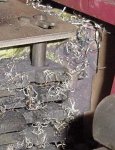
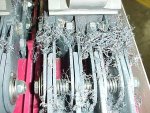
Yep, those are called silver whiskers and can get big quick (I have pics at work I can post Monday) and cause a fault. Caused by sulphur rich atmosphere.

Find the source of sulphur and remove it, if not possible you can use carbon filters if the room is forced air (They NEED to be changed regurally) if not then there are some treatments for the equipment.
 
Shoot ! I remember seeing copper in that same condition , but I just can't remember the circumstances . Probably a chemical plant or one of our other
wonderful customers . :smile:
 
I too would say sulfur. But since it is gaseous it should have a smell that can be located - well unless you were storing black powder in there....:roll:

While there are a number of other chemical compounds that could produce a black oxidation - besides it being bad for your copper - it might not be a good idea for humans as well. JMSO
 
I was involved in a situation @ a chicken rendering plant and a chicken processing facility. After samples of the "flakes" were analized the main culprit was Hydrogen-Sulfied and to a lesser extent some of the airborne protiens.

In on case the switchboard was cleaned and as far as I know it is still in service. As for the other case both switchboards utimately had to be replaced due to the amount of flaking of the silver plating on the bus.

The recommended solution was to add some charcoal filters to the air intake for the electrical rooms and place them in a potisive pressure environment. In the case of the replacement switchboards all plating was changed from silver to tin which will not react with the H2S.
 
I have seen this in commercial buildings, sewage treatment plants, water treatment plants, hospitals and other establishments. Most times it is the coating on the copper.


I have not seen the flaking but would have to think it is a chemical reaction (as noted) and warrants investigation (such as a forensic firm) to determine if this will worsen or stops at some point.
 
lmmillican said:
We are designing an addition to a local high school, and when we had the electrician open the switchboard we noticed that all the bussing was black and flaking off as well. After looking further we discovered that even the copper conductors were turning black. I have never seen a reaction like this and was curious if someone has ran across this. My opinion is that at some point there was something stored in the main electric room which has caused the copper to react this way. Maintenance personel said they could not remember anything ever being stored in there that would cause everything copper to turn black. I had them open the sprinkler riser room next door, and all the copper fittings were black as well. There was a new roll of copper tubing the same way. The switchboard is a 3 section 4000 amp and in every section the buss is the same way. Just curious if anyone had ever ran into this. I have pictures, but was unsure of how to post the pictures here. I will try to get them on. Thanks for your input.

More than a nice brown patina we see all of the time.
Are you near a pump house. or in Contact with high sulfer content sprinkler water system?
 
We see this occassionally in certain areas of the refinery.
Silver whiskers caused by sulfer contamination (H2S)

We had issues with microprocessor relays failing due to these whiskers. and control issues due to the tracking of the signals across consecutive terminals.
(We now utilize conformal coatings on all electronics, and we no longer utilize silver coated conductors, busses)

It only takes a negligible amount to start corroding (less than 10PPM) since none of our H2S detectors were activated in the areas we had the corrosion.
 
I worked with a major manufacture of bolted pressure switches today. I asked him about this issue. Their stance is the silver coating was installed for the benefit of wear and conductivity on the contact mating surfaces. If the switch is normally closed the flaking does not occur on the contact surface areas this should not be an issue. The complete bus bar is coated strictly because it is easier from a manufacturing standpoint, some vintage switches from this manufacture will have only portions of the stationary contacts coated.

Obviously flaking that results in damaged contacts is a concern and flaking that deposits metal on insulating surfaces is a concern.

Sulfur was one item noted to result in this condition, chlorine was another item noted to have an adverse affect.
 
stickelec said:
My first job was in a Sulfur Plant, all the copper looked just like that (caused by Hydrogen Sulfide).

Could sewer-gas somehow be getting in there?

That was my first initial thought was the problem they have had with sewer gas in the area. They have taken steps to eliminate the sewer gas problem and it does not appear to be as noticeable as it used to be.
 
Here is how bad they can get
 

Attachments

  • AgWhisk-FingClust-after-fail.jpg
    AgWhisk-FingClust-after-fail.jpg
    29.2 KB · Views: 3
  • AgWhisk-PrimCont-after-fail1.jpg
    AgWhisk-PrimCont-after-fail1.jpg
    60.6 KB · Views: 3
Status
Not open for further replies.
Top