disconnect switch color marking

Merry Christmas
Status
Not open for further replies.

JAMMAN

Member
Location
ny
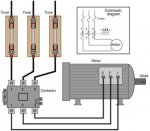
I'm sure this is a violation but not sure where in code. We installed a three stop hydro elevator. In order to get proper phase sequence the installing electrician(for the power) switched two legs on the disconnect switch. It is a 480 volt installation with color codes BOY. The electrician swapped two load side wires, so now the BOY on the load does not match the colors on the load side.
Although it is easily corrected by reidentification, the installing electrician does not feel it is a violation. His argument is that it is common to swap phases to get proper motor rotation. Is there a code that states that line and load wire identification must match?
 
I'm sure this is a violation but not sure where in code. We installed a three stop hydro elevator. In order to get proper phase sequence the installing electrician(for the power) switched two legs on the disconnect switch. It is a 480 volt installation with color codes BOY. The electrician swapped two load side wires, so now the BOY on the load does not match the colors on the load side.
Although it is easily corrected by reidentification, the installing electrician does not feel it is a violation. His argument is that it is common to swap phases to get proper motor rotation. Is there a code that states that line and load wire identification must match?

The electrician did nothing wrong. That's the way it's done.

Is the job T&M, (Time and Material) or a bid contract? IF T&M I am sure the electrician would be more than happy to remark both ends of the load conductors if you told him to.


.
 
The electrician did nothing wrong. That's the way it's done.

And it's usually done on the load side of the disconnect switch so you don't have open the peckerhead and re-wire two leads feeding the motor.
 
And it's usually done on the load side of the disconnect switch so you don't have open the peckerhead and re-wire two leads feeding the motor.
Or at the motor controller.

I am guilty of doing this, will probably do it again.

Am not going to climb up that 150' tall grain elevator leg again just to swap leads on the motor when the motor starter is on grade level and real easy to access.

If inspector wants me to change that then he is earning his pay and coming up top to make sure I marked it correctly on that end as well.:happyyes:
 
Last edited:
Isn't that why we phase id . so you know rotation? Open a disco. line boy, load yob, unless you phase/rotation meter the motor you don't know rotation until you add power.
Now phase and rotation for your infrastructure yes, at the final load, what's the big deal?
 
Isn't that why we phase id . so you know rotation? Open a disco. line boy, load yob, unless you phase/rotation meter the motor you don't know rotation until you add power.
Now phase and rotation for your infrastructure yes, at the final load, what's the big deal?
Some instances it is important to know rotation before you energize the load or it can damage driven components. Such equipment is wise to also include a phase monitor so that it won't run with wrong input phasing.

Most of what I have worked on didn't matter or at least didn't hurt to "bump" the motor to check phasing. Even if you were careful to mark things in an effort to get correct phasing on initial install - you still "bump" the motor(s) to double check rotation before you actually run them.

If supplying a three phase resistive load or even a VFD - who cares about input phasing? The equipment certainly doesn't care.

This is more design requirements by an NEC that states it isn't a design manual.
 
Some instances it is important to know rotation before you energize the load or it can damage driven components. Such equipment is wise to also include a phase monitor so that it won't run with wrong input phasing.

Most of what I have worked on didn't matter or at least didn't hurt to "bump" the motor to check phasing. Even if you were careful to mark things in an effort to get correct phasing on initial install - you still "bump" the motor(s) to double check rotation before you actually run them.

If supplying a three phase resistive load or even a VFD - who cares about input phasing? The equipment certainly doesn't care.

This is more design requirements by an NEC that states it isn't a design manual.
Thanks, I know but I thought we were talking about color of tape, that's why I mentioned the rotation meter you use before power is applied.
 
We replaced a dishwasher in school kitchen a couple weeks ago. Pump motor was only thing that needed proper rotation. Had no clue what incoming line rotation was, or what it needed to be on the new machine. Hooked it up not knowing what rotation would be and when pump came on found out if right or wrong. Seems it would have taken as much if not more effort to check rotation ahead of time - then you still have some chance of being wrong anyway. If it were critical enough type of load that reverse operation would damage something - you would hope they included a phase monitor.

There was only a single voltage system at this facility BTW so phase/system identification not even required.
 
You have a new 3 phase motor to install. You have a phase meter that can show A-B-C or A-C-B (or whatever the two directions are labeled). How do you know what the rotation of the motor will be?

I can use a phase meter to read an existing motor circuit and move that motor to another circuit and know what direction it will turn with confidence. But a new piece of equipment?

Or to paraphrase the question, do ALL motor manufacturers guarantee that given rotation A-B-C determined by phase meter, that A connected to L1, B to L2, C to L3 will always result in the motor turning CW when viewed from the drive end?:?
 
Or at the motor controller.

I am guilty of doing this, will probably do it again.

Am not going to climb up that 150' tall grain elevator leg again just to swap leads on the motor when the motor starter is on grade level and real easy to access.

If inspector wants me to change that then he is earning his pay and coming up top to make sure I marked it correctly on that end as well.:happyyes:

I am guilty of doing this, will probably do it again.

Nothing in 210.5 says you can't. We are talking about a 3ph AC motor here.
 
We replaced a dishwasher in school kitchen a couple weeks ago. Pump motor was only thing that needed proper rotation. Had no clue what incoming line rotation was, or what it needed to be on the new machine. Hooked it up not knowing what rotation would be and when pump came on found out if right or wrong. Seems it would have taken as much if not more effort to check rotation ahead of time - then you still have some chance of being wrong anyway. If it were critical enough type of load that reverse operation would damage something - you would hope they included a phase monitor.

There was only a single voltage system at this facility BTW so phase/system identification not even required.


Another example is found on an elevator leg in a bean meal. The gear drive will have an anti reversal dog to prevent the weight of the full buckets of product on the belt from reversing when the motor stops for any reason.

In the case of a new motor install the direct drive coupling is not completely connected from the motor to the gear drive so the motor can be bumped to check for the correct rotation. Replacing a bad motor with a new one the same process is used.
 
Nothing in 210.5 says you can't. We are talking about a 3ph AC motor here.

From 2014 NEC 210.5(C)(1):

Where the premises wiring system has branch circuits supplied from more than one nominal voltage system, each ungrounded conductor of a branch circuit shall be identified by phase or line and system at all termination, connection, and splice points in compliance with 210.5(C)(1)(a) and (b)

...
To me that says if there is more then one nominal voltage system, you must identify each branch circuit conductor to designate which phase and system it goes with.

If you only have one nominal system voltage at the premises then you don't even need to identify anything except what is grounded and equipment grounding conductors.
 
Status
Not open for further replies.
Top