Do we need ground fault protection or not???

Status
Not open for further replies.

AEFAC

Member
Location
Montana
Hello,

We recently ran power to some heat mats on a roof designed to take care of a ice build up issue on a flat roof.

We installed ground fault protection as per code. When the mats were turned on after awhile the ground fault protection tripped.

The ground fault is a separate unit and the circuit is not over loaded.

We took a megger and tested the mats and they all checked out just fine.

We then called the manufacturer and they told us that there mats do not need ground fault protection as it is not a resistive load.

They say it is a carbon nano sheet heating element (which I know nothing about) and it sends false readings and trips the ground fault protection.

Here is there sheet that they sent us and they say everything is UL listed after we asked them. Any input is greatly appreciated as we are hesitant of disconnecting the ground fault protection.

Thanks
 

Attachments

  • CCF12122017.pdf
    82.8 KB · Views: 1
They say that there product cannot be used with "GFCI", you would need to determine what code section or Article these mats fall under and whether or not the NEC requires GFPE. If it's under article 426 and is a product that is not one of the types listed in that Article then it need to comply with 426.14. Judging from the specs in the sheet (using 110 and 220 as supply voltages) the manufacturer might not be of much help.

426.14 Special Permission. Fixed outdoor deicing and snow-melting equipment employing methods of construction or installation other than covered by this article shall be permitted only by special permission.
 
agree with above 100%. were you using GFCI (5ma) protective devices or GFP (30ma) devices ?
 
We are using 30 ma trip.

We did notice that they stated "GFCI" protection and when we spoke to the manufacturer and told them we were using the 30 ma trip I think it went right over their head.

Forgot to mention that we spoke with the local inspector and he said it would probably be fine as long as it was installed to manufacturers specs.

Will see if its something they will sign off on.

Has anybody heard of nano sheet heating?
 
"Nano sheets" are just a (relatively) new technology for making "non-woven" fabrics. If you are familiar with Tyvek, the white stuff that is used for building sheathing or impossible-to-tear Amazon envelopes, that's an example of a non-woven fabric. Nano sheets are different, but similar in how they are made and used. They are very very tough, resistant to tearing and don't degrade in UV light (at least not as fast as plastics).

One thing you can do with nano sheets is embed other materials in them, so for instance make them conductive. Nano sheet heaters are these flexible tough sheets that have been infused with conductive materials. From their description they have apparently use a material that makes them into a large PTC resistor. PTC stands for Positive Temperature Coefficient of resistance, meaning as the temperature increases, the resistance increases as well. PTC resistors are therefor self-limiting, because the closer they get to becoming dangerously hot, the more they resist the flow of electricity into them. That's what makes them a good way to heat something.

The thing about their data sheet that bugs me is their use of "like a cell phone". That smacks of technobabble, something often used by scam artists. But what I THINK they are meaning is that one thing you can do with a large nano sheet heating element is to design it to react to something like a PWM output signal and produce infra-red spectrum heating across the entire sheet, as opposed to radiant heating. It essentially makes the sheet a large flat transmitting antenna of sorts. If they use the "far infrared" spectrum, it would heat water (aka snow) without needing to heat the air around it, similar to what a microwave oven does. I suppose, in a far fetched way, you might think of that as "similar" to how a cell phone communicates, i.e. microwave communications. I suppose from a marketing standpoint, if they said "melts the snow like a microwave oven would" it might freak out a lot of people who incorrectly associate "microwave radiation" with radioactivity (ionizing radiation).

The PWM signal that would make that happen is likely what will cause a GFCI to trip.
 
We are using 30 ma trip.

We did notice that they stated "GFCI" protection and when we spoke to the manufacturer and told them we were using the 30 ma trip I think it went right over their head.

I could see it going over their head when they used those voltages in their literature.
 
are they straight-up PTC, or is there a controller involved?
really need scope with FFT function to see what the thing is doing.

try wrapping the ckt wires around ferrite ring before attaching to whatever they are supplying. gfi breakers seem to be susceptible to line noise being amplified enough for the unit to believe there is a fault and then trips.
 
Last edited:
i.e. microwave communications. I suppose from a marketing standpoint, if they said "melts the snow like a microwave oven would" it might freak out a lot of people who incorrectly associate "microwave radiation" with radioactivity (ionizing radiation).

The PWM signal that would make that happen is likely what will cause a GFCI to trip.
Yes.
But I've read through their elementary school description and it sounds live a passive PTC device which wouldn't need a PWM controller.
Obviously I'm missing something.........or just thick.
 
I don't think you are missing anything.

They do not say how a 'false reading' is created for a GFCI. Either they have real leakage (in which case it isn't a false reading) or they have so much capacitive coupling to ground that apparent leakage is seen (I would argue that this is also real leakage, just not caused by an insulation failure).

Lots of other manufactures have stated their equipment is not compatible with GFCI, simply because their normal design has significant leakage of current to ground!!!

-Jon
 
Yes.
But I've read through their elementary school description and it sounds live a passive PTC device which wouldn't need a PWM controller.
Obviously I'm missing something.........or just thick.

Yes, I agree their description is woefully inadequate. I came up with the high infra-red spectrum aspect because I know from a project that there are nano sheet based personnel heaters that work this way and thought that might explain their "cell phone" technobabble. These heaters work to heat the water in your skin rather than the air around you. I'm on my phone now but I have a website for them at my office desk, I'll post it later today.
 
Are these the product type used to set up radiant heating panels in the modesty panel for keeping the secretary's legs warm?
Maybe now, but those panels have been around for a lot longer than this technology. The old ones were just radiant heaters, but I've seen some new ones that are super thin, so they likely use this now.
 
Hello,

We recently ran power to some heat mats on a roof designed to take care of a ice build up issue on a flat roof.

We installed ground fault protection as per code. When the mats were turned on after awhile the ground fault protection tripped.

The ground fault is a separate unit and the circuit is not over loaded.

We took a megger and tested the mats and they all checked out just fine.

We then called the manufacturer and they told us that there mats do not need ground fault protection as it is not a resistive load.

They say it is a carbon nano sheet heating element (which I know nothing about) and it sends false readings and trips the ground fault protection.

Here is there sheet that they sent us and they say everything is UL listed after we asked them. Any input is greatly appreciated as we are hesitant of disconnecting the ground fault protection.

Thanks

The manufacture's web site is pretty lacking. No documentation or even a mention of an NRTL listing. If I was the owner, installer or AHJ I would want to see an NRTL file number and the standard it was listed to and the instructions approved as part of the listing. You mentioned that they didn't seem to know the difference between GFCI and GFP-a flag for me.
 
We are using a heat cable controller with a combo moisture and temp sensor.

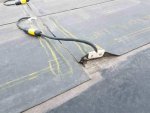
Took a picture of the mat, (We did not install anything, but were called to get power ran) and found a connector that looks like this.

Could be the culprit but not sure, (going to disconnect the one mat and see what happens)

Going to call the manufacturer back and try to get to the bottom of it. I agree that it sound like they don't really have a clue as to what they are selling.
 

Attachments

  • Resized952017121195123159.jpg
    Resized952017121195123159.jpg
    120.3 KB · Views: 3
The manufacture's web site is pretty lacking. No documentation or even a mention of an NRTL listing. If I was the owner, installer or AHJ I would want to see an NRTL file number and the standard it was listed to and the instructions approved as part of the listing. You mentioned that they didn't seem to know the difference between GFCI and GFP-a flag for me.
I agree with it being lacking of anything approaching details, but on their first page, they do say this:
...quality certified components and ETL design and component approval ...
ETL is an NRTL listing. But still, the way they worded that sounds a little sketchy to me.
 
I agree with it being lacking of anything approaching details, but on their first page, they do say this:

ETL is an NRTL listing. But still, the way they worded that sounds a little sketchy to me.

I missed that verbiage on the site. But, yes, that sketchy wording is another flag for me. Sounds like the old standby language that folks use to lead you to believe it is a listed product by saying it has NRTL certified components. That photo the OP posted is a little scary looking too.
 
I missed that verbiage on the site. But, yes, that sketchy wording is another flag for me. Sounds like the old standby language that folks use to lead you to believe it is a listed product by saying it has NRTL certified components. That photo the OP posted is a little scary looking too.

Just a little? :jawdrop:
 
Status
Not open for further replies.
Top