does a water proof membrain effect ufer grnd

Status
Not open for further replies.
acrwc10 said:
It is like a giant boat. there is a drainage system with sump pumps both above and beneath the water proof membrain. the ground water table in this area is not so high that it would lift the house due to hydrostatic pressure.

I knew it sounded like a boat :)

It takes about 2' of head before the slab becomes bouyant. Meaning, anything less than 2' of water above the bottom of the slab and the slab is still pressing down harder than the water is pressing up.

I'd be more concerned about the transverse loads on the walls than the upwards pressure on the slab. And as I wrote, those loads occur even if the basement isn't completely waterproof. But Bob's the PE, not me. I can make a boat float, but I can't make a house float ...
 
I might have missed it, but has anyone mentioned that the side and top of the footing will be in contact with the earth? Around here a 2' spread footing is typical, so even if the membrane was laid under the footing, the 12" high side and about 8" on top are in direct contact with the earth, with at least 4' of coverage. It doesn't say that the bottom of the footing must be in direct contact with earth.
 
j_erickson said:
I might have missed it, but has anyone mentioned that the side and top of the footing will be in contact with the earth? Around here a 2' spread footing is typical, so even if the membrane was laid under the footing, the 12" high side and about 8" on top are in direct contact with the earth, with at least 4' of coverage. It doesn't say that the bottom of the footing must be in direct contact with earth.

I asked about the membrane being on the bottom of the footing because around here it is not done that way. The footing is poured first, then the wall is poured or built on top of the footing. The membrane is installed afterward to the wall and extending down onto the side of the footing, but AFAIK the membrane is not under the footing, just on the side.

I agree the code does not say the bottom of the footing has to be in direct contact with earth, only that it has to be in direct contact with earth. It does say that the electrode has to be near the bottom of the footing to qualify as a CEE.
 
tallgirl said:
I knew it sounded like a boat :)

I can make a boat float, but I can't make a house float ...


ever see a house boat, like a motor home, but with a hull. Lots of the in the San Fransisco bay,Sasalito has a huge house boat community.

Back to the question, With the water main being run in copper from the street and bonded to the UFFER It will equallize the potential in the slab. But it is then using the water main as a ground instead of the UFFER, our water mains are all metal, copper from the house to the street.Most of the city mains are metal also I don't know if they are steel or cast Iron. And the water prooofing does run above grade.
 
acrwc10 said:
Well time to lay doubt aside, the houses here have a membrane under the whole thing...
Well, then I guess you have your answer. :)

Even if the installer were to tie to the rebar in the foundation, it would not qualify as a grounding electrode as defined in 250.52(A)(3).

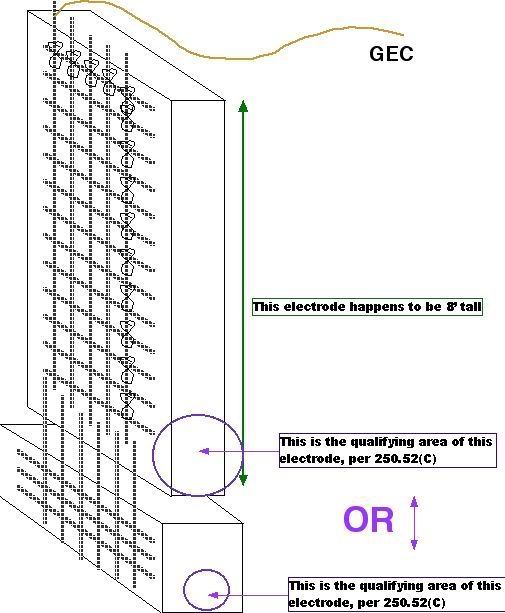
This is how I see the concrete encased electrode:
Ufer.jpg

It can exist in either a footer, the bottom of a basement wall, or both.

acrwc10 said:
What I did find out today is there is a part of the garage that has no basement under it and the footing is in contact with the earth for about 40ft.The problem is the UFER was run up at the oppisite end of the house and the garage footing was poured at a later time even though the steel was left 30'' out to tye into the garage I don't know how well the rebar was tyed in.So is it UFFER or is it just some rebar that looks like a Uffer??????
I'd say it's probably tied in pretty well. If they'd like to use it as a Ufer, it sounds as though the engineer who designed the foundation would need to sign off on it, or perhaps you could accept a fall of potential test to prove it's worth something.

I think it would be easier for them to just drive a couple of ground rods, tie in the "Ufer" just in case, and call it a day. What do they want to do?
 
steve66 said:
I think you are back to the two ground rods and water pipe for grounding the service. But IMO, that leaves a dangerous situation. That is, the whole concrete basement, walls, footings, etc. are ungrounded. What if the concrete is somehow energized (say a short to a piece of rebar sticking out somewhere).
Steve, do you see a realistic chance of this happening? Prior to the 'Uferia' surrounding the 2005 code change to 250.50, most of the CEE's in the nation weren't being utilized as grounding electrodes - hence the change.

steve66 said:
But there is no requirement for bonding concrete slabs that are insulated from the earth. I am wondering if a new requirement should be added for these situations. Require a CEE in insulated slabs to keep the potential of the slab at zero.
I truly can't see this as an issue. For slab pours, the electrical conduits are installed prior to the pour, same as any post-tensioning cables or rebar. They're all then encased in concrete, to rest for all time - what would cause these conduits to break, and then creep over to the rebar (since PT cables, at least the ones I've seen, are insulated so they will slide after the pour), and energize them?

I just can't envision a scenario where concrete encased rebar is subject to energization - until, of course, we connect to it to ground our services. Then, they are subject to energization from open neutrals. ;)
 
"UFERIA" ?? sounds awful maybe you should get doctor to look at that.:)
 
georgestolz said:
Steve, do you see a realistic chance of this happening? Prior to the 'Uferia' surrounding the 2005 code change to 250.50, most of the CEE's in the nation weren't being utilized as grounding electrodes - hence the change.


I truly can't see this as an issue. For slab pours, the electrical conduits are installed prior to the pour, same as any post-tensioning cables or rebar. They're all then encased in concrete, to rest for all time - what would cause these conduits to break, and then creep over to the rebar (since PT cables, at least the ones I've seen, are insulated so they will slide after the pour), and energize them?

I just can't envision a scenario where concrete encased rebar is subject to energization - until, of course, we connect to it to ground our services. Then, they are subject to energization from open neutrals. ;)

I'm not sure the rebar has to be energized. Isn't concrete somewhat conductive? If the entire slab/wall/footing is insulated from ground with a vapor barrier, and a hot wire is pushed up against the concrete anywhere, doesn't the whole thing become energized?

Steve
 
acrwc10 said:
ever see a house boat, like a motor home, but with a hull. Lots of the in the San Fransisco bay,Sasalito has a huge house boat community.

Back to the question, With the water main being run in copper from the street and bonded to the UFFER It will equallize the potential in the slab. But it is then using the water main as a ground instead of the UFFER, our water mains are all metal, copper from the house to the street.Most of the city mains are metal also I don't know if they are steel or cast Iron. And the water prooofing does run above grade.

I've worked on a few of those house boats, and (Funny you should mention them on this thread) some of them are light-wieght concrete foundations, and have the steel bonded - essecially a Ufer..... Yep, floating concrete foundation = BOAT! Then again an empty swimming pool will float as well...

As for water, if you have a metallic water main it has to be bonded and will become part of the system. And if it qualifies as an electrode it would have to be a full-sized conductor for the size of the service. The way 250.53(D)(2) is written all other electrodes become supplimental. Or at least that is how some look at it...
 
Steve, I'd say that yes, concrete is conductive. I'm not sure if it's more or less conductive than earth, I'm sure someone here could answer that.

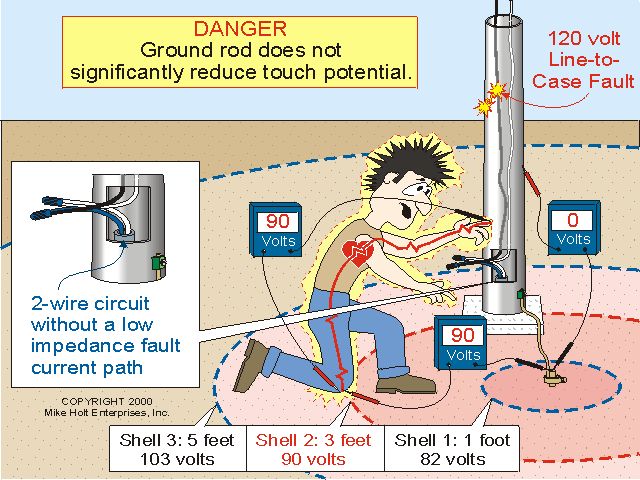
I'm trying to figure out what the step potential would be for energized rebar. That would be the worst case scenario.

Realistically, if the concrete itself were energized (not the rebar), it would react similarly to the way earth reacts when energized.

touch.gif


If a person were not touching the pole, but were touching the earth 1 foot away and also 3 feet away from the pole, they would experience 8 volts.

So based on that idea, I would say that concrete would not pose much of a hazard, if it were the point of contact to the source. The rebar would be more effective at getting voltage to the concrete, since it would be spreading the voltage to probably the whole area. But, then again, since all the concrete is being exposed to the same voltage, it would be fairly even, like a bird on a wire. :)
 
e57 said:
I've worked on a few of those house boats, and (Funny you should mention them on this thread) some of them are light-wieght concrete foundations, and have the steel bonded - essecially a Ufer..... Yep, floating concrete foundation = BOAT! Then again an empty swimming pool will float as well...

As for water, if you have a metallic water main it has to be bonded and will become part of the system. And if it qualifies as an electrode it would have to be a full-sized conductor for the size of the service. The way 250.53(D)(2) is written all other electrodes become supplimental. Or at least that is how some look at it...

I have wondered about the salt water in contact with the hull , how well it would work compared to soil. I would assume it would be an exellent ground.
On the water pipe bond I normally run a solid wire from the main to the uffer then on to the water main unbroken. It seems just as easy as two leads out of the panel.
 
Concrete below grade is approx. 3000 ohm-cm resistivity at 20 deg C., which is somewhat lower then loam soil. In earth with average to high resistivity, the encasement of the rod in concrete results in lower resistance then when placed directly in contact with earth.
 
Status
Not open for further replies.
Top