EGC twist .

Years ago, I went to T/S a shock complaint in the two bathrooms at a home. I found that the EGC of an incoming NM cable at a 2g switch box in the hall had broken at the sheath, probably damaged when the cable was first stripped and installed.

With the twisted but non-wire-nutted EGCs pointing upward, the broken wire had screwed itself down the rest of twisted bare wires over time, until it stopped when it just happened to touch a switch screw, energizing the entire downstream circuit's EGCs.
 
I have seen a LOT of houses where the grounds were only twisted from maybe the 70s plus or minus a decade.
around here that seemed to start from about when EGC's were required for every circuit and seemed to continue into the 1980's here and there, probably the same guys that been doing it for 25 years were still doing it then, newer guys were not doing that though.

Another one I encounter a lot on 50's and 60's homes is at light boxes - particularly with multiple neutral conductors - they twist them together, leave one of them long for connecting to the luminaire and solder and tape the twisted joint. Is usually a good solid joint, but a PITA to work with. Box fill and free conductor length either wasn't a thing yet or was ignored, but this connection just hard to bend where you want it to go regardless.
 
Other than in a control panel, the only time I come across twisted and soldered is old K&T. Solder is great for a lot of things, but not so much anything that vibrates. It makes for a stiff spot, and then it fatigues there and breaks.

I used to see a lot of grounds looped around box cover screws on early installations with an EGC. I don't know if that ever was code. Although it may have been done before grounds were required. I do recall early NM without a ground
 
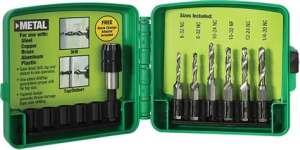
I always carry small taps and the right size drills. If I run into an old box with no hole I drill and tap it.

The little job I am working on now has old boxes. All the BX clamps and the extra hole for the grounds are tapped 10-24 instead of 10-32 that we have now.

I had just got started when I discovered this. I had to go to the hardware store 3 blocks away for some 10-24 screws. Never liked the little green ground clips anyhow.
 
I always carry small taps and the right size drills. If I run into an old box with no hole I drill and tap it.

The little job I am working on now has old boxes. All the BX clamps and the extra hole for the grounds are tapped 10-24 instead of 10-32 that we have now.

I had just got started when I discovered this. I had to go to the hardware store 3 blocks away for some 10-24 screws. Never liked the little green ground clips anyhow.
I typically run drywall screws or if I’m out I take my lineman’s and smash the EGC over the front of the box and let the cover push down and hold it on.


I’m jk.

But have seen it done.
 
I just rewired an old bath fan. Took it apart and cleaned it. Its old but works fine so we are going to leave it. Replacement won't fit without cutting the ceiling which is drywall over and old plaster ceiling with blown in insulation above so it would be a mess. Plus its vented with like 3 x 10 rectangular duct.

Gotta leave some work for someone else someday. LOL

Pulled out the old BX and fed it with 1/2 NM. Problem is no good way to ground it. Old fan with no ground lug or pigtail. Tiny wiring access box in fan. I wrapped the EG around the box cover screw and its tight.

Going to be on a GFCI anyhow so not to concerned. Sometimes you do the best you can.
 
I always carry small taps and the right size drills. If I run into an old box with no hole I drill and tap it.

The little job I am working on now has old boxes. All the BX clamps and the extra hole for the grounds are tapped 10-24 instead of 10-32 that we have now.

I had just got started when I discovered this. I had to go to the hardware store 3 blocks away for some 10-24 screws. Never liked the little green ground clips anyhow.
Most the "ground screws" available anymore tend to have thread cutting/forming tips. I have often zipped in a self drilling screw, removed it then Ip the ground screw in and let it cut it's own threads in the hole.
 
Top