EV charger

45 amps is not a standard charge rate. A 48 amp charger would require a 60 amp circuit (48 amps * 1.25). This would require #4 NM cable.

The chargers are designed to be used on multiple circuit sizes so they are set to the desired circuit size in the field.
 
45 amps is not a standard charge rate. A 48 amp charger would require a 60 amp circuit (48 amps * 1.25). This would require #4 NM cable.

The chargers are designed to be used on multiple circuit sizes so they are set to the desired circuit size in the field.
To expand, “standard” AC charge rates all correspond to 80% of a standard breaker rating…12, 16, 24, 32, 40, 48…..
 
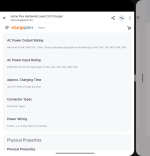
Also, why does it seem some of these EV chargers have different amperages looking under the specification section
And to further expand, it’s common that someone might install a 32A or 48A EVSE in a location where the service - or customer’s wallet - can’t support that maximum charging rate.

Maybe it’s an old 60A service , or the distance and routing from the EVSE back to the main panel is difficult ($$). In those cases, it can make sense to dial back the max charging current that the EVSE will “advertise” to the EV when they negotiate at the start of a charging session. This smaller charging circuit can then make a more affordable installation possible.

For example , it's easy to set a 32A or 48A EVSE to a 16A limit and wire it on a 20A circuit. Or a 24A limit on a 30A circuit.

This derating is accomplished via dip switches in the EVSE, or via an app when first powering up the unit.

So the same EVSE can have different (smaller) max current limits if needed to make the install feasible. It will take longer to charge the car, but in most cases that’s completely acceptable.
 
45 amps is not a standard charge rate. A 48 amp charger would require a 60 amp circuit (48 amps * 1.25). This would require #4 NM cable.

The chargers are designed to be used on multiple circuit sizes so they are set to the desired circuit size in the field.
So the circuit size is set at the charger?
 
So the circuit size is set at the charger?
Yes, basically.

For the Chargepoint EVSE in your post above, when you first commission it, you specify what circuit breaker is protecting the unit in an app - typically on your phone. It then takes that number, multiplies it by 80% (for the continuous duty derate) and sets the max charge current to that number.

So you indicate it's on a 30A breaker and it sets the max limit for the EVSE to 24A.
 
Too bad 4/2 NM cable doesn't exist. I guess 4/2 MC cable does, but one could use 6/2 MC or SER copper if charging will not exceed 48A.
For new construction projects we typically install 6-6-6 CU SE cable for charger circuits. I keep trying to get my supplier to stock it but they haven't yet. They just order whatever we need from Priority and it arrives in 1-2 days so not a big deal.
 
Wow! It's very confusing determining the various circuit sizes that can be run and for what reason
It's an installer's responsibility to ensure a hardwired EVSE can be programmed and is programmed not to exceed 80% of the installed circuit ampacity, if not installing a circuit that's 125% of the EVSE's max amp rating. The EVSE in turn tells the EV what the max draw is; the EV may or may not use that much.
 
What I don't understand is all the input user ratings? So what it is it ???? Choose what circuit size you want?
 

Attachments

  • Screenshot_20260101-171549.png
    Screenshot_20260101-171549.png
    191 KB · Views: 6
What I don't understand is all the input user ratings? So what it is it ???? Choose what circuit size you want?
Yes, choose what you want. Based on charging speed desired, affordability (where the circuit is long bigger wire adds up), or service capacity.

As the industry has matured the EVSE manufacturers are finding it makes more sense to provide one or two models with adjustable parameters, rather than six different SKUs for each amperage.
 
What I don't understand is all the input user ratings? So what it is it ???? Choose what circuit size you want?
Yes, you choose depending on what size circuit you installed the EVSE on.

As Retired pointed out in post#4, the EVSE input ratings in the list you showed...

16, 24, 32, 40, 48 amps

all these correspond to standard breaker ratings of...

20, 30, 40, 50, 60 amps

They are all related by the 80% derating factor.
16A = 20 x 0.8
24A = 30 x 0.8
32A = 40 x 0.8
40A = 50 x 0.8
48A = 60 x 0.8
 
Yes, you choose depending on what size circuit you installed the EVSE on.

As Retired pointed out in post#4, the EVSE input ratings in the list you showed...

16, 24, 32, 40, 48 amps

all these correspond to standard breaker ratings of...

20, 30, 40, 50, 60 amps

They are all related by the 80% derating factor.
16A = 20 x 0.8
24A = 30 x 0.8
32A = 40 x 0.8
40A = 50 x 0.8
48A = 60 x 0.8
So obviously the higher amperage I would think would give faster charging?
 
So obviously the higher amperage I would think would give faster charging?
Yes. The charge rate is power measured in KW. KW = (V x A) / 1000.

The charger (in the vehicle) converts the AC input to DC to charge the battery, thus there are conversion losses. The energy (kWh) the battery receives will be less than the kWh input due to these losses.
 
Top