Exceeding Inverter IMP

redtruck

Member
Location
Colorado
Occupation
Master Electrician
Hello,

With a shortage of modules in my area, we are having a tough time finding modules that abide by all inverter input specifications. There are an abundance of bi-facial modules meeting most requirements except the maximum IMP.

I understand an overvoltage in any scenario can be destructive. However, after little research it appears some inverter MPPTs will throttle, "ignore", or clip excess current. I am not yet convinced.
Say an inverter max IMP is 15 amps and these modules have a IMP of 15.1A. What are the implications here, is IMP a less "strict" max than VMP?

Ultimately, I'd like to find another module if possible for safety and warranty purposes, this is getting tougher to do, have any of you exceeded these values?

This specific case will use a tesla PW3, but the question remains to all inverters.
(I'm aware you can jumper PW3 inputs to increase current capacity, but not all MPPTs and this will not work for larger more complex roof set-ups with the module mentioned earlier)

Thanks
 
Hello,

With a shortage of modules in my area, we are having a tough time finding modules that abide by all inverter input specifications. There are an abundance of bi-facial modules meeting most requirements except the maximum IMP.

I understand an overvoltage in any scenario can be destructive. However, after little research it appears some inverter MPPTs will throttle, "ignore", or clip excess current. I am not yet convinced.
Say an inverter max IMP is 15 amps and these modules have a IMP of 15.1A. What are the implications here, is IMP a less "strict" max than VMP?

Ultimately, I'd like to find another module if possible for safety and warranty purposes, this is getting tougher to do, have any of you exceeded these values?
To begin with, it isn't Imp that is the limiting factor, it's Isc, and then there is the 1.25 multiplier for irradiance of more than 1000W/m^2. Inverters can indeed throttle back current using their MPPT circuitry, but there is a limit to how much.

To answer your question, though, many (most? all?) inverters will have a maximum connected maximum current per MPPT input number on their data sheets, so yes, there is some wiggle room there, though if it says "maximum current" it means 1.25 times the combined Isc, but it may say "maximum Isc" which means the 1.25 factor is already in there. I would take that number as a hard stop if you want to preserve the inverter warranty.

All that said, though, if your bifacial modules are flush mounted on a roof, IMO you can safely ignore the contribution of the back side to the maximum current.
 
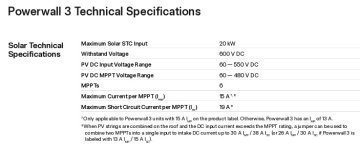
In my experience using Tesla products they can be weird about the specs and restrictions. There was a hard limit on AF IE on the megapacks that was just strange and they rolled it back. Here's a snip of the important specs and my opinion on the hard limits and equipment limits. Hard limits are not to exceed in operation. Equipment limits are the maximum the device can use even if the input could be higher and represent best operating conditions.
Maximum PV STC rating of 20kW. Looks like a hard limit
Withstand voltage. Hard limit
PV DC input voltage range. Equipment limit for best operation
PV DC MPPT voltage range. Equipment limit for best operation
Maximum current per MPPT. Equipment limit, the equipment will only draw 15A from the array even if it could supply more at the MPP
Maximum short circuit current per MPPT. Hard limit.

PW 3.jpg
In most inverters this question is answered by staying below an STC DC/AC ratio limit that limits the array size and available current and not a limit on Imp.
 
In most inverters this question is answered by staying below an STC DC/AC ratio limit that limits the array size and available current and not a limit on Imp.
Most inverters will have a published DC:AC power ratio limit, but it's usually somewhere around 1.5; is that what you are referring to?
 
Most inverters will have a published DC:AC power ratio limit, but it's usually somewhere around 1.5; is that what you are referring to?
With multiple MPPT's, I've experienced the case of an unpublished limit on the max power per MPPT. This could be significant with an unbalanced distribution of array power, such as 4 strings on one zone, and 3 strings on the other, even if you do otherwise meet all published limits.

The published maximum DC:AC ratio isn't necessarily something that may be practical to achieve, depending on how else your string size and configuration fits the other limits of the inverter. So you may be able to get to that ballpark, but not exactly on the dot. High DC:AC ratios may clip power, which may not be desirable to the end user.
 
I understand an overvoltage in any scenario can be destructive. However, after little research it appears some inverter MPPTs will throttle, "ignore", or clip excess current. I am not yet convinced.
Say an inverter max IMP is 15 amps and these modules have a IMP of 15.1A. What are the implications here, is IMP a less "strict" max than VMP?
Voc and Isc, with applicable adjustments, are the limitations that are more strict, since these are upper limits that govern whether a given array has the ability to damage wiring and equipment. By contrast, Vmp and Imp are target points for operating voltage and current, and operating voltage and current are flexible values that can adapt to other constraints.

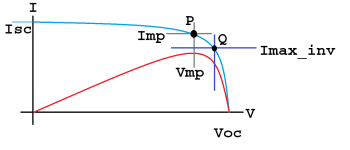
What ends up happening, is that the inverter will no longer seek the operating voltage at maximum power, on the IV curve, but rather it will seek a point on this curve that allows it to work within its other limitations. Here's an example IV curve, to demonstrate.
1760483714487.png

The blue curve shows current as a function of voltage (the IV curve), and the red curve shows corresponding DC power as a function of voltage, which is the area of any given rectangle from the origin to a point on the blue curve. Point P is where the power is maximized, and is the maximum power point where inverters seek to operate to optimize the power collected from the array. Follow the gray crosshair down, and see the corresponding peak power point on the red curve. These curves are shaped by sunlight intensity that generally governs current, and cell temperature that generally governs voltage.

If the inverter can't seek point P because of its limitations, it will seek point Q. Here, you don't have the optimal amount of power, but you have the best you can, when subject to the limit of the inverter input current (Imax_inv). Voltage is slightly higher than Vmp, and power is slightly less than Vmp*Imp. The power is curtailed and excess power remains on the array in the form of heat. Still no more heat than an off-array at open circuit would produce.
 
Most inverters will have a published DC:AC power ratio limit, but it's usually somewhere around 1.5; is that what you are referring to?
Yes. Some inverter manufacturers that have online tools for sizing systems will require you to use the tool to show DC/AC ratio compliance if warranty work is needed in the future. Get a printout and save it with the system documentation. The online systems also help with the question of how to rate bifacial modules. If the online tool says it's good then it's inverter manufacturer approved.
The published DC/AC ratios can often be increased by the manufacturer for specific projects.
 
With multiple MPPT's, I've experienced the case of an unpublished limit on the max power per MPPT. This could be significant with an unbalanced distribution of array power, such as 4 strings on one zone, and 3 strings on the other, even if you do otherwise meet all published limits.
I remember a long time ago SunPower had an inverter with two MPPT inputs and they had different max current ratings. That was a pain.
The published maximum DC:AC ratio isn't necessarily something that may be practical to achieve, depending on how else your string size and configuration fits the other limits of the inverter. So you may be able to get to that ballpark, but not exactly on the dot. High DC:AC ratios may clip power, which may not be desirable to the end user.
Higher DC/AC ratios will clip the peak power but the overall area under the power curve increases so the inverter can produce more energy over a day even while clipping the peak. So loosing the peak power is not a problem. Running a smaller string inverter fully loaded for more hours of the day might have an impact of the life though.
 
Yes. Some inverter manufacturers that have online tools for sizing systems will require you to use the tool to show DC/AC ratio compliance if warranty work is needed in the future. Get a printout and save it with the system documentation. The online systems also help with the question of how to rate bifacial modules. If the online tool says it's good then it's inverter manufacturer approved.
I ran into something similar for some SolarEdge systems where the design tool approved strings shorter than the numbers published on the optimizer data sheet. I made sure that the design tool report was included in the design packet and that there was an engineering note about it on the electrical drawing.
 
I ran into something similar for some SolarEdge systems where the design tool approved strings shorter than the numbers published on the optimizer data sheet. I made sure that the design tool report was included in the design packet and that there was an engineering note about it on the electrical drawing.
I've found that sometimes the design tool gets updated more often than the data sheets or manuals. So they can get out of sync.
 
Top