
In our area for farms the POCO usually provides a meter with a “site isolating switch”
The isolating switch isn’t a service disconnect (no ocpd) just a switch. “Up” is utility power and “down” is generator power (manual transfer switch), or “off” if there’s no generator.
Then you run “service conductors” (3-wire) to the separate structures on the farm and bond ground and neutral at each structure along your grounding electrode at each structure.
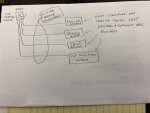
If you have a new generator with an ATS sized to feed the whole farm it is usually located by the meter and the conductors are pulled out of the meter, placed on a the load side of the ATS, then properly sized service conductors are run out of the meter over to load side of ATS.
In the example in the photo, depending on a load calculation they might be parallel runs of 250 kcmil with reduced neutral.
I’d be interested in hearing feedback from you guys about how this is setup.
Not a specific question, just looking for comments. I’ll have some questions after listening to the comments.
Thanks!
The isolating switch isn’t a service disconnect (no ocpd) just a switch. “Up” is utility power and “down” is generator power (manual transfer switch), or “off” if there’s no generator.
Then you run “service conductors” (3-wire) to the separate structures on the farm and bond ground and neutral at each structure along your grounding electrode at each structure.
If you have a new generator with an ATS sized to feed the whole farm it is usually located by the meter and the conductors are pulled out of the meter, placed on a the load side of the ATS, then properly sized service conductors are run out of the meter over to load side of ATS.
In the example in the photo, depending on a load calculation they might be parallel runs of 250 kcmil with reduced neutral.
I’d be interested in hearing feedback from you guys about how this is setup.
Not a specific question, just looking for comments. I’ll have some questions after listening to the comments.
Thanks!


 ~RJ~
~RJ~


